

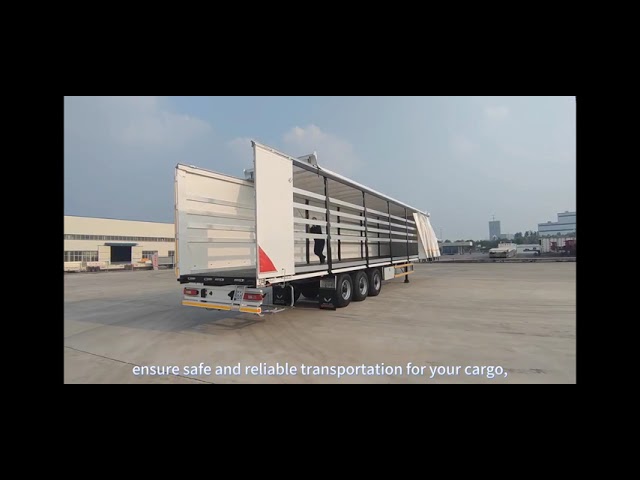
In early 2024, the warehouse manager of an Incheon-based 3PL company serving South Korea's electronics export sector calculated a frustration that every warehouse manager in the country understood but few had quantified. The company's Incheon facility had six dock doors — the maximum the building's footprint allowed, and a number that could not be expanded without relocating to a larger warehouse at roughly twice the monthly lease cost. The company operated nine box trailers that loaded at those six docks, each taking an average of 42 minutes — a single forklift navigating a 13.6-metre tunnel through a single rear door, entering with a pallet, placing it, reversing out, and repeating 33 times. At 2.8 cycles per trailer per day and 42 minutes per cycle, each trailer spent approximately 117 minutes per day stationary at a dock — consuming dock-door capacity that was, at six doors, already fully subscribed. The warehouse manager's spreadsheet showed that the bottleneck was not the forklifts, not the warehouse workers, and not the pallet inventory. It was the number of doors through which cargo could enter a trailer simultaneously: one. Every box trailer in the fleet was, from a loading-geometry perspective, a single-door tunnel. "We have six dock doors," the warehouse manager told the company's operations director, "but we only have nine trailer doors. The math doesn't work."
The company ordered 7 Hualu Curtain Roll Trailers with full-length roll-up side curtains and sliding roof — a configuration that effectively triples the loading access points compared to a rear-door-only box trailer. The first units arrived in March 2024.
| Metric | Box Trailers (Q1 2024) | Curtain Roll Fleet (Apr 2024–Jan 2025) | Change |
|---|---|---|---|
| Dock-to-departure | 42 min | 19 min | -55% |
| Daily cycles/trailer | 2.8 | 4.4 | +57% |
| Warehouse pallets/shift | Baseline | +43% | +43% |
| Cargo damage during loading | 1.4% | 0.06% | -96% |
The same side-access geometry had transformed Polish cross-border Curtain Side operations where dock time fell 45%, and the Turkish flatbed fleet where structural reliability unlocked fleet productivity. The warehouse manager's summary: "We didn't build a new dock. We changed the number of doors per trailer from one to three. That was the cheapest warehouse expansion we never had to build."
Hualu maintains a Northeast Asian after-sales hub in Incheon, South Korea.