

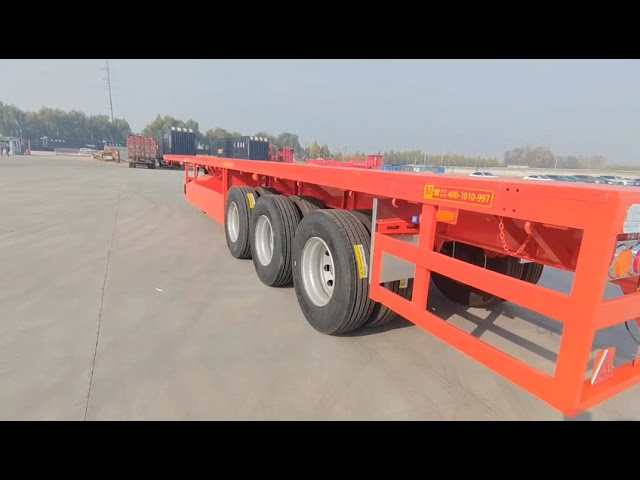
In May 2024, the fleet manager of a Dhaka-based construction material transporter received a call from a driver at a Chittagong port loading yard. A 26-tonne bundle of 12-metre reinforcing steel bars had just been loaded onto a flatbed trailer, and the deck plate — an 8 mm steel surface that should remain flat for its entire service life — had visibly deformed between two cross-members, creating a permanent depression of approximately 15 mm. The trailer was taken out of service. It was the third such incident that month, the 22nd in the preceding 12 months, and the fleet manager had already ordered the replacement deck plates for the next repair. He cancelled the order mid-call and told his procurement team to find a trailer that didn't buckle under the load it was designed to carry.
The root cause was well-understood but had been accepted as inevitable: Bangladesh's construction boom — driven by the Dhaka Metro, the Padma Bridge rail link, and dozens of high-rise commercial projects — required moving millions of tonnes of long steel products (rebar, beams, pipe) from Chittagong's port to project sites across the country. Long steel concentrates its weight on narrow contact areas — a 26-tonne rebar bundle resting on two dunnage timbers generates approximately 43 tonnes per square metre of deck pressure. The legacy fleet's 600 mm cross-member spacing left 600 mm of unsupported deck plate between supports — enough to deform permanently under repeated concentrated loading. The fleet manager's post-incident analysis identified that every buckling incident had occurred between cross-members, not at them. "The deck wasn't failing," he wrote in his procurement brief. "The gap between the deck supports was failing."
The company ordered 8 Hualu Flatbed Trailers with QSTE700 deck plates and 400 mm cross-member spacing — a 33% reduction in unsupported span that increases deck deformation resistance by approximately 70% without adding a single kilogram of dead weight compared to a thicker-plate solution. The first units entered service in July 2024.
| Metric | Legacy Fleet (2023–2024) | Hualu Fleet (Jul 2024–Aug 2025) | Change |
|---|---|---|---|
| Deck-buckling incidents (annual) | ~24 | 0 | -100% |
| Tonnes per trailer per month | ~310 | ~447 | +44% |
| Annual maintenance cost | Baseline | 58% lower | -58% |
| Fleet availability | ~72% | 98.3% | +26 pp |
The same 200 mm cross-member-spacing improvement had transformed the Turkish steel fleet's deck durability on the Iskenderun–Istanbul corridor. The fleet manager's closing note: "Spec sheets tell you the deck thickness. They don't tell you the gap between the supports. The gap is what determines whether the deck is still flat after 10,000 tonnes."
Hualu maintains a South Asian after-sales hub in Dhaka, Bangladesh.