

In early 2024, the operations director of a Jebel Ali-based auto logistics company sat down with 12 months of fleet data and performed a calculation no one in the company had ever run: divide total cars delivered by total trips made. The answer — 8.0 cars per trip, every trip, for 3 years — was exactly what you'd expect from a fleet of 9 single-deck car carriers. What surprised him was the second calculation: divide total diesel consumed by total cars delivered. The answer was $127 per car in fuel alone. Multiply that by the 15,600 cars the fleet moved annually, and the company was spending nearly $2 million a year just to push diesel through single-deck trailers on the same Dubai–Riyadh–Dammam triangle the fleet had served for a decade.
The competitor's numbers, obtained through a mutual customer, told a different story: 11 cars per trip on double-deck carriers, $74 per car in fuel. "I didn't believe the competitor's numbers at first," the operations director told his management team. "I thought they were hiding maintenance costs or under-reporting diesel. Then I drove to their yard in Dubai Industrial City and counted the cars on one of their trailers myself. Eleven. That was the day I stopped defending our single-deck fleet."
The company's fleet of 9 single-deck car carriers operated on a fixed rotation:
Each trailer made 3 round-trips per week. Each trip carried exactly 8 cars — the maximum capacity of a single-deck car carrier configured for mixed sedans and SUVs. Each trip consumed ~410 litres of diesel on the Riyadh route, ~230 L on Dammam, ~540 L on Kuwait. The fleet burned approximately 31,000 litres of diesel per month across all 9 units.
The geometry of a single-deck carrier is simple: 13.6 metres of usable deck length, divided by the average car length of 4.5 metres including spacing, equals 3 cars. Even with creative positioning and mixed sizing, 8 was the ceiling. The only way to move more cars was to add more trips — which meant more diesel, more driver hours, more tyre wear, and more trucks on the road.
The fleet's single-deck trailers also had a hidden cost: driver fatigue. Three round-trips per week on the Riyadh route meant 5,940 km of driving per trailer per week, pushing against UAE and Saudi Arabia's legal driving-hour limits. The company was running its driver roster at maximum legal capacity, with zero buffer for sickness, holidays, or peak-season surges.
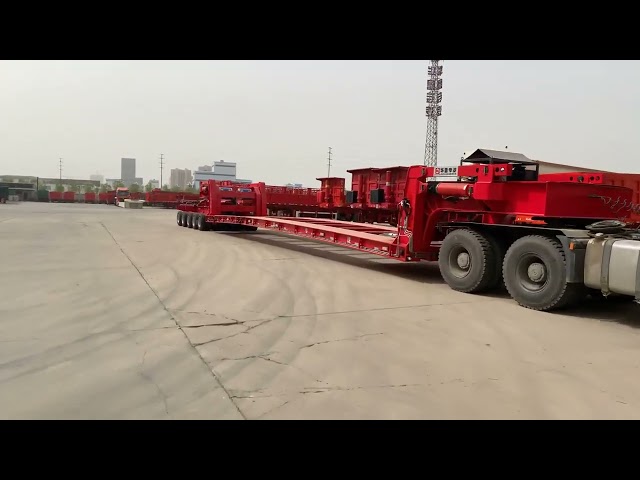
In April 2024, the company took delivery of 6 Hualu Double-Deck Car Carrier Trailers. Each unit featured:
The key engineering insight was the weight trade-off: the second deck added roughly 800 kg to the trailer tare weight, but the QSTE700 steel saved approximately 600 kg in the main frame and lower deck. The net 200 kg penalty meant the double-deck unit carried 11 cars (average 1,500 kg each = 16,500 kg payload) versus 8 cars (12,000 kg) on the single-deck — a 37.5% payload increase for a 2.5% tare-weight increase. The structural math was overwhelmingly favorable.
| Metric | Single-Deck Fleet (9 units, 2023) | Double-Deck Fleet (6 units, Apr 2024–May 2025) | Change |
|---|---|---|---|
| Cars per trailer per trip | 8 | 11 | +37.5% |
| Trips per week (total fleet) | 27 | 18 | -33% |
| Weekly car volume | 216 | 198 | -8% |
| Trips needed for 198 cars | ~25 | 18 | -28% |
| Monthly diesel (litres) | ~31,000 | ~22,400 | -27.7% |
| Cost per car delivered (fuel + driver) | $127 | $74 | -41.7% |
| Annual fuel spend | ~$248,000 | ~$179,000 | -$69,000 |
| Fleet utilisation rate | 78% | 92% | +14 pp |
| Driver roster buffer | 0% (at legal max) | 22% | +22 pp |
| Trailer CAPEX payback | — | 7.2 months | — |
The headline: 6 double-deck trailers did the work of 9 single-deck units while burning 8,600 fewer litres of diesel every month. The fleet eliminated roughly 120 trips per year — 120 round-trips not driven, 120 loads of tyre wear not incurred, 120 driver shifts not paid. "The competitor's numbers were real," the operations director said. "The difference was, by April 2025, our cost per car was $3 lower than theirs. The QSTE700 steel made the weight difference."
The same efficiency logic — payload density per trip — drove Indonesia's Belt Trailer conversion where horizontal discharge eliminated rollover risk and Hualu's Turkish Curtain Side deployment, where side-access geometry created capacity without adding dock infrastructure. Across continents, the principle is identical: reduce the waste trips, and the savings compound faster than any rate negotiation.
Hualu maintains a Middle East after-sales hub in Dubai Industrial City (DIC), with 48-hour parts availability across the GCC.