
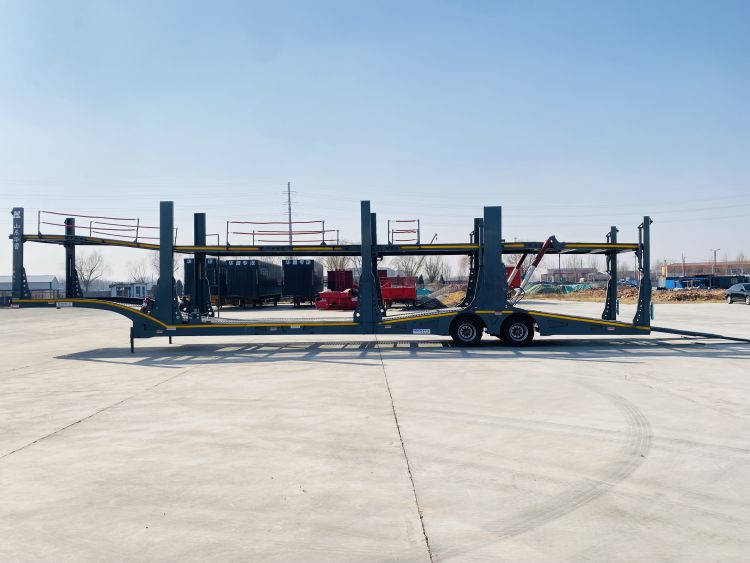
In the vehicle import business, the math is unforgiving. A single deep scratch on a new SUV arriving at a dealership in Riyadh can knock $800 off its wholesale value. A dented door panel on a luxury sedan — $1,500. For a mid-sized Jeddah-based importer moving 180–220 vehicles per month from King Abdullah Port to showrooms across the Kingdom, pre-delivery damage was quietly consuming 2.3% of gross margin. Over a calendar year, that translated to approximately $175,000 in repainting, panel replacement, and dealer compensation claims.
The culprit was not driver error or port handling. It was the trailers themselves. The company's fleet of eight ageing car carrier trailers — a mix of European and Turkish units purchased second-hand — had fixed deck positions that forced vehicles into suboptimal spacing. SUVs rode too close to the upper deck frame, scratching roof rails. Sedans on the lower deck sat nose-to-tail with insufficient clearance, leading to contact damage on uneven highway expansion joints at 120 km/h. The fixed-deck design meant every loading decision was a compromise between vehicle count and vehicle safety.
The fleet manager's original plan was to refurbish the existing trailers — reinforce the decks, add rubber padding, weld additional tie-down points. But the quotes came back at roughly 60% of the cost of new equipment, with no guarantee that the structural fixes would survive Saudi highway conditions. "We were going to spend good money to make old trailers slightly less bad," he later told the company's board.
Instead, the company ordered six Hualu car carrier trailers with the following configuration:
The company's enterprise resource planning system tracks every vehicle from port arrival to dealership handover. After twelve months and approximately 2,300 vehicles moved, the numbers told a clear story:
| Metric | Old Mixed Fleet | Hualu Fleet | Change |
|---|---|---|---|
| Pre-delivery damage rate (vehicles) | 4.2% | 0.6% | -85.7% |
| Annual damage-related costs | ~$175,000 | ~$26,000 | -85% |
| Average load time per trailer (8 vehicles) | 55 minutes | 28 minutes | -49% |
| Vehicles moved per trailer per week | 22 | 34 | +55% |
| Dealer satisfaction score (1–10) | 6.8 | 9.2 | +35% |
| Tyres replaced (fleet total, 12 months) | 14 | 6 | -57% |
The 85% reduction in delivery damage was the headline number — but the fleet manager pointed to a quieter metric that mattered more operationally. The adjustable deck system eliminated the loading compromise that had defined the old fleet. "Now we load each vehicle to its exact clearance requirement. The SUV goes where there is room for an SUV. The sedan goes where a sedan fits. Nobody has to decide which car gets the bad spot."
Dealer satisfaction jumped from 6.8 to 9.2 largely because vehicles now arrived in showroom-ready condition. Pre-delivery inspection time at dealerships dropped from an average of 45 minutes per vehicle to 18 minutes — the detailing team was wiping off highway dust rather than scheduling paint correction.
The adjustable deck is not a luxury feature. It is a capacity multiplier. Fixed-deck trailers can carry exactly one vehicle configuration efficiently — typically eight identical sedans. Every deviation from that configuration — an SUV mixed with a sedan, a sports car with lower clearance, a light commercial van — forces a suboptimal loading arrangement that either sacrifices a vehicle slot or risks contact damage. The hydraulic deck removes this constraint entirely.
For the Saudi importer's typical inbound mix — 45% SUVs, 35% sedans, 15% pickup trucks, 5% other — the hydraulic deck allowed a consistent 8-vehicle load regardless of the vehicle type mix on any given shipment. On the old fixed-deck trailers, mixed loads averaged 6.4 vehicles per trip. The difference — 1.6 additional vehicles per trip multiplied by six trailers operating five days per week — added approximately 2,500 additional vehicle deliveries per year without adding a single new trailer or driver.
Saudi Arabia's highway network is world-class, but the operating environment is punishing. Summer ambient temperatures exceed 48°C, asphalt surface temperatures reach 75°C, and fine desert dust penetrates every mechanical component. Three design decisions in the Hualu specification proved critical:
First, the white polyurethane topcoat. Dark-coloured trailers absorb solar radiation, raising deck surface temperatures high enough to soften tyre rubber on loaded vehicles during multi-hour highway transits. The white finish reflects approximately 85% of solar radiation, keeping deck temperatures 15–20°C cooler. This is not cosmetic — it prevents flat-spotting of loaded vehicle tyres on long hauls between Jeddah and Dammam.
Second, sealed LED lighting. Desert dust ingress is the leading cause of trailer lighting failure in the Gulf region. Hualu specified IP68-rated LED units with double-sealed connectors throughout. Over 12 months, the fleet recorded zero lighting failures — compared to an average of 2.3 failures per trailer per year on the previous fleet.
Third, the galvanised deck surface. Perforated steel decking provides natural drainage for the rare but intense rainfall events that cause flash flooding on Saudi highways. Combined with the zinc-galvanised treatment, the decks showed no visible corrosion after 12 months despite occasional exposure to standing water.
The GCC automotive logistics market is structurally different from European or North American markets. Vehicles arrive almost exclusively through ports — Jeddah, Dammam, Dubai, Doha — and travel long highway distances to inland dealerships. Trip lengths of 400–1,200 kilometres are routine. The cost of pre-delivery damage is therefore amplified: a damaged vehicle must either be repaired locally (at unpredictable cost and quality) or returned to port (at roughly $0.85/km in round-trip transport cost).
The Saudi importer's experience demonstrates that a purpose-built car carrier trailer with adjustable hydraulics, climate-appropriate finishes, and sealed electrical systems can reduce per-vehicle delivery costs by roughly $68 — a number that, multiplied across a six-trailer fleet moving 2,300 vehicles per year, compounds to approximately $156,000 in annual savings from damage reduction, faster loading, and lower maintenance combined.
Every Hualu car carrier trailer is manufactured by Liangshan Hualu Special Automobile Manufacturing Co., Ltd. — a factory-direct manufacturer established in 2001 with a 150,000 m² production facility in Shandong, China, employing over 360 staff including 20+ senior engineers. The company holds CCC, ISO 9001:2015, ISO/TS 16949, CE, DOT, and MIIT certifications. Hualu exports to over 30 countries worldwide. For specifications on car carrier configurations, load planning support, and delivery timelines, contact the Hualu sales team.