

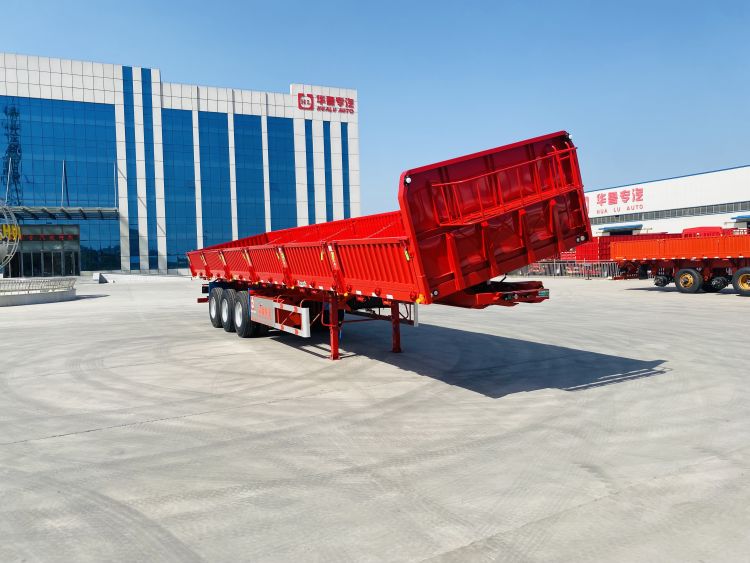
A mid-sized grain trading company operating out of Asuncion, Paraguay, ships approximately 120,000 tonnes of soybeans and corn annually to markets in Brazil, Argentina, and beyond. Their fleet of conventional End Tipper Trailers was adequate for farm-to-silo runs, but the critical bottleneck was at the river port terminal. Each end-tipper required 12–15 minutes to complete a full unload cycle — reverse into position, raise the trailer bed, wait for the 40-tonne grain load to gravity-feed through the rear gate, lower, and pull forward. During peak harvest season (February–April), trucks routinely queued for 3+ hours at the port, burning fuel and delaying the next farm pickup.
Beyond the time cost, the gravity-dump method was causing measurable grain damage. Soybeans dropped from a 45° angle onto concrete receiving pits showed a 2.1% split-and-crack rate, downgrading the cargo from premium export grade to feed grade — a loss of approximately $12 per tonne on affected shipments. The company estimated annual revenue leakage from grain damage alone at roughly $180,000 across their 120,000-tonne annual volume.
After a field demonstration at the port terminal, the company ordered six Hualu Belt Trailers in a 3-axle configuration, each specified with a 40-tonne payload capacity and a hydraulically driven 900 mm wide rubber conveyor belt running the full length of the cargo floor. The belt system, powered by the tractor's PTO-driven hydraulic pump, discharges the entire 40-tonne load in under 4 minutes through a rear chute — with the trailer remaining level throughout the process.
Key technical specifications of the delivered units:
After 18 months of operation spanning two full harvest seasons, the fleet data showed transformative improvements across all key metrics:
| Performance Indicator | Previous End-Tippers | Hualu Belt Trailers | Change |
|---|---|---|---|
| Unloading cycle (40-tonne load) | 12–15 minutes | 3.5–4 minutes | ~3x faster |
| Daily trips per truck (peak season) | 4–5 | 7–8 | +60% |
| Grain damage (split & crack rate) | 2.1% | 0.6% | -71% |
| Port queue time (peak season) | 3.2 hours avg. | 0.8 hours avg. | -75% |
| Fuel consumption (idle time reduction) | Baseline | -840 L/month per truck | Significant savings |
| Annual grain damage cost | ~$180,000 (est.) | ~$51,000 (est.) | -72% |
The 3x improvement in unloading speed effectively doubled each truck's daily trip capacity during the critical harvest window. This allowed the company to handle the same 120,000-tonne annual volume with six belt trailers instead of the nine end-tippers previously required — a 33% reduction in fleet size while maintaining throughput. The three displaced end-tippers were redeployed to shorter farm-to-silo shuttle routes where their longer unloading times were less of a constraint.
The core value proposition of a belt trailer for agricultural logistics is not just speed — it is cargo integrity. In a conventional end-tipper, grain falls 2–3 metres under gravity, impacting the receiving pit floor and each other. Every impact point creates micro-fractures in soybean husks and corn kernels. The belt trailer eliminates gravity drop entirely: grain rides the conveyor belt horizontally to the rear chute, where it slides gently onto the receiving conveyor or pit at near-zero drop height.
The 71% reduction in split-and-crack rate (from 2.1% to 0.6%) means that for every 1,000 tonnes shipped, roughly 15 fewer tonnes are downgraded from premium export grade. At a typical $12/tonne price spread between export and feed grades, this preserves approximately $180 in cargo value per 1,000 tonnes — or roughly $21,600 per year for a 120,000-tonne operation. The belt mechanism effectively pays for itself through cargo protection alone within the first three harvest seasons.
While the Paraguayan deployment is focused on soybeans and corn, the Hualu belt trailer is fundamentally a horizontal-discharge bulk transporter. Additional use cases validated across Hualu's global customer base include:
The most overlooked cost in bulk agricultural logistics is not fuel, maintenance, or even labour — it is the opportunity cost of a stationary truck. A truck waiting to unload is a truck not earning revenue on the next load. At the Paraguayan operation, reducing port queue time from 3.2 hours to 0.8 hours freed approximately 2.4 hours of productive time per truck per day. With six trucks operating through a 90-day harvest window, this released roughly 1,296 hours of additional hauling capacity annually — the equivalent of adding 1.5 full-time trucks to the fleet without purchasing, insuring, or maintaining them.
Every Hualu belt trailer is manufactured by Liangshan Hualu Special Automobile Manufacturing Co., Ltd. — a factory-direct manufacturer established in 2001 with a 150,000 m² facility in Shandong, China, employing over 360 staff including 20+ senior engineers. The company operates under ISO 9001:2015 quality management and holds CCC, ISO/TS 16949, CE, DOT, and MIIT certifications with over 50 patented technologies.
Hualu exports to over 30 countries across Southeast Asia, Central Asia, the Middle East, Africa, and South America. A dedicated international after-sales team provides remote technical support and on-site commissioning worldwide. For specific belt trailer configurations, spare parts availability, and delivery timelines to your region, please contact the Hualu sales team.