

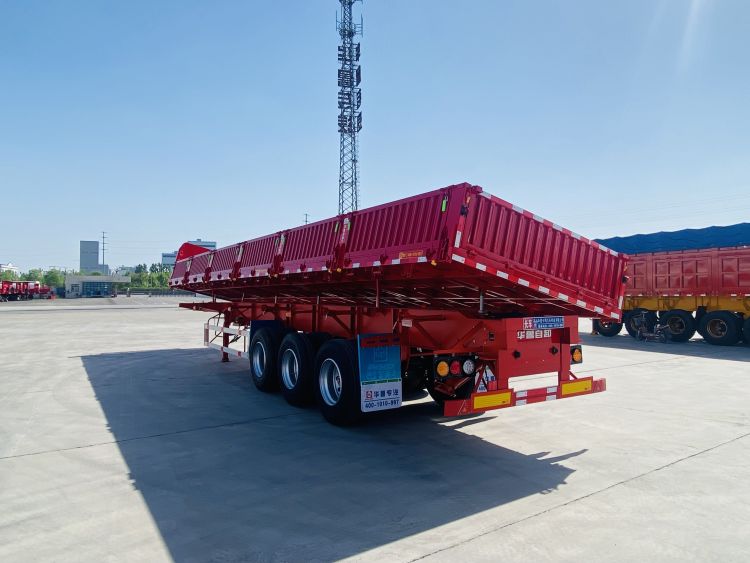
In early 2022, a major open-pit copper mine in Zambia's Copperbelt Province was facing a critical safety and productivity problem. The mine's fleet of conventional End Tipper Trailers had recorded three rollover incidents in an 18-month period on the uneven pit floor. Each incident caused an average of 11 days of equipment downtime, cost approximately $45,000 in repairs and lost production, and — most critically — exposed operators to serious safety risks. The mine's safety committee mandated a review of all bulk transport equipment with a priority on tip-over prevention.
The fundamental issue was physics: end-tippers pivot from a single rear hinge point, and when discharging on ground with more than 3° of lateral slope, the combined centre of gravity of the trailer and its 45-tonne load can shift outside the vehicle's stability triangle. On the mine's irregular pit floor — where blasting created uneven benches and temporary haul roads had variable compaction — perfectly level dumping positions were rarely available.
After evaluating suppliers from China, South Africa, and Europe, the mine's procurement team selected Hualu Side Tipper Trailers in a 4-axle configuration. Twelve units were delivered in Q3 2022, each specified with the following configuration:
As of Q2 2024, the Hualu side tipper fleet had accumulated over 19,000 combined operating hours across approximately 130,000 discharge cycles — with zero tip-over incidents recorded. This represents a complete elimination of the rollover risk that had plagued the previous end-tipper fleet. The mine's safety director publicly credited the side-tipper configuration as the single most impactful equipment change in the operation's five-year safety improvement programme.
Key performance metrics from the mine's fleet management system:
| Performance Indicator | Previous End-Tippers | Hualu Side Tippers | Improvement |
|---|---|---|---|
| Tip-over incidents (per 10,000 cycles) | 2.3 | 0.0 | 100% reduction |
| Average cycles per 10-hour shift | 14 | 18 | +29% |
| Unloading cycle time (arrival to departure) | 4 min 20 sec | 2 min 55 sec | -33% |
| Body liner replacement interval | 5,000 hours | 8,000+ hours | +60% |
| Annual maintenance cost per trailer | $2,800 | $1,200 | -57% |
| Equipment availability (fleet average) | 87% | 96% | +9 percentage points |
The 29% increase in daily cycles is particularly significant. By reducing unloading time from over 4 minutes to under 3 minutes, each trailer effectively gains capacity for one additional round-trip per hour during peak operations. Across the 12-trailer fleet operating two 10-hour shifts, this translates to approximately 960 additional tonnes of overburden moved per day — equivalent to adding two extra trailers to the fleet at zero capital cost.
The decision to specify Hardox 450 for the cargo body was driven by a lifecycle cost analysis. Hardox 450 offers a yield strength of 450 MPa — approximately 30% higher than standard structural steel (345 MPa). This allows a 4 mm floor thickness to match or exceed the puncture resistance of a 6 mm standard steel floor, reducing empty trailer weight by roughly 800 kg on a 4-axle configuration.
At 18 cycles per day and 300 operating days per year, that 800 kg weight saving becomes additional payload on every trip — delivering approximately 4,320 additional tonnes of annual haulage capacity per trailer. For a mining operation billing $3–5 per tonne for overburden removal, this generates $13,000–$22,000 in incremental annual revenue per trailer from weight savings alone.
The extended liner replacement interval — from 5,000 hours to beyond 8,000 hours — reduces maintenance downtime by an estimated 120 hours per trailer per year. At the mine's hourly equipment cost rate of $180/hour for truck-trailer combinations, this represents an additional $21,600 in annual cost avoidance per unit.
Unlike end-tippers that rely on a single rear pivot, the side-tipper discharges material laterally through hydraulic cylinders mounted along the chassis side rails. This configuration keeps the trailer's centre of gravity within its track width throughout the full 45° tilt arc. Hualu's engineering team conducted tilt-table testing at the factory, confirming stable discharge at up to 5° of lateral ground slope without requiring stabiliser legs — a critical capability on mine pit floors where perfectly level ground is the exception, not the rule.
Additional safety features specified for the Zambia fleet include:
The Zambia deployment provides real-world data for a 5-year TCO comparison between the Hualu 4-axle side tipper and the mine's previous standard end-tipper fleet:
| Cost Category (per trailer) | Hualu Side Tipper | Standard End Tipper |
|---|---|---|
| Purchase price (FOB Qingdao) | $22,500 | $19,800 |
| Annual maintenance (body, hydraulics, running gear) | $1,200 | $2,800 |
| Annual tyre replacement | $900 | $1,500 |
| Tip-over incident cost (insurance, downtime, repairs, 5-yr probability-adjusted) | $400 | $3,200 |
| Additional payload revenue (Hardox weight saving) | +$17,500/yr | — |
| Residual value at Year 5 | $8,500 | $5,200 |
| 5-Year Net Cost (incl. revenue offset) | −$63,000 | $33,900 |
The Hualu side tipper effectively pays for itself within 18 months through the combined effect of higher productivity, lower maintenance, eliminated rollover costs, and incremental payload revenue. Over a 5-year lifecycle, each trailer generates approximately $63,000 in net positive value compared to the continuing cost of operating an end-tipper — a compelling return on investment for any mining or bulk transport operation.
Every Hualu side tipper is manufactured by Liangshan Hualu Special Automobile Manufacturing Co., Ltd. — a factory-direct manufacturer established in 2001 with a 150,000 m² production facility in Shandong, China, and over 360 employees including 20+ senior engineers. The company operates under ISO 9001:2015 quality management and holds the following certifications:
Hualu exports to over 30 countries across Southeast Asia, Central Asia, the Middle East, Africa, South America, and growing markets in Europe and North America. A dedicated international after-sales team provides remote technical support, on-site commissioning, and operator training worldwide. For spare parts availability and lead times in your region, please contact the Hualu sales team directly.