

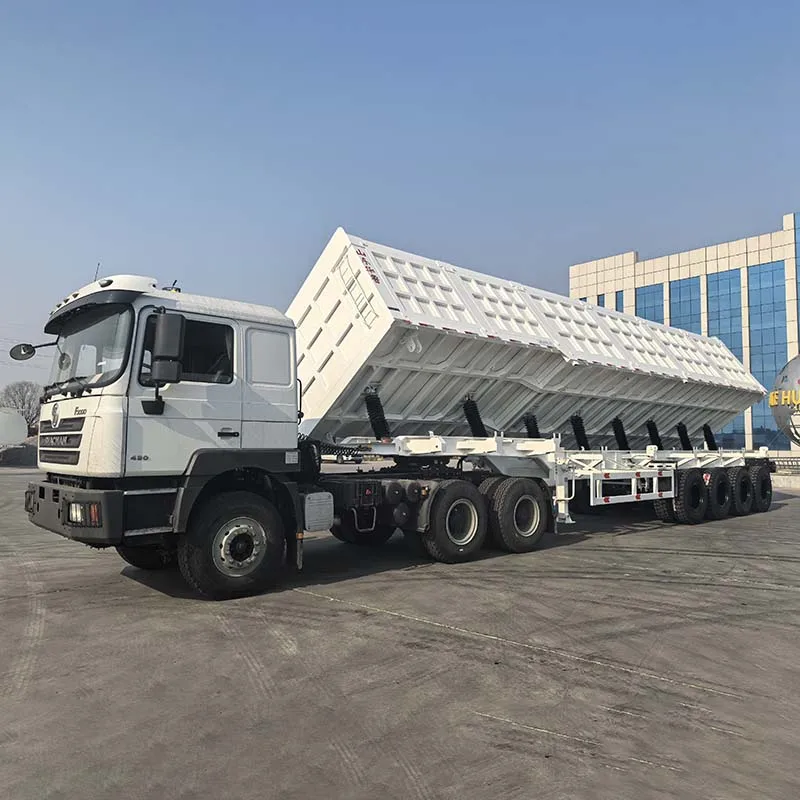
1. The problem never starts with the truck
It starts with the road. Laterite, unsealed, crowned in the middle, soft for two metres after rain, 40 °C by ten in the morning. Then a bridge with a posted limit that nobody respects, a port gate that opens for four hours a day, and a weighbridge that decides whether the trip was profitable or a donation.
In that corridor, a trailer is not judged by how it looks in a yard. It is judged by how many loads leave the pit in a week, and how many of those loads arrive without a repair bill attached.
2. Five things that fail first, and why
Each of these is a specification decision made months before the first load, not a maintenance decision made after the first breakdown.
3. What four axles actually buy you
Four axles are not "more axles". They are a different distribution of load, and the distribution is what solves the corridor:
4. Core parameters
| Item | Specification |
|---|---|
| Type | 4-axle rear-dump semi-trailer (end dump) |
| Overall length | 13,000–16,500 mm, custom |
| Box inner size | 12,500 × 2,550 × 1,700–2,200 mm, custom |
| Payload | 80–120 t, configuration dependent |
| Curb weight | 12–16 t |
| Main beam | High-strength steel 500–550 MPa, double-plate welded |
| Box plate | Side 6–8 mm, floor 8–12 mm wear-resistant |
| Axles | 4 × 13 t or 4 × 16 t |
| Tyres | 12.00R20 / 315/80R22.5, 12–16 units |
| Suspension | Mechanical leaf standard, air suspension optional |
| Hydraulic | Front-mounted telescopic cylinder, 5–6 stage, 20–22 MPa, dual safety valve, tipping angle 45–50° |
| Braking | Dual-line air brake, ABS optional |
| Landing gear | 28–30 t |
| Finish | Shot blast + primer + polyurethane topcoat |
5. Customisation that matters here, not on a brochure
Box height from 1,700 to 2,200 mm to stay inside local height limits while still hitting the tonnage the customer is actually paid for. Length and axle spacing set to the weighbridge and port gate. Right-tip or left-tip discharge, because the stockpile is not always on the same side. Hydraulic flip cover or heavy-duty tarpaulin for dusty routes and for ore that cannot be rained on. Dust-sealed hydraulic package and high-temperature hoses for the hot season. A critical-spares kit shipped with the unit, so the first repair is a two-hour job in the yard rather than a six-week wait for a seal.
6. The arithmetic the customer actually runs
One 110-tonne load replaces three 35-tonne loads. Trips fall by two-thirds, so fuel per tonne falls by roughly a quarter to a third on the same corridor. One driver instead of three, one set of escorts, one port slot. Unloading stops being a six-man, four-hour exercise and becomes a six-minute lift. Two units in a fleet of six can be stood down for maintenance without the contract slipping.
That is the case. Not a trailer, but a change in the cost per tonne delivered.
7. Closing
The pit does not get closer to the port, and the rain does not stop falling in the wet season. What can change is how many tonnes leave the pit before the gate closes, and how few of them come back as a repair bill. A four-axle rear-dump semi-trailer is a boring answer to that question — until you count the loads at the end of the month.