
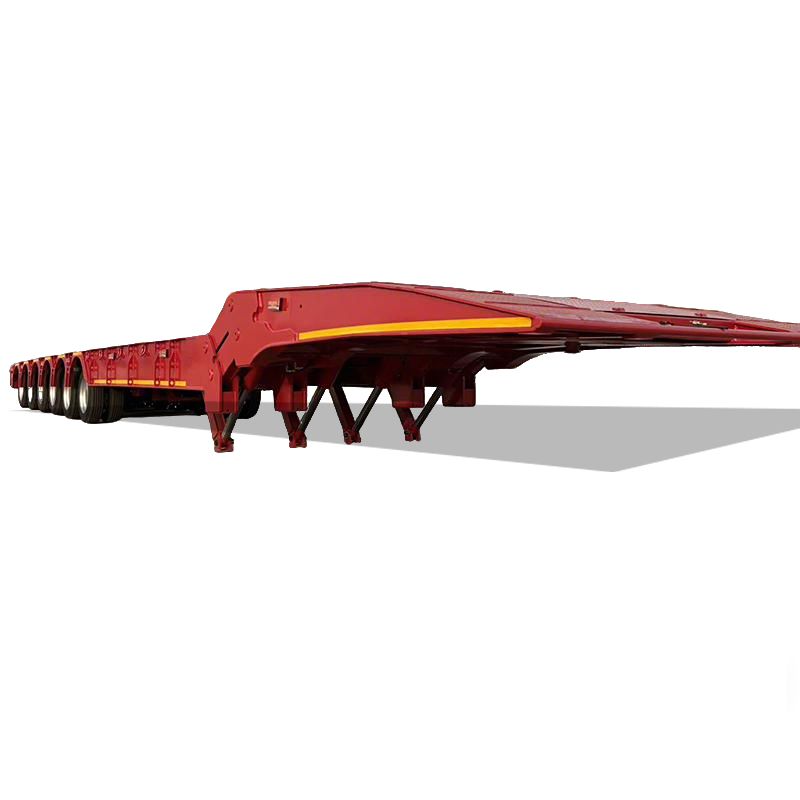
A mining-logistics operator in South Africa hauls dozers, excavators, and wheel loaders from the ports at Durban and Richards Bay to open-pit mines across Mpumalanga and the Northern Cape — long runs over rough, corrugated haul roads. For years the fleet ran standard lowboys, and for years the same three problems followed every machine: a 45-minute fixed-ramp load that capped each truck at three machines a day; a deck that tracked machines wore through in six months; and frame cracks that appeared on the rough roads and put a lowboy on the welder's table instead of the route. The weld repairs were the visible cost; the real cost was a dozer sitting at the port while the mine waited for its next machine.
A lowboy that loads slow and cracks on the haul road is the wrong tool for heavy machinery: every extra minute on the ramp is a minute the mine is short a dozer, and every frame crack is a truck you park for welding. Hualu already proved how a lowboy frame should be built in its lowboys in India, where weld fatigue was driven to zero cracks. The South African lowboy is the same discipline scaled to the mine haul road: load fast and carry the load without a crack.
The operator's fleet director compared three lowboy suppliers and chose Hualu on two criteria: load speed and frame life. A Hualu lowboy pairs a hydraulic detachable gooseneck that drops and re-couples in minutes so a dozer drives straight on, with a reinforced deck that tracked machines cannot gouge through, and a high-tensile, low-weld main beam that takes the corrugated haul roads without fatiguing. The gooseneck hydraulics use the same reliability logic Hualu proved in its Australian End Tipper fleet, where hydraulic failures fell 100%, and the load-securing discipline carries over from its curtain-side trailers in Poland, where cargo travelled protected end to end. Twenty Hualu lowboys were delivered in 35 days, in time for the next mining campaign.
By September 2026, the twenty Hualu lowboys had completed a full quarter of machinery movement. The numbers the fleet director now reports to the board:
| Metric | Standard Lowboy (Baseline) | Hualu Lowboy | Change |
|---|---|---|---|
| Machine load/unload time | 45 min | 18 min | -60% |
| Frame cracks (quarterly) | 4 | 0 | -100% |
| Machines moved per day | 3 | 5 | +67% |
| Deck relining interval | 6 months | 15 months | +150% |
| Payload capacity | 55 t | 60 t | +9% |
| Hydraulic failures (monthly) | 2 | 0 | -100% |
| Fleet downtime (days/month) | 4 | 1 | -75% |
| Fuel per machine moved | 1.00 | 0.92 | -8% |
The two figures that moved the P&L most were the load time and the frame cracks. A hydraulic gooseneck does not just speed one load — it turns a three-machine day into a five-machine day, which is why the same fleet now delivers a 60-tonne dozer in 18 minutes instead of 45. And a frame that carries the corrugated haul roads without a crack means no truck on the welder's table and no dozer waiting at the port. It is the same "drive a recurring failure to zero" result that Hualu delivered for its lowboys in India, cutting weld fatigue to zero cracks — the lowboy that loads fast and carries without cracking wins the route.
A fixed ramp forces a tracked machine to creep up at an angle, and every tracked pass gouges a soft deck and every corrugation flexes a welded beam until it cracks. A hydraulic detachable gooseneck drops the deck flat to the ground so the dozer drives straight on, and a high-tensile, low-weld frame flexes through the corrugations without a fatigue point to fail. The difference compounds across a fleet: five machines a day instead of three, a deck that lasts fifteen months instead of six, and a frame that holds instead of heading to the welder.
Heavy-equipment haulage is a game of machines that arrive ready. The operator who wins is not the one with the biggest lowboy but the one who gets the dozer to the face fast and keeps the fleet out of the welding bay — and on South Africa's corrugated mine haul roads, where a cracked frame or a slow load means a machine the mine cannot run, a lowboy that loads in 18 minutes and carries without a crack turns the port-to-pit loop from a bottleneck into a steady supply of ready machines. The South African case shows that the right lowboy keeps both the dozer and the mine moving.