

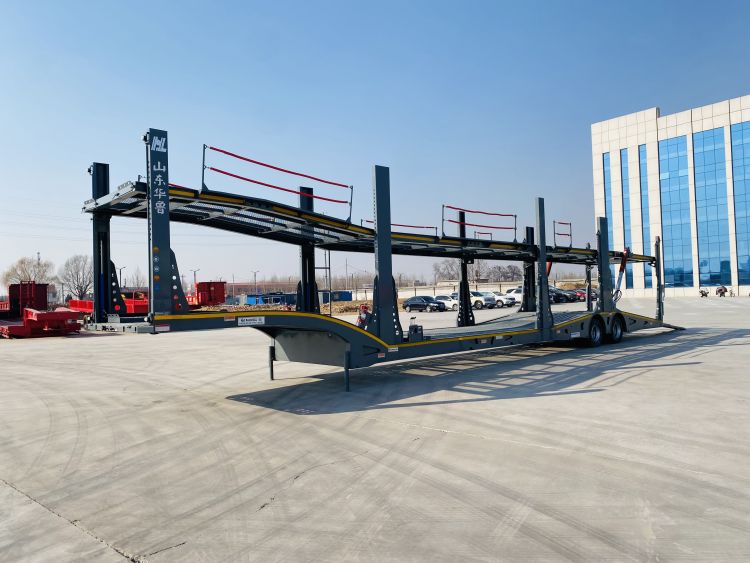
A Mexican auto-logistics operator hauls new SUVs and pickups from the Bajío assembly plants at Aguascalientes, Silao, and Salamanca to the Pacific and Gulf ports at Lázaro Cárdenas, Manzanillo, and Veracruz for export. For years the fleet ran standard car carriers, and for years the same three problems followed every unit: a 4% vehicle-damage rate from scratches, door dings, and over-compressed suspension on tight ramps; a slow single-vehicle load that capped each trailer at six cars; and deck corrosion that ate the coastal routes. The damage claims were the visible cost; the real cost was a reworked vehicle, a delayed ship slot, and a customer who stopped trusting the carrier.
A car carrier that scratches on the way up and rusts on the way down is the wrong tool for new vehicles: every ding is a rework bill and a missed sailing, and every corrosion pit is a deck you repaint while the cars sit. Hualu already proved how protected cargo travels in its curtain-side trailers in Poland, where cargo travelled protected end to end. The car carrier is the same discipline applied to a moving load: load it soft and hold it firm.
The operator's fleet manager compared three car-carrier suppliers and chose Hualu on two criteria: damage rate and load speed. A Hualu car carrier pairs low-angle hydraulic ramps that let a vehicle roll on without scraping, adjustable multi-level decks that seat each car with clearance, and soft wheel-strap tie-downs that hold the car without stressing the suspension. The hydraulic ramps use the same reliability logic Hualu proved in its Australian End Tipper fleet, where hydraulic failures fell 100%, and the bolted, low-weld frame carries over from its lowboys in India, where weld fatigue was driven to zero cracks. Thirty Hualu car carriers were delivered in 28 days, in time for the export peak.
By September 2026, the thirty Hualu car carriers had completed a full quarter of export delivery. The numbers the fleet manager now reports to the board:
| Metric | Standard Car Carrier (Baseline) | Hualu Car Carrier | Change |
|---|---|---|---|
| Vehicle damage rate | 4% | 1% | -75% |
| Cars per trailer | 6 | 8 | +33% |
| Loading time per car | 9 min | 5 min | -44% |
| Cargo damage claims (monthly) | $12,000 | $3,000 | -75% |
| Loading-crew incidents (monthly) | 3 | 0 | -100% |
| Fleet downtime (days/month) | 3 | 0.5 | -83% |
| Deck recoating interval | 24 months | 48 months | +100% |
| Fuel per car delivered | 1.00 | 0.88 | -12% |
The two figures that moved the P&L most were the damage rate and the capacity. A low-angle ramp and a soft tie-down do not just stop a ding — they remove the rework, the delayed slot, and the lost trust in one change, which is why the same fleet now delivers eight cars a load with 99% arriving untouched. It is the same "drive a recurring failure to zero" result that Hualu delivered for its curtain-side trailers in Poland — the carrier that loads soft and holds firm wins the route.
A steep ramp scrapes a low front bumper on the way up, and a hard chain compresses the suspension on every bounce of the road. A low-angle hydraulic ramp lets the vehicle roll on flat, and a soft wheel-strap holds the wheel — not the body — so the car rides on its own suspension the way it was designed to. The difference compounds across a fleet: five minutes a car instead of nine, eight cars instead of six, and a 1% damage rate instead of 4% on the way to the port.
Auto export is a game of damage-free, on-time delivery. The carrier who wins is not the one with the biggest deck but the one whose cars arrive showroom-clean and catch their scheduled ship — and on Mexico's Bajío-to-port corridors, where a scratched unit means a rework and a missed sailing slot, a car carrier that loads soft and holds firm turns the export loop from a source of claims into a steady, trusted pipeline. The Mexican case shows that the right carrier keeps both the vehicle and the sailing on schedule.