
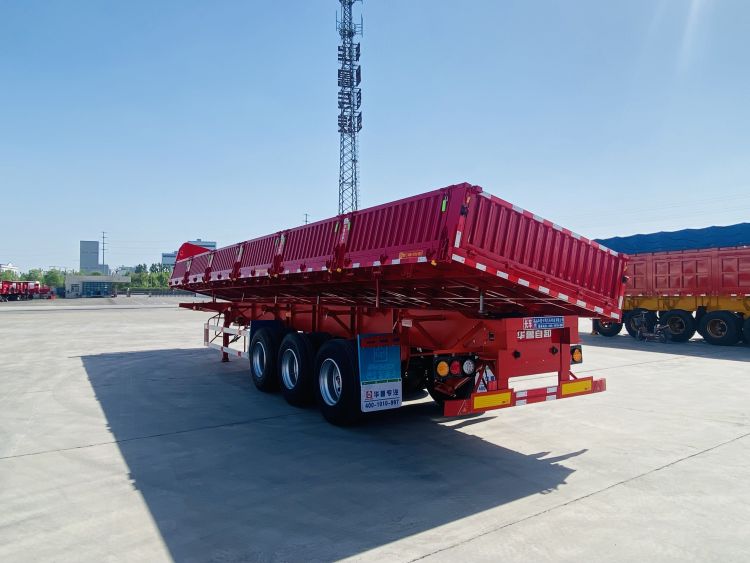
A bulk-logistics operator in Colombia runs thermal coal from the Cesar and La Guajira basins and bagged fertilizer back, over steep mountain switchbacks and down to the Caribbean ports at Santa Marta and Barranquilla. For years the fleet ran standard side tippers, and for years the same three problems followed every load: 180 kg of coal dribbled out of the tailgate and over the side on every trip, the dump itself took 90 seconds of raising and shaking, and the side hydraulic cylinders leaked on the long grades. The spilled coal was the visible loss; the real cost was a slower dump that capped each truck at eight loads a day while the excavator waited at the stockpile.
A side tipper that spills on the road and lingers at the dump is the wrong tool for coal: every kilogram on the shoulder is a kilogram you paid to haul and never sold, and every extra second of tipping is a second the loader is idle. Hualu already proved how to end a messy, slow discharge in its belt trailers in Indonesia, where rollover accidents were driven to zero with the right geometry. The side tipper is the same discipline on a dump body: tip faster and spill nothing.
The operator's fleet director compared three side-tipper suppliers and chose Hualu on two criteria: dump speed and spillage. A Hualu side tipper lifts and returns the body in 45 seconds on a single-side hydraulic stage, and the sealed, wear-resistant body with a locked tailgate keeps every kilogram inside until the moment it tips. The side-tip hydraulics use the same reliability logic Hualu proved in its Australian End Tipper fleet, where hydraulic failures fell 100%, and the sealed, protected body carries over from its curtain-side trailers in Poland, where cargo travelled protected end to end. Twenty-five Hualu side tippers were delivered in 40 days, in time for the export season.
By August 2026, the twenty-five Hualu side tippers had completed a full quarter of coal and fertilizer haulage. The numbers the fleet director now reports to the board:
| Metric | Standard Side Tipper (Baseline) | Hualu Side Tipper | Change |
|---|---|---|---|
| Tip (dump) time | 90 sec | 45 sec | -50% |
| Spillage per trip | 180 kg | 0 kg | -100% |
| Loads per truck per day | 8 | 11 | +38% |
| Payload per trip | 42 t | 45 t | +7% |
| Hydraulic failures (monthly) | 3 | 0 | -100% |
| Body relining interval | 6 months | 14 months | +133% |
| Fleet downtime (days/month) | 4 | 1 | -75% |
| Fuel per tonne hauled | 1.00 | 0.93 | -7% |
The two figures that moved the P&L most were the spillage and the dump time. A sealed body that tips in 45 seconds does not just stop the road loss — it turns an eight-load day into an eleven-load day, which is why the same truck moved 45 tonnes a trip instead of 42, with every kilogram delivered instead of left on the shoulder. It is the same "drive a recurring failure to zero" result that Hualu delivered for its belt trailers in Indonesia, cutting rollover accidents by 100% — the tipper that spills nothing and dumps faster wins the route.
A leaky tailgate lets coal escape from the first kilometre, and a slow side-tip keeps the truck standing at the stockpile long after the excavator has finished. A sealed body with a locked tailgate holds every kilogram until the moment it tips, and a 45-second single-side hydraulic cycle puts the truck back under the loader while the next bucket is still swinging. The difference compounds across a fleet: eleven clean dumps instead of eight slow, messy ones, and a body that wears for fourteen months instead of six on abrasive coal.
Bulk haulage is a game of delivered tonnes. The operator who wins is not the one with the biggest truck but the one who delivers every tonne and keeps the excavator moving without waiting on a slow dump or a leaking cylinder — and on Colombia's mountain grades, where a lost 180 kg a trip becomes a lost truckload a month across a fleet, a side tipper that tips clean and fast turns the haul loop from a source of losses into a steady profit. The Colombian case shows that the right dump body keeps both the coal and the schedule moving.