
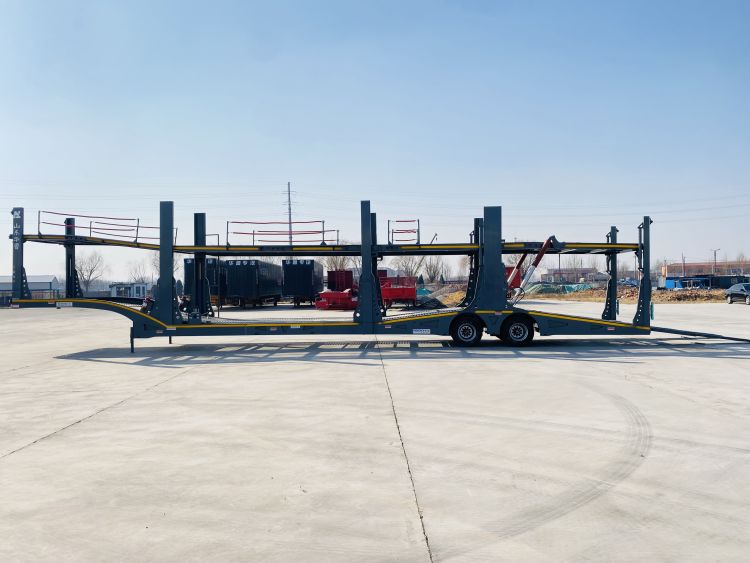
From Jeddah Islamic Port, a Saudi auto distributor moves imported sedans and SUVs to dealerships across Riyadh, Dammam, Mecca and Medina. For years the fleet ran fixed-deck car carriers, and for years the same three problems ate into every shipment: manual winch-and-ramp loading that scratched and dented twelve cars a month, a fifteen-minute load time per vehicle, and a fixed six-car deck that forced extra trips on the Kingdom's hot, long hauls. The damage claims were the visible cost; the real cost was a brand-new car reaching a showroom with a scuffed bumper that had to be repainted before it could be sold.
A fixed deck is the wrong shape for a loading ramp: every car has to be winched up a steep angle with a driver working at height, and every inch of that angle is a chance for a scrape. Hualu already showed how much the right loading geometry matters in its Curtain Side trailers in Poland, where side-access loading cut turnaround 45%. The tilting-deck car carrier is the same idea for vehicles: bring the deck down to the car, not the car up to the deck.
The distributor's fleet manager compared three carrier suppliers and chose Hualu on two criteria: loading angle and deck flexibility. A Hualu car carrier carries nine vehicles on a tilting upper deck and hydraulic tail ramp, so a car drives on at a low angle instead of being winched up a steep one, and the decks adjust to mix sedans, SUVs and pickup trucks in a single load. The hydraulic ramp and deck lifts use the same reliability logic Hualu proved in its Australian End Tipper fleet, where hydraulic failures fell 100%. Eight Hualu car carriers were delivered in 30 days, in time for the import peak.
By September 2026, the eight Hualu car carriers had moved a full quarter of imported vehicles. The numbers the fleet manager now reports to the board:
| Metric | Fixed-Deck Fleet (Baseline) | Hualu Car Carrier Fleet | Change |
|---|---|---|---|
| Vehicle damage incidents per month | 12 | 2 | -83% |
| Dealer rejection claims per month | 9 | 1 | -89% |
| Load time per vehicle | 15 min | 6 min | -60% |
| Cars per trip | 6 | 9 | +50% |
| Trips per week per truck | 3 | 4 | +33% |
| Driver loading injuries (yearly) | 4 | 0 | -100% |
| Ramp/winch setup per load | 20 min | 8 min | -60% |
| Fleet on-road utilization | 68% | 82% | +14 pts |
The two figures that moved the P&L most were damage incidents and load time. Cutting vehicle damage from twelve incidents to two a month does not just save repainting — it removes the rework and delay that used to hold a car back from the showroom, which is why dealer rejection claims fell from nine to one. And driving the load time down from fifteen minutes to six turns a six-car trip into a nine-car trip on the same driver's hours. It is the same "drive a recurring failure to near zero" result that Hualu delivered for its belt trailers in Indonesia, cutting rollover accidents by 100% — the trailer that protects the cargo wins the contract.
A fixed-deck carrier winches a car up a steep ramp, so the driver works at height with the vehicle teetering on the edge of the angle, and every slip is a scrape or a dent. A tilting-deck carrier brings the deck down to the car, so the vehicle drives on at a shallow angle, the driver stays on the ground, and the wheels are strapped with the body untouched. The difference compounds across a shipment: nine cars loaded in under an hour instead of six winched up over two, and a showroom that receives cars with no scuffed bumpers to repaint.
Vehicle importing is a game of unblemished metal. The distributor who wins is not the one with the most trucks but the one who delivers every car to the showroom without a scratch — because a repainted bumper is a cost, a delay, and a customer who notices. In a market like Saudi Arabia, where imported vehicles travel long hot hauls from port to dealership, a carrier that loads nine cars quickly and without damage turns the riskiest step of the chain into the most reliable. The Saudi case shows that the right car carrier protects both the metal and the margin.