
From a heavy-haul yard at Bremerhaven, a German transport operator moves wind-turbine tower sections, nacelles and 70-metre blades from the port to inland wind farms across Lower Saxony and Brandenburg. For years the fleet ran on high-deck lowboys, and for years the same three problems ate into every project: a 1.15-metre loaded deck that pushed tower sections and saddles into bridge and overhead-line clearances, forcing six clearance detours per project; tower flanges that arrived dented or scored in transit, with five rejected at site in a single season; and a 90-minute setup per oversized load that capped each truck at three deliveries a week. The detours were the visible cost; the real cost was a turbine standing idle on a ridge while a damaged section went back to the port.
A high deck is the wrong shape for a tall cargo: every extra centimetre of deck height is a centimetre of clearance you spend on a route survey instead of the road. Hualu already proved the value of a low, stiff deck in its lowboys in India, where weld fatigue was driven to zero cracks on heavy loads. The extendable lowboy is the same idea scaled for a wind farm: carry an 80-tonne tower section as low and as securely as the route allows.
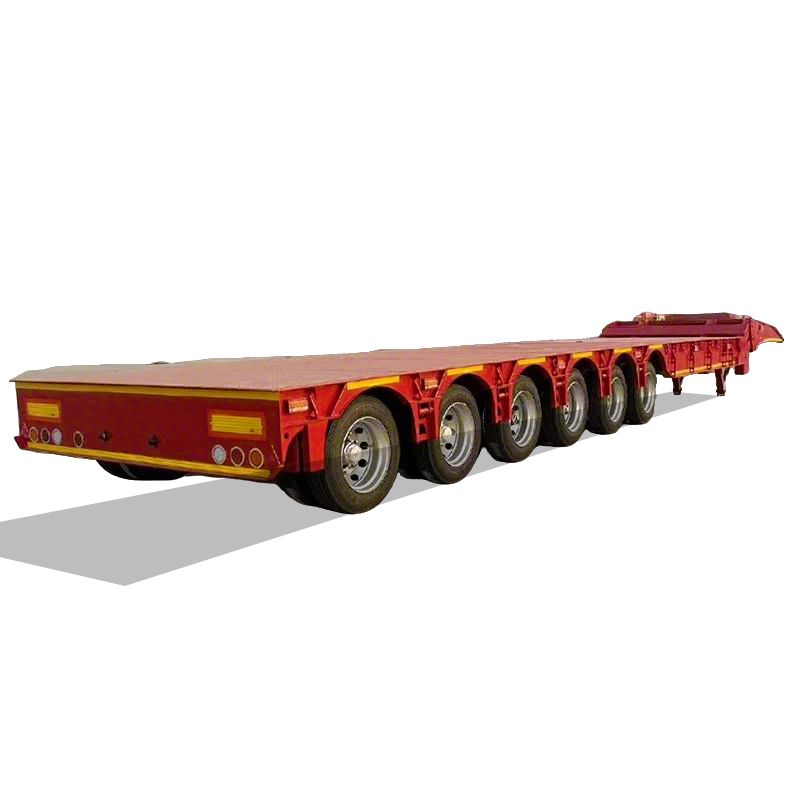
The operator's transport manager compared three heavy-haul suppliers and chose Hualu on two criteria: deck height and setup time. A Hualu extendable lowboy rides on a 0.88-metre loaded deck with a hydraulic detachable gooseneck that drops the front of the deck to the ground for tower loading, and extendable beams that stretch to take a 70-metre blade or a long tower section in one piece. The deck's high-strength steel and bolted cross-members hold the flange load without flex, which is exactly the hydraulic-reliability logic Hualu proved in its Australian End Tipper fleet, where hydraulic failures fell 100%. Six Hualu extendable lowboys were delivered in 45 days, in time for the spring construction season.
By October 2026, the six Hualu extendable lowboys had moved a full season of turbine components. The numbers the transport manager now reports to the board:
| Metric | High-Deck Fleet (Baseline) | Hualu Lowboy Fleet | Change |
|---|---|---|---|
| Loaded deck height | 1.15 m | 0.88 m | -23% |
| Clearance detours per project | 6 | 1 | -83% |
| Tower flange damage incidents | 5 | 0 | -100% |
| Setup time per oversized load | 90 min | 35 min | -61% |
| Trips per turbine | 8 | 6 | -25% |
| Deliveries per week per truck | 3 | 5 | +67% |
| Tare weight | 14.5 t | 12.8 t | -12% |
| On-time delivery to site | 78% | 97% | +19 pts |
The two figures that moved the P&L most were deck height and flange damage. Dropping the deck from 1.15 to 0.88 metres does not just save a detour — it removes the clearance risk that used to turn a direct route into a survey-and-permit exercise, which is why detours fell from six to one per project. And zero rejected flanges in a season means no component sent back to the port, no re-ordering, and no crane crew standing idle on a ridge. It is the same "fit the trailer to the cargo, not the cargo to the trailer" result that Hualu delivered for curtain-side distribution in Poland, cutting turnaround 45% — the trailer that clears the route wins the schedule.
A high-deck lowboy lifts a tower section high above the road, so the same tower that fits under a bridge at 0.9 metres of deck suddenly needs a detour at 1.15. Every centimetre of deck height is clearance you buy back with a longer route, a slower speed, and a permit. An extendable lowboy rides low and long, so the tower travels under the same bridges the route was surveyed for, and the flange sits on a stiff, bolted deck that does not flex or score it in transit. The difference compounds across a turbine: six trips instead of eight, five deliveries a week instead of three, and a crane crew that never waits on a ridge.
Wind-farm construction is a race against the crane schedule. The cost that matters is not the trailer but the crane and crew standing idle while a component is late — and a rejected flange or a clearance detour is a day the crane does not work. In a country like Germany, where route surveys and permits are strict and every centimetre of clearance is argued, a lowboy that carries an 80-tonne tower low and undamaged turns the logistics from the project's bottleneck into its quiet engine. The German case shows that the right heavy-haul deck keeps both the road and the schedule clear.