
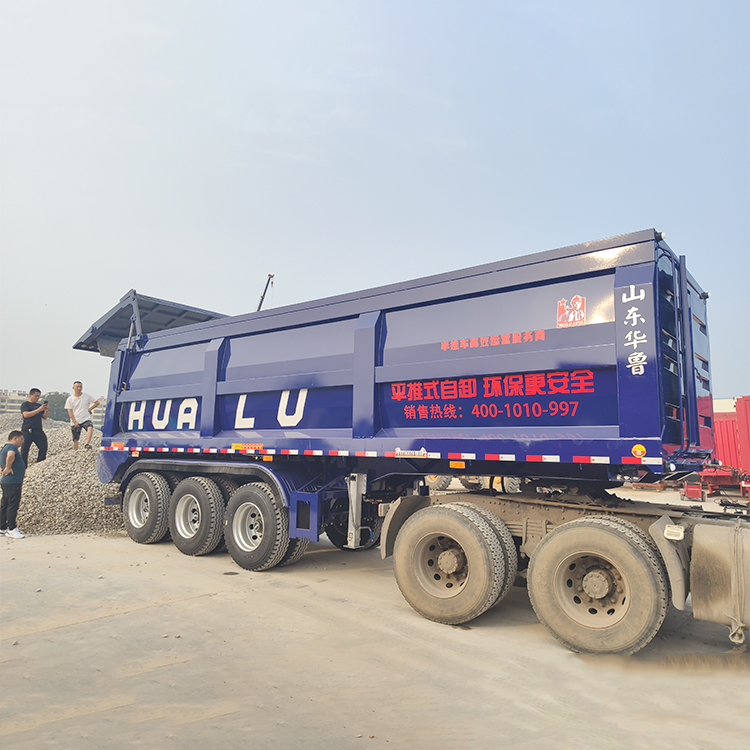
From a receival depot in Western Australia's Wheatbelt, a grain logistics operator runs a fleet of fourteen end-tipper trailers moving wheat, barley and canola from farm receivals to a bulk grain terminal at Geraldton port. Every harvest the same three problems ate into the October-to-January window: a 35-minute gravity-and-auger unload that capped each truck at four loads a day, a tipping body that caused three rollovers in a single season on uneven receival ground, and an auger that cracked enough kernels to trigger a quality downgrade at the terminal. The rollovers were the visible cost; the real cost was a truck and its driver standing still through the three months when grain prices reward speed.
Tipping is the wrong mechanism for a receival where the ground is never perfectly level: every lift shifts the centre of gravity, and every shift is a chance for a rollover. Hualu already removed that risk for one bulk fleet — its belt trailers in Indonesia cut rollover accidents by 100% by discharging on the flat. The belt trailer is the same idea applied to grain: unload the full 40 tonnes without ever lifting the body.
The operator's fleet manager compared three unloading methods — end-tip, walking floor and belt discharge — and chose Hualu on two criteria: unload speed and grain integrity. A Hualu belt trailer carries a full-length hydraulic belt under the load, discharged to the side by remote control in about eight minutes for 40 tonnes, with the body never lifting an inch. A low-speed, enclosed discharge chute drops grain gently into the receival pit instead of auguring it, which is exactly the hydraulic-reliability logic Hualu proved in its Australian End Tipper fleet, where hydraulic failures fell 100%. Ten Hualu belt trailers were delivered in 40 days, in time for the harvest peak.
By the end of January 2026, the ten Hualu belt trailers had completed a full harvest season. The numbers the fleet manager now reports to the board:
| Metric | End-Tipper Fleet (Baseline) | Hualu Belt Fleet | Change |
|---|---|---|---|
| Unload time per 40 t | 35 min | 8 min | -77% |
| Loads per truck per day | 4 | 7 | +75% |
| Tonnes per truck per day | 160 | 280 | +75% |
| Cracked-grain breakage | 3.2% | 0.8% | -75% |
| Tipping/rollover incidents per season | 3 | 0 | -100% |
| Spillage per unload | 25 kg | 3 kg | -88% |
| Unload operators per truck | 2 | 1 | -50% |
| Peak receival wait time | 90 min | 40 min | -56% |
The two figures that moved the P&L most were unload time and grain integrity. Cutting the unload from 35 minutes to eight does not just speed one receival — it turns a four-load day into a seven-load day, which is why the same driver and truck moved 280 tonnes a day instead of 160. And dropping cracked-grain breakage from 3.2% to 0.8% means a higher receival grade on every load, no downgrade deductions and no re-screening at the terminal. It is the same throughput logic that Hualu applied to curtain-side distribution in Poland, cutting dock turnaround 45% — the fastest unload wins the queue.
An end-tipper unloads by raising the body to a steep angle, so grain flows out under gravity while the truck sits on a slope — a rollover risk on soft receival ground and a slow, dusty process that needs a second person to watch the tailgate. A belt trailer unloads flat: the belt moves the grain, not gravity, so the body never lifts, the driver stays in the cab with the remote, and the enclosed chute drops the load straight into the pit. The difference compounds across a harvest: a truck making seven loads a day saves more than three hours of unloading against the old fleet, and three hours a day is three extra loads that the harvest window no longer swallows.
Bulk grain hauling is a race against a window that stays open for three or four months. The operator who wins is not the one with the biggest truck but the one who clears a receival and is back on the road fastest — and in a region like Western Australia's Wheatbelt, where receivals run around the clock at peak and every queue minute is a lost load, a trailer that unloads 40 tonnes in eight minutes flat turns the slowest step of the day into the fastest. The Australian case shows that the right discharge mechanism turns a harvest from a sprint you survive into a season you bank.