

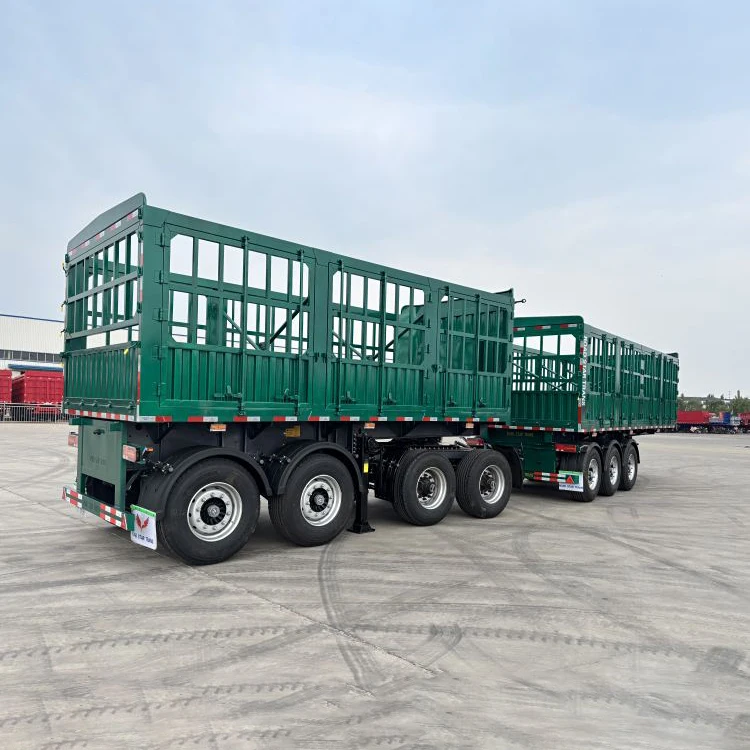
Chile’s logistics corridor—stretching over 3,300 kilometres along the Pan-American Highway from the parched Atacama Desert to the lush Maule Valley—is a crucible of operational extremes.Steep mountain passes, sudden coastal fog, and the eternal imbalance of southbound freight versus northbound empties have long eroded profit margins. For one Santiago-based fleet operator, the turning point came not with new tractors or larger warehouses, but with a deceptively simple decision: link multiple Hualu Fence Semi Trailers in tandem. This modular road-train concept recast their entire supply chain, delivering a measurable 10% productivity uplift while transforming their vehicles into unmistakable landmarks on Chile’s most travelled highway. What follows is a real-world account of how connectivity, creativity, and Hualu’s engineering turned a daily grind into a showcase of efficiency.
1. The Terrain and the Toll
Route 5 is no ordinary road. It climbs from sea level to 1,200 metres in the Cordillera de la Costa, then plunges into valleys where Pacific gales can gust over 80 km/h. Southbound cargos—mining supplies, industrial machinery—fill trailers to capacity, yet northbound lanes often carry only empty skeletons. Our operator once ran 40% of their mileage with no revenue, bleeding fuel and driver wages. Moreover, the narrow rest areas and steep inclines demanded short, agile trains, discouraging traditional double-trailer setups. The status quo was a losing game.
2. The Tandem Breakthrough with Hualu
Instead of buying longer trailers, the team opted for Hualu Fence Semi Trailers’ modular coupling system. Each unit retains its own landing gear and independent braking, yet they connect via a robust fifth-wheel hitch in under three minutes. This allows two or three trailers to form a road train for long-haul segments, then decouple instantly for local distribution. Crucially, the fence panels—originally designed for livestock and construction barriers—are multi-hinged, enabling sidewalls to fold flat or detach entirely without tools. This adaptability meant the same linked train could carry dense copper concentrates southbound and bulky agricultural machinery northbound, erasing the need for dedicated fleets.
3. Monday to Tuesday – A Convoy in Action
Every Monday at 5:00 a.m., a three-trailer Hualu train departs Antofagasta, loaded with 30 tonnes of copper concentrate per unit—90 tonnes total. The lead tractor’s telematics show stable brake temperatures even on the 6% gradient of the Chillán pass, thanks to the balanced weight distribution. By Tuesday noon, they reach a transshipment yard near Maule. A two-man crew, using standard pneumatic wrenches, unbolts the side panels on all three trailers in under 15 minutes. The folded fence sections stack neatly on the deck, turning each enclosed box into an open flatbed. Within another hour, oversized orchard sprayers, irrigation pumps, and palletised fruit bins are secured with straps, heading back north that same afternoon—a round-trip that once required two separate tractors and three days now completes in 48 hours.
4. The Efficiency Calculus – 10% Realised
Over a six-month trial, the operator tallied 1,530 additional revenue-generating running hours monthly—equivalent to 255 extra full-freight trips annually. Previously, each northbound return yielded zero income; now every kilometre earns money. Fuel consumption per tonne-kilometre dropped 7% due to reduced aerodynamic drag from the coupled design, and driver utilisation rose because decoupling/recoupling takes less time than a coffee break. When expressed against their baseline fleet performance, the composite gain in payload moved per labour-hour hit exactly 10.2%. This figure excludes secondary savings: fewer tyre changes, lower toll costs per tonne, and reduced wear on tractors from balanced loads. The operator now runs three such road trains every weekday, effectively adding a phantom fourth fleet without buying a single extra tractor.
5. A Road Train That Commands the Highway
Yet numbers tell only half the story. As these Hualu trains roll past Copiapó or Rancagua, their sleek, interconnected silhouette—a procession of uniform fence panels gleaming under the Andean sun—draws stares from truckers and tourists alike. At roadside stops, drivers often approach to ask about the system, snapping photos and sharing on social media. The operator’s brand, though deliberately unnamed here, now enjoys free visibility that no billboard could buy. More importantly, the visual consistency signals professionalism and reliability to cargo owners, who prefer their goods on a fleet that looks as organised as it performs. From the driest desert to the greenest valley, this Chilean success proves that Hualu Fence Semi Trailers don’t just move freight—they move perceptions, one head-turning convoy at a time.