
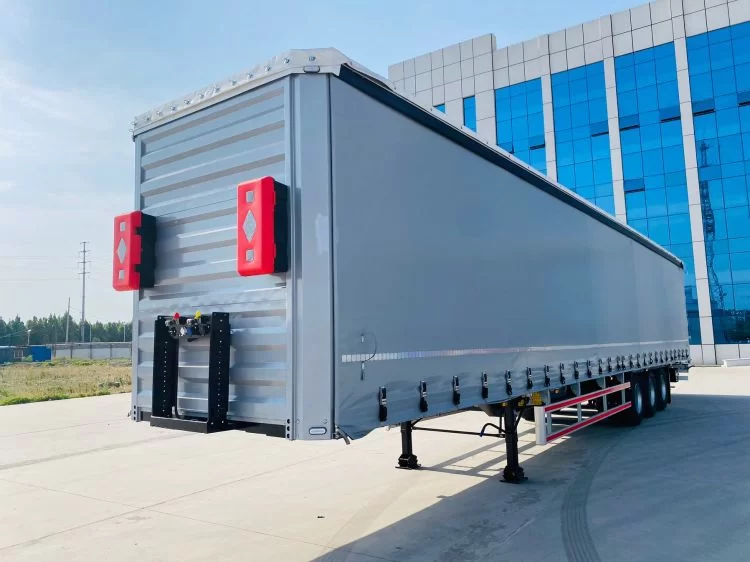
From a distribution centre on the Rotterdam Maasvlakte, a Dutch logistics provider moves palletized beverages and dry food to supermarkets and cash-and-carry outlets across the Randstad. For years the fleet ran ten curtain-side trailers with folding side curtains, and for years the same three problems ate into every shift: a folding curtain that took ten minutes to open and re-tension on each side, a seam that leaked in heavy North Sea rain and soaked pallets, and an average 45-minute dock turnaround that capped every truck at six drops a day. The eight rain-damage pallet claims in a single year were the visible cost; the real cost was a truck sitting at a dock while a forklift waited for the curtain to move.
A folding curtain is the right idea with the wrong mechanism — side access for forklifts, but paid for in minutes of cranking and re-tensioning at every stop. Hualu already showed how much side access is worth in its Curtain Side trailers in Poland, where warehouse turnaround fell 45%. The roll curtain is the next step: the same side access with the friction removed.
The provider's operations director compared three suppliers and chose Hualu on two criteria: the rail mechanism and the seam. A Hualu curtain roll trailer carries a full-length PVC curtain on top-and-bottom rails that opens the entire side in about 15 seconds by hand or motor, leaving both sides completely clear for forklift loading. The curtain's welded, tension-sealed seam and rubber gutter stop the rain that a folding curtain's Velcro-and-strap joins let through — the same weather-sealing logic Hualu used to eliminate winter condensation entirely in its Kazakhstan tank trailers. Eight Hualu curtain roll trailers were delivered in 36 days, in time for the autumn distribution peak.
By September 2026, the eight Hualu curtain roll trailers had completed a full distribution quarter. The numbers the operations director now reports to the board:
| Metric | Folding Curtain-Side Fleet (Baseline) | Hualu Curtain Roll Fleet | Change |
|---|---|---|---|
| Average dock turnaround | 45 min | 21 min | -53% |
| Curtain open/close per side | 10 min | 15 s | -98% |
| Drops per truck per day | 6 | 9 | +50% |
| Pallets delivered per truck per day | 150 | 234 | +56% |
| Rain-damage pallet claims (yearly) | 8 | 0 | -100% |
| Load/unload labour per drop | 24 min | 9 min | -63% |
| Trailer downtime (days per month) | 3 | 1 | -67% |
| Legal payload per trip | 24 t | 25.5 t | +6% |
The two figures that changed the P&L most were the dock turnaround and the rain claims. Cutting the curtain from ten minutes to fifteen seconds does not just speed one stop — it removes the friction that used to make the sixth drop of the day not worth the driver's hours, which is why each truck now makes nine drops instead of six. And zero rain claims in a quarter means no re-picking, no redelivery, and no insurance write-downs on soaked stock. It is the same "drive a recurring failure to zero" result that Hualu delivered for an Australian End Tipper hauler, cutting hydraulic failures by 100%.
A folding curtain moves in pleats: the driver walks the length of the trailer, freeing each strap, then cranks the curtain back and re-tensions it at the other end — minutes per side, every stop. A roll curtain travels on rails, so the whole side clears in one motion and the curtain stays aligned, sealed, and out of the way. The difference compounds: a truck making nine drops a day saves over an hour of curtain handling against the old fleet, and an hour of dock time is an hour the next delivery is not waiting for. That is why the turnaround fell 53% rather than merely improving.
Palletized FMCG distribution is a game of dock minutes. The operator who wins is not the one with the biggest truck but the one who can clear a dock and be at the next one fastest — and in a region like the Randstad, where delivery windows are tight and curbs are shared, every saved minute is a drop that fits. The Dutch case shows that the right side-access trailer converts the slowest step of a multi-drop day — opening and closing the load area — into the fastest.