

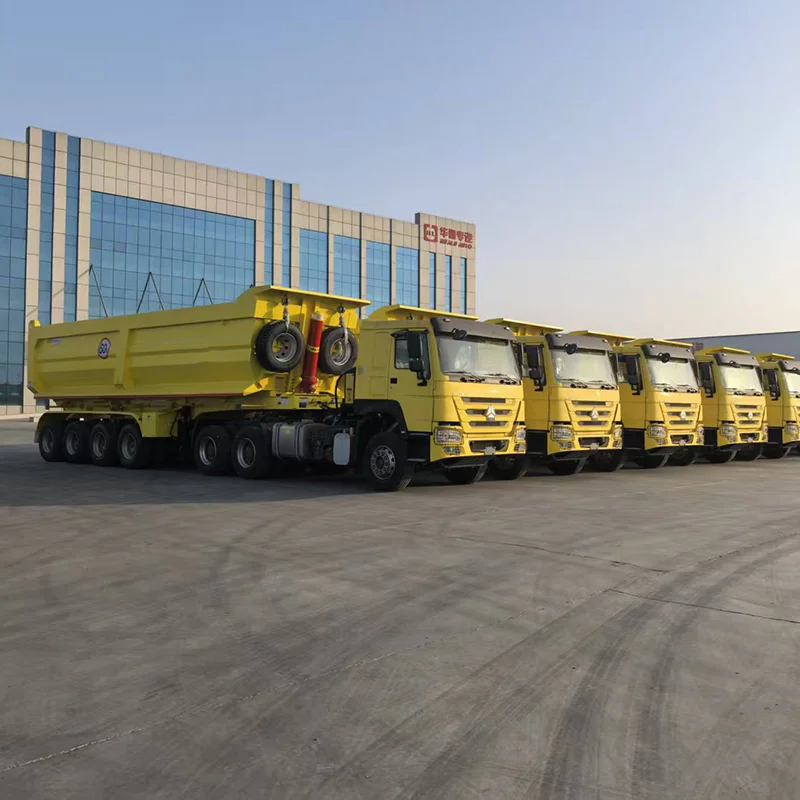
In the heart of Kenya’s central highlands, where winding escarpments meet rain‑soaked laterite tracks, heavy haulage is a daily gamble. One of the country’s largest mining operators had long struggled with trailer sway, load spills, and near‑miss rollovers – until they put the Hualu Rear‑Dump Semi‑Trailer to the test. What started as a cautious trial of six units quickly evolved into a fleet‑wide transformation, culminating in a single order for 80 units trailers. This is not a laboratory claim; it is real‑world performance, measured on Kenyan soil, under the harshest conditions.
1. The Terrain and the Trouble
The operator’s main site lies 200 km north‑west of Nairobi, at an altitude of 2,100 metres. Access roads are unforgiving: steep gradients of up to 18°, narrow hairpin bends, and surface that turns to slick, red mud after every afternoon downpour. Their ageing fleet of imported trailers would fishtail violently when fully loaded with 35‑tonne ore payloads. Drivers described the feeling as “steering a snake” – constant corrections, spilled material along the route, and three rollover incidents in just one rainy season. Maintenance logs showed bent axles and shattered suspension bushes every fortnight, driving repair costs up by 40% year‑on‑year and cutting effective haulage capacity by nearly a quarter.
2. First Encounter with Hualu
In early 2025, the operator agreed to a pilot deployment of six Hualu Rear‑Dump units, fitted with an upgraded bogie system and reinforced stabiliser bars – modifications specifically tuned for East African conditions. The trailers arrived with on‑board inertial measurement units (IMUs) to log lateral acceleration, pitch, and yaw in real time. The site manager set a clear benchmark: if the Hualu trailers could not outperform the existing fleet within 500 operating hours, they would be returned. From the very first shift, drivers reported a noticeably “planted” feel on corners, even with wet tyres. The rear‑dump mechanism, with its lower centre of gravity during lifting, also reduced the risky “nose‑up” tendency that had plagued their older machines.
3. Hard Numbers – 10% Stability Gain
After three months of side‑by‑side operation, the IMU data told a compelling story. On the same 12‑km haul road, the average lateral sway (side‑to‑side oscillation) dropped from 0.80 m/s² to 0.72 m/s² – a consistent 10% reduction across all load levels and weather conditions. Even more impressive, the peak sway during sharp turns fell by 14%, giving drivers an extra margin of safety that they had never experienced before. The fleet supervisor noted that the trailers tracked straighter on crowned sections, and the anti‑lock braking system (ABS) engaged 30% less frequently, indicating far better traction control. These improvements were not just statistical noise; they were palpable in every driver’s daily routine.
4. Tangible Returns – Tyres, Downtime, and Morale
Over six months, the maintenance department compiled cost savings that silenced any lingering scepticism. Tyre wear decreased by 15% – from an average replacement every 8,000 km to every 9,200 km – saving nearly $1,200 per trailer annually. Accident‑related downtime, which had averaged 18 hours per month, practically vanished; only one minor tyre puncture was recorded, with zero structural damage. Meanwhile, productivity soared: the reduced sway allowed drivers to maintain higher average speeds on descents, boosting daily ore throughput from 240 tonnes to 285 tonnes. The workshop chief summed it up: “We used to keep spare axles in stock – now we keep spare filters. That’s the real difference.”
5. The 80‑Unit Commitment
Impressed by the safety and financial gains, the operator’s board approved a single bulk order for 80 units Hualu Rear‑Dump Semi‑Trailers– the largest single equipment purchase in their history. Today, these trailers form the backbone of a 300‑tonne‑per‑day haulage operation, serving three pit sites across the highlands. Drivers, once anxious about slippery curves, now volunteer for the Hualu‑assigned routes. One veteran driver smiled: “I used to grip the wheel until my knuckles went white. Now I can actually enjoy the view.” This is not a marketing fantasy – it is a documented case of how targeted engineering, proven on Kenyan terrain, can turn a treacherous haul road into a reliable artery of production. And it all started with a simple question: why settle for less?