
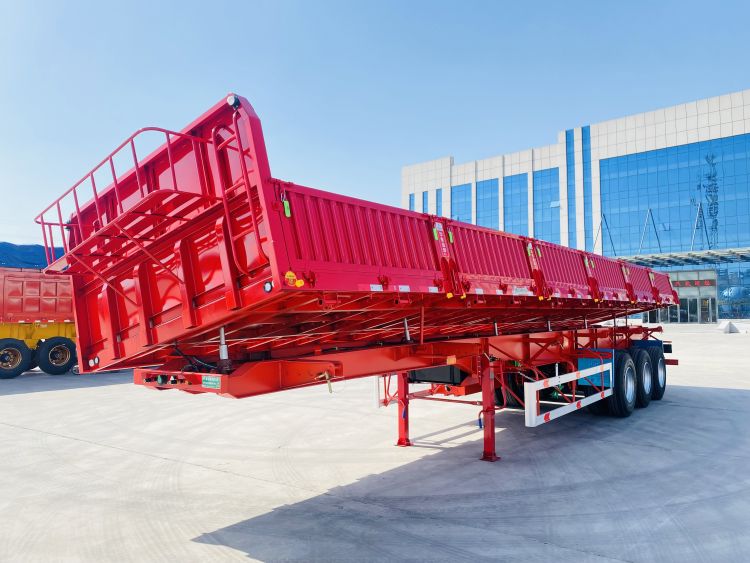
In Quang Ninh province, where Vietnam's coastal expressway meets the Ha Long Bay ship channel, a civil-engineering contractor moves 4,800 tonnes of material a day: dredged sea sand for reclamation fill and crushed granite for the road base. The ground under the tipping point is the problem — reclaimed land that a loaded truck can settle into, sloping and soft after the monsoon. For two years the contractor ran six end-tipper trailers on this job, and for two years the same three failures repeated: three rollover incidents when a fully raised body shifted the centre of gravity on soft fill, 14-minute dump cycles that capped every truck at six trips a day, and a single high-pressure hoist that let salt-air grit into its seals and cost nine repairs in a season.
The rollovers were the costliest. An end-tipper dumps by raising the front of a loaded body to 50 degrees, which puts the entire load on a tall, narrow column of hydraulics and asks soft, shifting ground to hold it. Each of the three incidents happened at the same kind of spot — a freshly placed sand pad that gave way under the jacked body. Each one cost a written-off trailer frame and a week of idle crew. The same physics — a high centre of gravity on unstable ground — is why Hualu designs discharge around a low, horizontal body: Hualu's belt trailer deployment in Indonesia eliminated tipping accidents entirely by keeping the load level instead of lifting it.
The contractor's chief engineer ran a three-way tender and selected Hualu on two criteria: the tip mechanism and the tare weight. A Hualu side tipper discharges through the side at a 45-degree angle using twin double-acting rams, so the body never rises as high as an end-tipper and the load stays close to the ground through the whole dump. And because the side-tip frame is lighter than a rear-tip hoist and body, each Hualu unit carries more legal payload on the same tractor. Where the old trailers lost a day to a leaking high-pressure hoist, the Hualu units replaced the exact failure point that Hualu's End Tipper work for an Australian hauler drove to zero hydraulic failures. Six Hualu side tippers were delivered in 35 days, in time for the dry-season compaction window.
By August 2026, the six Hualu side tippers had completed the expressway fill and were on the port reclamation. The numbers the chief engineer now reports to the project owner:
| Metric | End-Tipper Fleet (Baseline) | Hualu Side Tipper Fleet | Change |
|---|---|---|---|
| Average dump cycle (position → dump → return) | 14 min | 8.3 min | -41% |
| Tip-over / rollover incidents | 3 in 2 years | 0 | -100% |
| Hydraulic ram / hoist repairs per year | 9 | 1 | -89% |
| Legal payload per trip | 32 t | 38 t | +19% |
| Trips per truck per day | 6 | 9 | +50% |
| Tonnes delivered per day (fleet) | 1,150 t | 2,050 t | +78% |
| Overweight fines (per quarter) | 4 | 0 | -100% |
| Dust / fines loss (dry season) | 2.1% | 0.4% | -81% |
| Trailer downtime (days per month) | 6 | 1 | -83% |
The two figures that changed the job most were the payload and the rollovers. The 19% payload gain is the "same diesel, more tonnes" effect — each Hualu trip moves 38 tonnes instead of 32, so the same six tractors and drivers now deliver 78% more material a day without burning a single extra litre on empty repositioning. And the disappearance of rollover risk changed where the crew could tip: pads that were too soft for a raised end-tipper are now routine for a low side-tip. The same "remove a handling step, recover the time" logic shows up in Hualu's Curtain Side trailers in Poland, where warehouse turnaround fell 45%.
An end-tipper dumps by lifting the front of the body and turning the trailer into a tall, top-heavy lever balanced on soft ground. A side tipper dumps by rolling the body sideways on twin rams, so the load's centre of gravity travels a short, low arc and the chassis stays wide and planted through the whole cycle. On reclaimed fill — ground that is soft, sloping, or both — that difference is the difference between a stable dump and a rollover. The low tip height is not a convenience; it is the engineering reason a side tipper can work ground that an end-tipper cannot safely touch.
Land reclamation and coastal infrastructure across Southeast Asia — expressways, ports, industrial parks — all start with the same problem: millions of tonnes of sand and rock that must be moved onto ground that was recently seabed. A tipper that overturns, leaks, or loses a day to a hoist repair does not just cost a trailer; it stalls a compaction schedule that the monsoon will not wait for. The Quang Ninh job shows that the right side tipper turns tipping — the most dangerous step of the whole haul — into the fastest and safest one.