
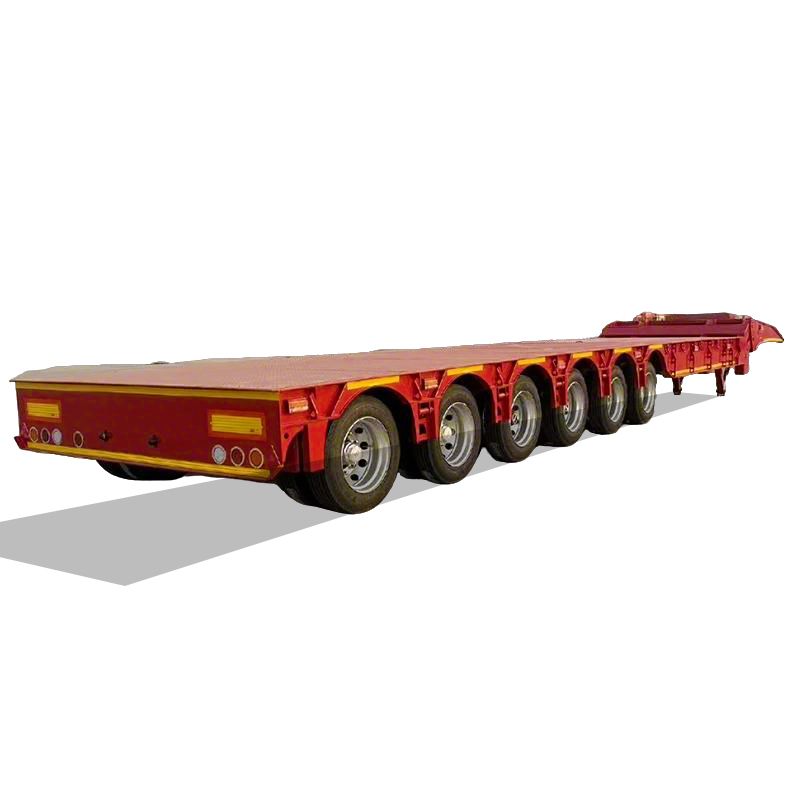
In the Sierra de Outes and the ridgelines of inland Galicia, a Spanish heavy-haul contractor moves wind turbine components to sites that sit 1,100 metres above sea level at the end of access tracks that were once cattle paths. A single modern turbine arrives as three loads: a 68-metre blade that overhangs the trailer by nearly 40 metres, a 95-tonne tower section, and a 62-tonne nacelle. For a decade, the contractor's fleet of ageing European lowboys handled this work — and for a decade, the same three failures recurred: hairline cracks in the main beams under blade-overhang flex, hydraulic gooseneck failures on the steepest climbs, and 45-minute load cycles that turned every turbine into a two-day delivery.
The cracks were the costliest. A 68-metre blade acts as a 40-metre lever arm; every switchback and expansion joint cycles the trailer frame through flex loads that ordinary structural steel accumulates as fatigue. The contractor's maintenance log showed 17 weld-repair interventions in one year. Each one pulled a trailer out of service for four days during the short summer construction window when wind farms are built. The same fatigue problem is why Hualu engineered the solution differently — the kind of zero-weld-crack durability documented in Hualu's Lowboy deployment for an Indian heavy-transport operator.
The contractor's engineering director ran a three-way tender and selected Hualu on two criteria: the steel specification, and the gooseneck. Hualu's lowboy platform uses QSTE700 high-tensile steel in the main beams — the same material logic that lets a frame absorb blade-overhang flex without crack propagation — and a hydraulic detachable gooseneck rated for a 45-second drop-and-reconnect cycle on uneven ground. Where the contractor's old trailers lost a day to gooseneck hydraulics, the Hualu units replaced the failure point that Hualu's End Tipper work for an Australian hauler drove to zero hydraulic failures. Six Hualu lowboys were delivered in 41 days for the 2026 construction season.
By August 2026, the six Hualu lowboys had delivered components for 42 turbines across the Galician highlands. The contractor's site supervisor summarised the season in one line: "We stopped thinking about the trailers." The numbers behind that line:
| Metric | Old Fleet (Baseline) | Hualu Fleet | Change |
|---|---|---|---|
| Blade transit time, site to site | 6.2 h | 3.8 h | -38% |
| Weld-repair interventions (yearly) | 17 | 0 | -100% |
| Hydraulic gooseneck failures | 11 | 0 | -100% |
| Average load / unload cycle | 45 min | 18 min | -60% |
| Trailers out of service (season) | 68 days | 4 days | -94% |
| Route permit violations / fines | 6 | 0 | -100% |
| Turbines delivered per season | 31 | 42 | +35% |
| Driver self-steering corrections | frequent | rare | Automated |
The two figures that matter most to the contractor's finance team were the 68 lost service days — recovered, at roughly €1,900 a day in rental substitution and idle crew — and the 35% jump in turbines delivered, which is pure margin against a fixed seasonal labour force. The self-steering last axle deserves its own note: on the Sierra switchbacks, a 68-metre blade that used to require a second driver walking beside the dolly now tracks the curve automatically, which is why permit violations — always an overhang or centreline infraction on a blind corner — dropped to zero. The same "remove a handling step, recover the time" logic shows up in Hualu's Curtain Side trailers in Poland, where warehouse turnaround fell 45%.
A lowboy hauling a 68-metre blade is not carrying a load; it is carrying a bending moment. Every curve, bump, and expansion joint flexes the trailer frame, and the accumulated cycles are what eventually crack a beam. The solution is not thicker steel — it is the right grade of steel, welded correctly, with a self-steering axle that removes the lateral scrub that overhang loads transmit through the frame. Hualu's combination of QSTE700 beams and a steerable dolly addresses both the fatigue source and the manoeuvrability symptom, which is why the weld-repair count went to zero rather than merely down.
Wind energy projects live and die on two logistics constraints: the size of the components, and the shortness of the weather window. A trailer that cracks or fails during the six-week summer build season does not just cost a repair — it costs a turbine that misses its commissioning date. The Galician contractor's season shows that the right lowboy converts wind-turbine transport from the project's biggest schedule risk into its most reliable operation.