
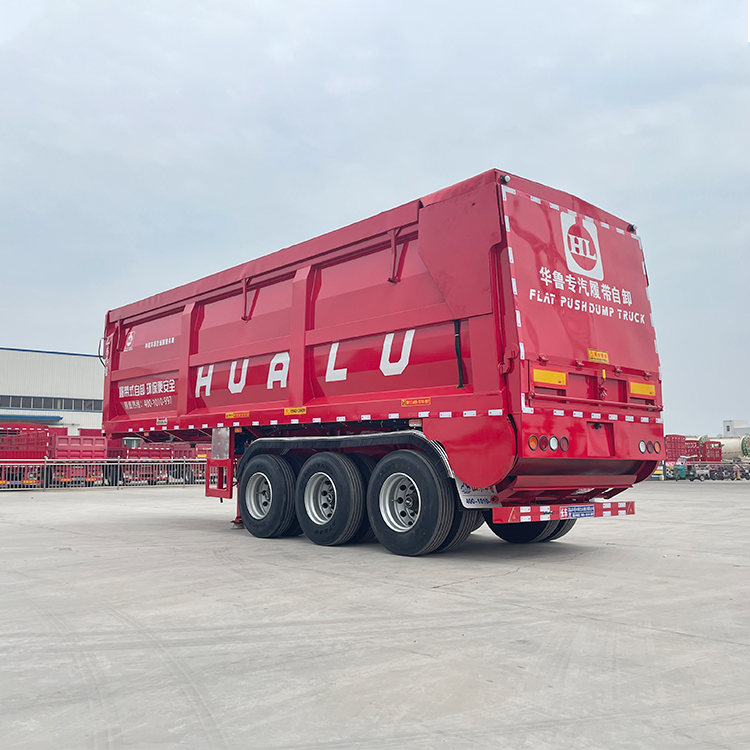
Between Regina and Saskatoon, a Saskatchewan transport company moves urea, monoammonium phosphate (MAP), potash, and cereal grain for farm cooperatives across the province's gravel-road network. For 18 years the fleet relied on conventional three-axle end-tip dump trailers, and for 18 years the operations manager watched the same three costs climb every winter: frozen product that would not slide out of a tipped body, cross-contamination between fertilizer and food-grade grain that triggered rejected loads, and 25-minute unloads that capped each truck at two and a half round trips a day during the spring seeding rush.
Winter was the worst. When urea absorbed moisture and froze into a solid block, a driver could spend two hours with a steam lance and a sledgehammer trying to loosen a load that a tipping body could not discharge. The company recorded four rollover incidents over three years — all on soft field drop points where a raised, loaded body shifted the centre of gravity — and nine load rejections in a single season when residue from a previous fertilizer load contaminated a food-grade wheat delivery. A similar pattern shows up across bulk hauling: Hualu's belt trailer deployment in Indonesia eliminated tipping accidents entirely on the same principle — keep the load moving horizontally instead of lifting it.
The operations manager and the fleet owner toured three manufacturers before choosing Hualu. The deciding factor was not a spec sheet — it was a video of a Hualu belt trailer discharging a full load of frozen aggregate at -30°C without a single hydraulic lift. "Our end-tippers unload by fighting gravity and the weather," the owner said. "The Hualu unloads by moving the floor. Gravity and weather stop being variables." Four Hualu belt trailers were ordered in March 2025, delivered in 38 days, and put into service for the 2025 seeding season. Where an end-tip relies on a high-pressure hydraulic hoist — the failure point Hualu eliminated in its End Tipper work for an Australian iron ore hauler, cutting hydraulic failures by 100% — the belt trailer discharges through a driven floor conveyor that keeps the body level at all times.
By August 2026, the four Hualu belt trailers had completed roughly 2,300 deliveries across two seeding seasons and one full harvest. The numbers the fleet owner now quotes to other operators:
| Metric | End-Tip Fleet (Baseline) | Hualu Belt Fleet | Change |
|---|---|---|---|
| Average unload time per 38 t | 25 min | 9 min | -64% |
| Load rejections (contamination) | 9 / season | 0 | -100% |
| Rollover / near-miss incidents | 4 in 3 years | 0 | -100% |
| Product loss (spill + dust) | 1.6% | 0.15% | -91% |
| Hydraulic repairs per year | 12 | 1 | -92% |
| Winter thaw / steam time | ~2.5 h avg | 0 | -100% |
| Round trips / truck / day (peak) | 2.4 | 3.9 | +63% |
| Deliveries into low-clearance sheds | 0 (could not tip) | 410 | New capability |
The two numbers that changed the business most were not the dramatic ones. The elimination of the ~2.5-hour winter thaw — where a driver idled a truck, a steam lance, and a second man's labour on every frozen load — recovered roughly 1,100 productive hours across the fleet in a single winter. And the ability to discharge inside low-clearance grain sheds, which an end-tip can never do, opened 410 deliveries that previously required a skid steer, a hopper, and a second handling step. Both mirror the throughput gains from Hualu's Curtain Side trailers in Poland, where warehouse turnaround fell 45% by removing a handling step from the flow.
An end-tip trailer unloads by raising the front of the body and asking a frozen, cohesive load to slide. On the Prairies, that fails in three ways at once: the load may be frozen solid, the ground may be too soft or sloped to safely raise a loaded body, and the wind can scatter fine product the moment the tailgate opens. A belt trailer sidesteps all three. The body stays level, so there is no centre-of-gravity shift and no rollover risk; the floor conveyor pushes the load out mechanically, so freezing is irrelevant; and discharge happens through a contained rear opening at ground height, so wind loss drops by an order of magnitude. The same winter-proofing logic drove Hualu's tank trailers in Kazakhstan, which eliminated winter condensation entirely.
Bulk agriculture and construction hauling has long accepted three handicaps as unavoidable: slow unloading, spillage loss, and the risk of tipping. The Saskatchewan fleet's experience shows those are design choices, not facts of nature. For any operator moving free-flowing or semi-cohesive bulk — grain, fertilizer, aggregate, wood chips, or biomass — a horizontal-discharge trailer converts what used to be the most dangerous and time-consuming step of the trip into the fastest and safest one.