

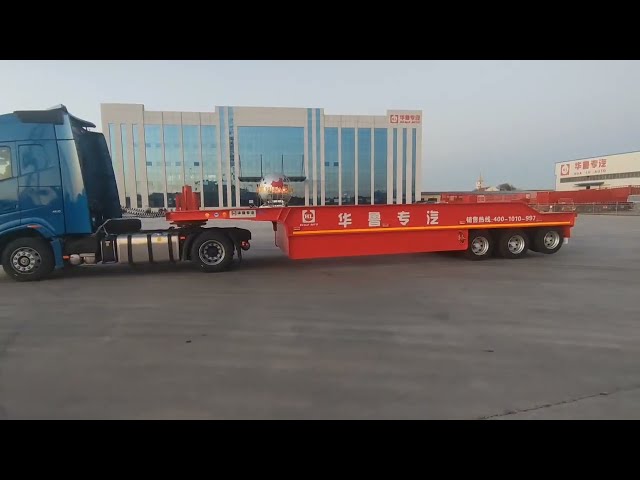
At the Hai Phong container terminal, the haulage contractor's maintenance bay sat directly beneath the port's ship-to-shore crane — a practical location, because the yard supervisor could watch for the next chassis to limp in with a fresh crack. The pattern had become grimly familiar: every few weeks, one of the company's 15 carbon-steel container chassis would come back with rust-eaten weld joints or a fatigued main beam, and it would spend the next 30 to 45 days parked in the bay being cut apart and re-welded. The drivers tracked a darker milestone of their own: roughly twice a year, a 40-foot container would slip free of a worn twist lock and drop onto the terminal asphalt.
"The rust we could live with," the operations manager said. "A chassis that cracks, you weld it. It costs you a month and a few thousand dollars, and you keep going. But a dropped container? The cargo, the crane time, the terminal penalties — one drop cost us more than we spent maintaining chassis for a year. And the worst part was that the two problems fed each other. The salt rusted the frame weak, and the overloaded containers — 35 tonnes on a chassis rated for 30 — worked the weakened frame until something let go."
Hai Phong sits on the Gulf of Tonkin, where salt-laden sea air and 80% average humidity conspire against unprotected steel. The company's chassis were built from ordinary carbon steel with a single coat of paint — adequate for inland service, but in a coastal port the paint chips within months, and the bare steel at every weld joint begins to rust. Weld joints are especially vulnerable: the heat of welding burns away the steel's protective scale and creates a galvanic couple between the weld metal and the parent plate, so corrosion attacks the very points that carry the chassis's structural load.
The second failure was a matter of load. A 40-foot container chassis is rated for a payload the market routinely exceeds — 35 tonnes of container on a chassis designed for 30. Every overloaded trip flexes the main beams, and the flex concentrates at the same weld joints the salt was already attacking. Rust plus fatigue is a multiplier, not a sum: a beam that survives 40,000 load cycles on clean steel fails in 8,000 once corrosion has opened a stress-concentrating pit. And the twist locks — the four cast lugs that hold a container to the chassis — wear with every load cycle. A worn twist lock that fails to latch is the entire difference between a container that rides to the depot and one that drops onto the asphalt.
In January 2025, the contractor took delivery of 11 Hualu Container Chassis Trailers, engineered specifically for coastal port service with four decisive changes:
| Metric | Carbon-Steel Chassis (15 units, 2021–Dec 2024) | Hualu Container Chassis (11 units, Jan 2025–Aug 2026) | Change |
|---|---|---|---|
| Frame corrosion/crack failures | ~12/year | 0 | -100% |
| Container drops (twist-lock release) | ~2/year | 0 | -100% |
| Chassis out-of-service (frame repair) | ~150 days/year | 0 | -100% |
| Tare weight (empty) | 4,700 kg | 3,800 kg | -900 kg |
| Payload per trip (40-ft) | 30.0 t | 30.9 t | +0.9 t |
| Fleet size for same volume | 15 | 11 | -27% |
| Cost per TEU delivered | $42 | $28 | -33% |
The headline: Zero frame failures and zero container drops in 20 months, across 11 Hualu chassis hauling the same overloaded 35-tonne containers on the same Gulf of Tonkin corridor that had rusted and cracked the steel fleet every few weeks. Eleven Hualu chassis now move the volume that 15 steel units handled — a 27% fleet reduction — while carrying 900 kg more per trip and cutting the cost per TEU delivered by roughly a third. "The crane bay is quiet now," the operations manager said. "The only time a chassis comes back is for a tyre check."
The same principle — fix the specification, not the symptom — drove Hualu's End Tipper deployment in Australia's Pilbara, where hydraulic systems were re-engineered for 50°C heat and 3-micron dust, and the Kazakhstan Curtain Side fleet upgraded to match Central Asian winters. Whether it is rust on a container chassis, fatigue on a lowboy, or corrosion inside a fuel tank, the lesson is the same: a recurring failure is a material and specification problem, and it is solved by changing what the equipment is made of — not by welding it back together one more time.
Hualu maintains a Southeast Asia after-sales and parts network with hubs in Ho Chi Minh City and Singapore, offering 72-hour parts availability across the region's container corridors.