

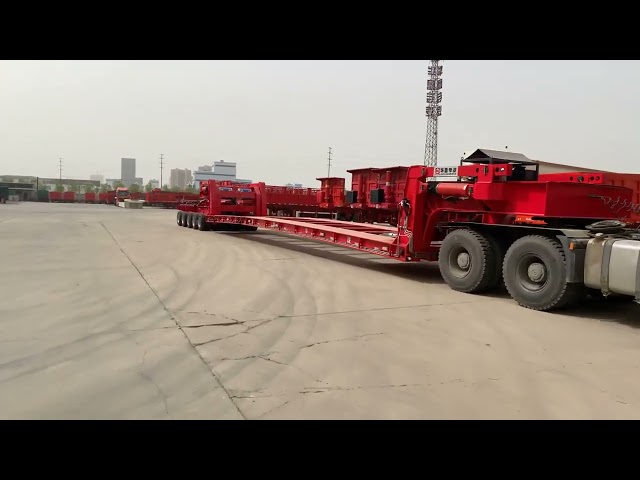
In the Dammam yard of a heavy-equipment haulage contractor, there was a running joke that the welding team never went home early. Every three months, like clockwork, the same 12 lowboy trailers would roll back into the yard with the same diagnosis: fatigue cracks at the deck-to-beam weld seams, caused by the same concentrated track loads from the same 79-tonne hydraulic excavators the company hauled from Jeddah and Dammam ports to the construction sites of NEOM, The Line, and the Red Sea giga-projects. The re-welding took four days per trailer, cost $2,800 per cycle in labour and consumables, and — most damagingly — removed each trailer from service for 96 hours during a construction program that measured schedule delays in millions of dollars per day.
"The NEOM sites don't wait for welds to cool," the company's operations manager told a logistics forum in Riyadh. "They need the excavator on the bench at 06:00, or the whole pour schedule slips. We were the weakest link in a supply chain that had no tolerance for weakness. And the worst part? Everyone in the industry had the same problem. It was accepted. 'Lowboys need re-welding' — that was just a fact of hauling heavy equipment, like tyres wearing out. I never questioned it until I saw a Hualu lowboy come back from 12 months of identical routes with zero cracks."
A hydraulic excavator does not distribute its weight evenly. A 79-tonne machine sits on two tracked undercarriages, and when loaded onto a lowboy trailer, each track transmits its load through a footprint of roughly 2.5 square metres — approximately 40 tonnes concentrated on an area the size of a dining table. Standard lowboy deck plates, fabricated from 5 mm Q345 steel welded to main beams spaced 600 millimetres apart, deflect measurably under this concentration. The company measured the deflection: 6 millimetres per load, every load, on the 12 trailers it had run for five years.
Six millimetres sounds trivial — the thickness of two coins. But it is the deflection cycle that matters, not the magnitude. Each 6 mm deflection is one stress cycle at the weld seam between the deck plate and the main beam. The seam flexes upward under load, relaxes when unloaded, and flexes again on the next load. Over the course of a trailer's life — roughly 1,800 load cycles per year for this contractor — the weld accumulates 3,600 flex cycles annually. Steel fails by fatigue at stress concentrations, and the toe of a weld is the most concentrated stress point in any steel structure. Six millimetres of deflection, repeated 3,600 times a year, is enough to initiate a fatigue crack in Q345 steel within 3–4 months. That is not a maintenance failure. That is a material specification failure.
In September 2024, the company took delivery of 9 Hualu Heavy-Duty Lowboy Trailers, each engineered for concentrated-load haulage with three decisive changes:
| Metric | Conventional Lowboys (12 units, 2019–Aug 2024) | Hualu Lowboys (9 units, Sep 2024–Nov 2025) | Change |
|---|---|---|---|
| Deck sag under 79-tonne load | 6.0 mm | <0.5 mm | -92% |
| Weld repairs per year | ~48 | 0 | -100% |
| Trailer out-of-service days (weld repairs) | ~192/year | 0 | -100% |
| Annual weld maintenance cost | $134,000 | $0 | -100% |
| Fleet availability (uptime) | 81% | 96% | +15 pp |
| Loads delivered per trailer per month | 14.2 | 19.6 | +38% |
| Fleet size required for same volume | 12 | 9 | -25% |
The headline: Zero weld repairs in 15 months, across 9 trailers hauling the same 79-tonne and 120-tonne loads on the same routes that had cracked the legacy fleet every 3 months. Nine Hualu lowboys now deliver the volume that 12 conventional trailers handled — a 25% fleet reduction achieved not by hauling more per trip, but by keeping every trailer in service instead of in the welding bay. "The welders are still on payroll," the operations manager said. "But now they do preventive inspections instead of chasing fatigue cracks. One of them told me he'd forgotten what a crack looked like. That's when I knew the problem was solved."
The same structural principle — eliminate deflection to eliminate fatigue — drove Hualu's End Tipper deployment in Australia's Pilbara, where hydraulic systems were re-engineered for 50°C heat and 3-micron dust, and the Kazakhstan Curtain Side fleet that withstood Central Asian winters by upgrading materials to match the environment. The lesson repeats across every continent: structural failure is almost never caused by the load being too heavy. It is caused by the specification being too light.
Hualu maintains a Middle East after-sales hub in Dammam, Saudi Arabia, with 48-hour parts availability across the Gulf region.