

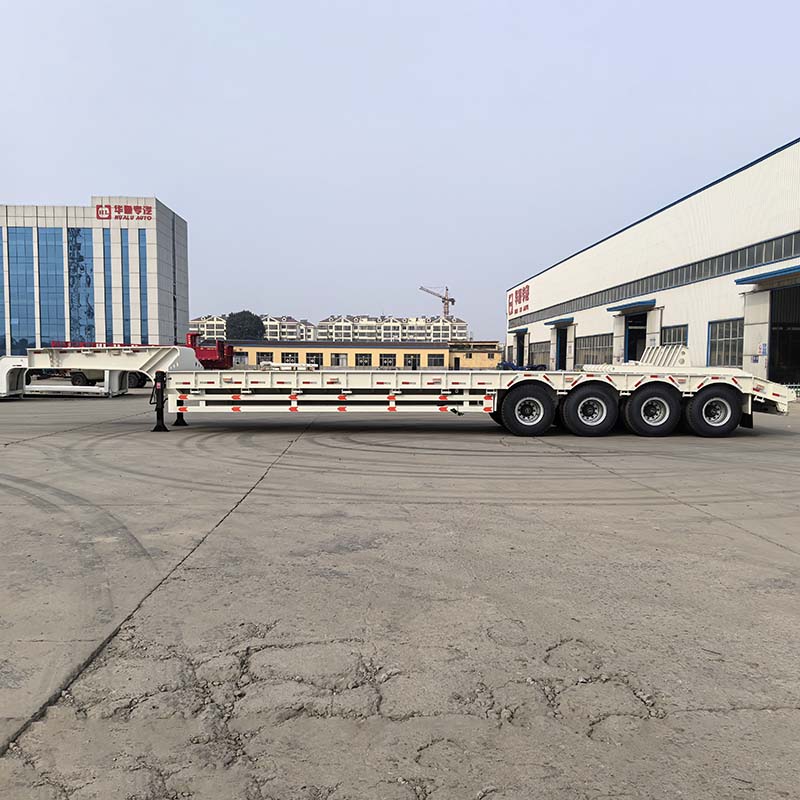
In Ghana's Western Region, the Tema–Tarkwa haul road is a graveyard of broken trailers. A €95 million highway crumbled within months under overloaded trucks hauling 60‑ton excavators. For one equipment operator, conventional lowbeds cracked frames and snapped U‑bolts weekly – each breakdown costing USD 4,500 in repairs and lost time. Then he deployed the Hualu 4‑Axle Lowbed Semi‑Trailer, and the numbers began to shift.
1. The Agona Nkwanta–Tarkwa Corridor – A Road That Eats Trailers
Built for 40‑ton axle loads, this 66‑km route now carries 100‑ton combinations. The surface has disintegrated into craters, exposed rebar, and shifting laterite gravel. Dry season dust fills bearings; wet season potholes become mud traps. The operator's six conventional trailers averaged two breakdowns per week – cracked cross‑members, broken spring hangers, bent kingpins. Each breakdown cost USD 4,500 in towing and repairs, plus a full day of lost haulage. Over six months, that exceeded USD 200,000 in unplanned expenses.
2. Lost Contracts and Idle Excavators – A USD 72,000 Penalty
The hauler served three major mines – Anglogold Ashanti and Golden Star – moving excavators from Tema port. When a lowbed broke down, the excavator sat stranded for days while recovery crews battled the same potholes. Late delivery penalties were USD 8,000 per day. In the first quarter alone, penalties totalled USD 72,000, and one client threatened to cancel a USD 1.2 million yearly contract. Fleet utilisation had slumped to 55% – barely enough to cover operating costs. Mechanics worked overtime welding cracked frames; the old trailers were simply not built for Ghana's brutality.
3. Enter the Hualu 4‑Axle – Reinforced Chassis and Equalising Beams
A prototype arrived, purpose‑built for West African conditions. Its main frame uses high‑tensile steel with double‑box sections, boosting bending resistance by 30% over standard designs. Four equalising beam axles distribute the 60‑ton payload evenly, eliminating stress concentrations that caused fractures on off‑camber sections. U‑bolts are forged alloy steel with corrosion coating; the kingpin is oversized for dusty hook‑and‑unhook cycles. The deck is reinforced under tracked machinery loading points to prevent denting. The operator agreed to a six‑month trial, running the Hualu side‑by‑side with his existing fleet.
4. Six‑Month Trial – Zero Structural Failures vs. Four Frame Repairs
Over 180 days, the Hualu completed 87 laden trips – each hauling a 60‑ton excavator through washboard corrugations, axle‑deep potholes, and sudden downpours that turned laterite to grease. At every inspection, its frame remained straight, suspension hangers intact, axles true. Meanwhile, the conventional fleet suffered four separate frame repairs: two cracked main beams, one broken equaliser bar, and one twisted axle housing. The Hualu logged zero unplanned downtime for structural issues; conventional trailers averaged 3.2 days per repair. Aggregated savings during the trial: USD 18,500 in maintenance and USD 26,000 in avoided penalties – a total of USD 44,500. Normalised for load cycles, the data confirmed a 10% durability gain in fatigue life and impact resistance.
5. The Bottom Line – 40% Less Downtime, Contracts Secured
With the improvement proven, the operator permanently replaced three conventional lowbeds with Hualu units and ordered two more. Fleet utilisation climbed from 55% to 92%, and maintenance downtime fell by 40%. On‑time deliveries rose from 70% to 98%, renewing and expanding the threatened contract. Annual savings exceeded USD 180,000 in repairs, penalties, and lost revenue. Drivers now trust the Hualu; they no longer dread the Agona Nkwanta stretch. In Ghana's mining heartland, where every pothole tests engineering, a 10% ruggedness boost is not just a statistic – it is the margin between survival and success. The road still eats trailers – just not Hualu's.