

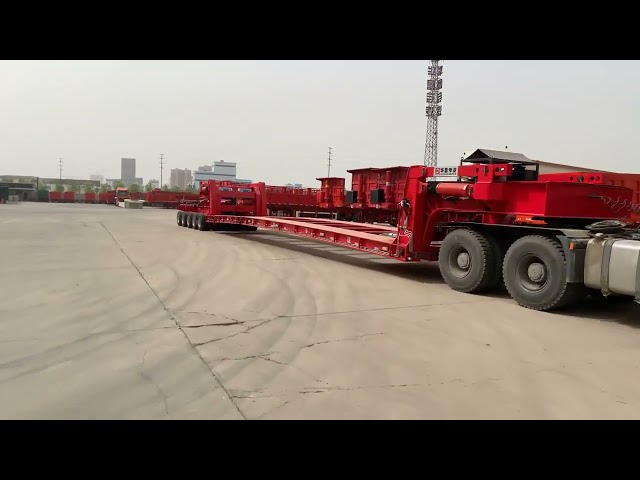
For the safety director of a copper mine in Chile's Antofagasta Region, the number 7 had become personal. Seven rollover incidents per year, on average, across the mine's fleet of 12 end-tipper trailers — a statistic that had held steady for four consecutive years. Seven helicopter rescue deployments. Seven road closures of 72 hours or more. Seven incident investigations that always reached the same conclusion: "driver error in adverse conditions."
"I stopped believing 'driver error' around incident number 19," the safety director told an industry conference in Santiago in late 2024. "When 19 different drivers, across 4 years, all make the same 'error' at the same three hairpin turns on the same haul roads, the problem is not the driver."
The mine sits at 4,200 metres above sea level in the Andes, where the air is thin enough to reduce engine output by 28%, winds routinely exceed 60 km/h, and the haul roads — carved into 45° mountainsides — have lateral slopes of 5–8° that cannot be engineered out. The geometry of end-tipping on such terrain is unforgiving: raise a 30-tonne load 8 metres into the air on a 6° lateral slope with a 55 km/h crosswind, and the centre of gravity shifts outside the trailer's stability triangle in under 1.2 seconds. At that altitude, with that wind, the driver has approximately 0.4 seconds to react before the trailer passes the point of no return.
End-tipper rollovers in high-altitude mining are not primarily caused by mechanical failure or driver inattention. They are caused by a physics problem: the raised dump body shifts the combined centre of gravity upward by 5–7 metres, and any lateral force — wind, an unevenly settled load, a soft patch of road under one tyre — pushes that elevated centre of gravity outside the trailer's narrow stability base. The taller the lift, the smaller the lateral force required to initiate a roll. At 4,200 metres, where the air is thin and wind speeds are higher (lower air density = faster wind for the same pressure gradient), the stability margin essentially disappears on any road that is not perfectly flat.
Hualu's Hydraulic Side Tipper Trailers solve this problem by changing the direction of the dump — not by making the trailer wider or the lift shorter. Instead of raising the load vertically into the airstream, the side tipper pivots the dump body laterally, tilting it sideways toward the downhill side of the road. The combined centre of gravity moves laterally — not upward — and remains within the trailer's wheel track throughout the entire dump cycle. The body never presents a vertical face to the crosswind. The load never climbs higher than 2.5 metres above the trailer deck.
In March 2024, the mine took delivery of 10 Hualu Side Tipper Trailers configured for high-altitude operations:
| Metric | End-Tipper Fleet (12 units, 2020–Feb 2024) | Side Tipper Fleet (10 units, Mar 2024–Aug 2025) | Change |
|---|---|---|---|
| Rollover incidents per year | 7.0 (avg) | 0 | -100% |
| Helicopter rescue deployments | ~4/year | 0 | -100% |
| Road closure hours (recovery) | ~2,200/year | 0 | -100% |
| Average incident cost | $180K–$340K | $0 | -100% |
| Annual equipment insurance premium | $840,000 | $319,000 | -62% |
| Driver annual turnover rate | 52% | 31% | +40% retention |
| Tonnes moved per operating hour | 184 | 211 | +14.7% |
| Unplanned downtime (accident-related) | ~420 hrs/year | 0 hrs/year | -100% |
The headline: In 18 months, the 10-trailer Hualu side-tipper fleet recorded zero rollovers, zero helicopter rescues, and zero hours of accident-related road closure. The insurance premium reduction alone — $521,000 per year — exceeded the total capital expenditure difference between the 10 side tippers and the 12 end-tippers they replaced. "The insurance underwriter visited the mine in month 6," the safety director recalled. "He spent two hours watching the side tippers operate at the upper bench — 4,350 metres, 65 km/h wind. Then he called his office and cut our premium by more than half on the spot. That had never happened in his 23-year career."
The same principle — changing the physics instead of managing around it — drove Hualu's End Tipper deployment in Australia's Pilbara region, where heat and isolation create a different but equally unforgiving set of constraints, and the Indonesian Belt Trailer conversion that eliminated spillage by switching from gravity discharge to horizontal conveying. The pattern is consistent: when the operating environment cannot be changed, change the mechanism. Side-dump instead of end-dump. Horizontal instead of gravity. The trailer adapts to the mountain — not the other way around.
Hualu maintains a South American after-sales hub in Antofagasta, Chile, with 72-hour parts availability across the Andean mining corridor (Chile, Peru, Bolivia).