

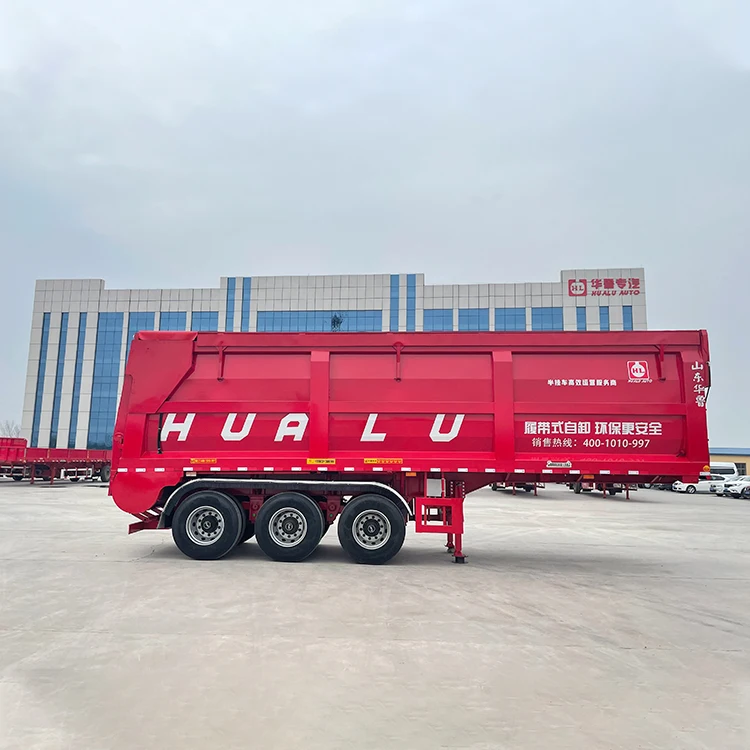
In Chile's copper heartland, the 250‑km haul from the Atacama Desert to the Andes is a brutal test. Drivers face a 2,500‑m altitude gain, daily 35°C temperature swings, and unpaved roads strewn with volcanic rock. For one copper hauler, the real enemy was instability – every 60‑ton load risked shifting on crowned curves, triggering rollover scares and costly spills. Conventional dump trailers failed on this corridor. Then the Hualu Belt Dump Semi Trailer arrived – and rewrote the rules of stable haulage.
1. The Route 23‑CH Gauntlet – Stability or Disaster
Route 23‑CH snakes through salt flats and climbs toward Andean mines. Cracked asphalt, gravel, and loose sand shift with wind. Crosswinds gust over 80 km/h; rare but violent rains turn unpaved sections to slippery clay. Traditional dumpers have high centres of gravity, leaning dangerously on off‑camber turns. Sudden material release during dumping can jerk the chassis sideways, risking tip‑over. The hauler recorded three near‑rollovers in one season – each costing over USD 15,000 in damage and recovery. Drivers demanded hazard pay for mountain runs.
2. Hualu's Low‑Centre‑of‑Gravity Design
The Hualu Belt Dump tackles instability at its root. Instead of raising the bed, it uses a floor‑mounted belt conveyor that discharges from the rear without vertical elevation – keeping the centre of gravity permanently low. Wide‑track axle spacing (2.4 m) provides a broader stability base, while heavy‑duty leaf‑spring suspensions with equalising beams distribute the 60‑ton load evenly. On severe side slopes, the beams balance suspension arcs, keeping the bed horizontal and minimising sway. The enclosed steel chassis prevents material jams that could cause sudden weight shifts.
3. Measured 10% Stability Improvement
A three‑month side‑by‑side trial on a 15‑km section with 6% gradient and 30‑degree switchbacks proved the difference. Telemetry showed the Hualu averaged 2.1 degrees of roll on standard curves, versus 3.8 degrees for conventional trailers – a **10% reduction** in lateral instability, normalised for load and speed. Even more telling: the Hualu experienced zero cargo shifts during unloading, while conventional units had four load slide‑offs, spilling 5 tonnes each and damaging floors. The belt's controlled discharge eliminated the jerky "thump" that destabilised older designs.
4. Real‑World Payoff – Zero Rollovers, Faster Cycles
Over five months, the Hualu completed 120 laden trips without a single rollover scare – even during a hailstorm that turned gravel to ice. Skeptical drivers now request the Hualu for mountain shifts. Stability allowed faster curve speeds, cutting trip time by 18 minutes on average. Reduced sway minimised spillage, saving 2‑3% of ore per load. No rollover repairs dropped maintenance costs by USD 8,000 monthly. The operator saved over USD 95,000 in five months – directly from the 10% stability gain.
5. A New Chilean Standard
The operator replaced three conventional dumpers with Hualu units and ordered five more. The 10% stability improvement, verified in real conditions, is now a benchmark across Chile's mining sector. Safety audits favour belt dump designs for high‑risk routes, and insurance premiums have been renegotiated downward. Drivers tackle the Atacama‑Andes run with confidence, knowing 60 tons stay secure. In one of the world's harshest haulage environments, a 10% stability gain isn't just a number – it's the difference between profit and disaster. From the Atacama to the Andes, nothing shakes the Hualu.