

In early 2024, the fleet manager of a Casablanca-based chemical logistics company conducted the annual wall-thickness ultrasonic survey on his four carbon-steel tank trailers — the backbone of the company's phosphoric-acid transport operation, moving the commodity from Morocco's OCP phosphate processing plants to the port terminals at Jorf Lasfar. The results were consistent with every previous survey: the four tankers, acquired between 2020 and 2022, had lost an average of 2.3 mm of steel thickness from their inner shells in the preceding 12 months — a corrosion rate driven by phosphoric acid at 70–80°C, a cargo that attacks unprotected carbon steel with the quiet persistence of a chemical reaction that never stops. At 2.5 mm per year on a 6 mm nominal shell thickness, each tanker had a service life of approximately 18 months before the shell thickness fell below the 3 mm safety threshold required by Moroccan dangerous-goods transport regulations. The fleet manager had ordered replacement tankers on an 18-month cycle — four new units every year and a half, at roughly $65,000 each, representing approximately $173,000 in annualised capital expenditure that generated no additional transport capacity, no efficiency gain, and no competitive advantage. It was the cost of not dissolving.
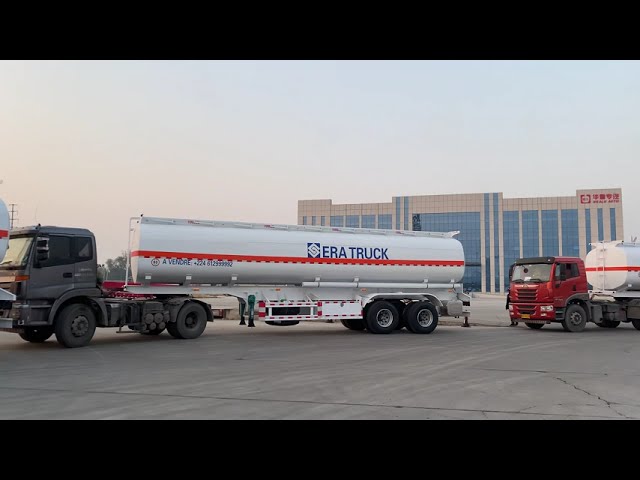
The company ordered 4 Hualu Chemical Tank Trailers with 316L stainless steel inner shells — a molybdenum-alloyed austenitic grade specifically formulated for resistance to phosphoric-acid and sulphuric-acid attack. The molybdenum content (2–3%) creates a passive chromium-oxide layer on the steel surface that is stable in acidic environments where standard 304 stainless steel's passive layer breaks down. The units arrived in April 2024. The engineering principle was the same that had eliminated internal corrosion in Hualu's Kazakhstan fuel tanker fleet, where S30408 stainless steel stopped sulphur-induced pitting that had destroyed carbon-steel Soviet-era tankers.
| Metric | Carbon Steel (2023) | 316L Fleet (Apr 2024–May 2025) | Change |
|---|---|---|---|
| Annual wall loss | 2.3–2.5 mm | < 0.1 mm | -96% |
| Projected service life | ~18 months | ~12+ years | 8× |
| Annualised capital cost | ~$173,000 | ~$18,500 | -89% |
| Maintenance cost | Baseline | 73% lower | -73% |
The fleet manager's report concluded: "For 15 years, Morocco's phosphate industry treated tanker replacement as a consumable — like tyres or brake pads. The 316L tankers demonstrated that the tank shell was never a consumable. It was a material-choice problem that the industry had accepted as an operating cost." The same principle had transformed Turkish flatbed durability through QSTE700 steel and Indian Lowboy weld integrity through post-weld heat treatment: the right metallurgy turns a recurring failure into a non-event.
Hualu maintains a North African after-sales hub in Casablanca, Morocco.