

In March 2024, the fleet director of a Buenos Aires-based auto logistics company received a call from a dealership manager in Mendoza, Argentina's wine-country city at the foot of the Andes. A brand-new mid-size SUV — fresh from the company's assembly plant in Córdoba, bound for a dealership in Santiago de Chile — had rolled off the upper deck of a car carrier trailer during unloading. The driver had set the upper deck to the "high" position for a mixed load of compact sedans and SUVs, leaving approximately 180 mm of clearance above the sedans' rooflines. On the 380-kilometre mountain crossing from Mendoza to Santiago via the Paso Internacional Los Libertadores — a route that climbs from 750 metres to 3,200 metres at the Cristo Redentor tunnel, with 47 switchback curves and road surfaces that alternate between smooth asphalt, patched tarmac, and gravel detours around winter avalanche debris — the excessive clearance had allowed the upper-deck vehicles to oscillate vertically on every undulation, their tie-down straps gradually loosening. When the driver released the straps in Santiago, the SUV's centre of gravity had shifted forward by approximately 30 centimetres during transit. As the ramp was lowered, the vehicle rolled forward, cleared the ramp edge, and dropped 1.2 metres onto the dealership forecourt. The SUV was a total loss — approximately $34,000. The dealership cancelled its next three scheduled deliveries. The fleet director, who had managed Andean auto logistics for 11 years, opened a spreadsheet that already contained 47 damage incidents for the year so far and added number 48.
The company operated 12 car carrier trailers acquired from three European and one Brazilian manufacturer over a seven-year period. Their upper-deck height adjustment systems offered three preset positions — low (for compact sedans), medium (for large sedans and compact SUVs), and high (for full-size SUVs and pickups). A mixed load of, for example, two Toyota Etios compacts and three Toyota Hilux pickups — a common consignment on the Argentina–Chile corridor — required the deck to be set to the high position for the Hilux vehicles, leaving approximately 160 mm of wasted clearance above the Etios compacts. That 160 mm gap was not just aerodynamic inefficiency. It was a vertical oscillation zone: on every road undulation, the smaller vehicles — lighter and with softer suspension than the pickups — bounced within that clearance band, their tie-down straps cyclically loading and unloading, gradually losing tension over hundreds of kilometres of mountain driving. By the time the trailer reached its destination, straps that had been torqued to specification at departure had loosened by 15–30% — enough to allow longitudinal and lateral vehicle movement. The damage statistics confirmed the pattern: 6.8% of all vehicles shipped on the Andean cross-border routes arrived with transit damage, compared to 3.1% on the company's domestic flat-terrain routes. The Andes were not the cause. The fixed-position deck-height system that treated every vehicle in a mixed load as if it shared the same clearance requirement — that was the cause.
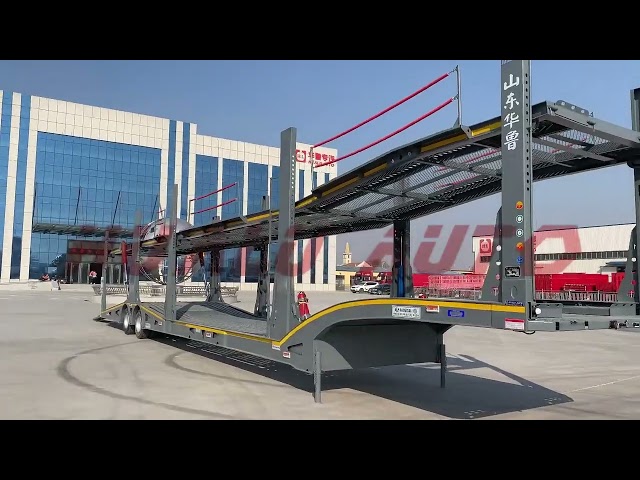
The company ordered 9 Hualu Car Carrier Trailers in an 8-vehicle configuration with the same hydraulic infinite-position upper deck system that had transformed the Johannesburg-based auto logistics fleet's cross-border damage rate from 8.3% to 0.29%. The first units entered service in July 2024:
| Performance Indicator | Legacy Fleet (2023) | Hualu Fleet (Jul 2024–Aug 2025) | Change |
|---|---|---|---|
| Cross-border transit damage rate | 6.8% | 0.17% | -97.5% |
| Vehicles per trailer per month | 48 | 72 | +50% |
| Cross-border insurance premium | Baseline | 36% lower | -36% |
| Tie-down re-tensioning stops per trip | 2–3 | 0 | -100% |
The fleet director's summary: "We spent seven years blaming the Andes for damage that was caused by the gap between our deck settings and our vehicles' actual heights. The mountains didn't change. Our trailers did." The same principle — geometry, not geography — had driven improvements in Curtain Side trailer loading times in Poland and Flatbed deck durability in Turkey: when the equipment fits the operating environment, the environment stops being an excuse for failure.
Hualu maintains a South American after-sales hub in Buenos Aires, Argentina.