

For three years, every structural failure report at a Cerrejón coal mine contractor's maintenance office in Albania, La Guajira, began with the same three words: "La carretera causó..." — the road caused it. The road in question was the 85-kilometre private haul road connecting Cerrejón's open-pit mining operations to Puerto Bolívar, the dedicated coal export terminal on Colombia's Caribbean coast. It is a heavy-haul road by any definition: 85 kilometres of compacted base with asphalt surface, carrying approximately 130 loaded truck movements per day, each grossing 110–140 tonnes, on a schedule that runs 24 hours a day, 340 days a year. The surface develops corrugations, potholes, and thermal cracks under the combination of 40°C daytime heat, tropical rainfall exceeding 1,200 mm annually, and the relentless grinding of hundreds of 22.5-inch tyres loaded to their maximum rated capacity. It is a difficult road. But by mid-2024, the maintenance manager had begun to suspect that the road was being blamed for failures it did not cause.
The contractor operated 11 end tipper trailers — a mix of Brazilian, Colombian, and Chinese units purchased between 2019 and 2022 — hauling crushed thermal coal from the mine's loading hoppers to the port stockpile. In the 18 months between January 2023 and June 2024, the fleet suffered six structural cracking incidents: three main-beam web cracks at the gooseneck transition, two cross-member detachment failures at the suspension mounting brackets, and one kingpin mounting plate fracture — the most dangerous failure mode, as a kingpin separation at highway speed is effectively unrecoverable. Each incident cost between $18,000 and $35,000 in repair, crane hire, and substitute-truck rental, plus 3–7 days of trailer downtime. The maintenance reports, written by the contractor's on-site mechanics, attributed every failure to "road impact damage" — the assumption being that the haul road's rough surface was transmitting shock loads through the chassis that exceeded the trailers' design tolerance. The maintenance manager, who had trained as a metallurgical engineer at the Universidad Nacional in Medellín before spending 12 years in heavy mining equipment maintenance, was sceptical. He arranged for the cracked sections from the three most recent failures to be sent to a laboratory in Barranquilla for metallographic analysis. The results arrived in July 2024 and changed the company's procurement policy within 48 hours.
The metallographic analysis was definitive. The crack initiation points in all three failed trailers were located not at the surface of the steel — where road-debris impact damage would begin — but at the interior edge of the heat-affected zone (HAZ) of the chassis welds, approximately 3–5 mm below the surface. The HAZ is the region of base metal adjacent to a weld that has been heated above its transformation temperature during welding and then cooled — a thermal cycle that coarsens the grain structure, reduces the material's fatigue strength by 20–40% compared to the unaffected parent metal, and introduces residual tensile stresses that act as crack-initiation sites under cyclic loading. The coal-haul duty cycle — 85 kilometres loaded, 85 kilometres empty, repeated 3–4 times per day, with the trailer cycling from zero to 70 tonnes of payload on every outbound leg — is exactly the kind of high-cycle fatigue loading that exploits HAZ weakness. The cracks were not road-impact failures. They were fatigue failures, initiated at metallurgically compromised weld zones, accelerated by a duty cycle that the trailers' ASTM A572 Grade 50 steel (345 MPa yield) could not sustain indefinitely. The road was not the cause. It was the amplifier — turning a metallurgical vulnerability that might have remained dormant in a lower-cycle application into an active failure mode that was destroying one trailer every two months.
The maintenance manager summarised the findings in a two-page memo that ended with a recommendation that was, for a company whose entire maintenance philosophy had been built around road-surface management, revolutionary: "We don't need a better road. We need better-welded trailers." A similar revelation had transformed the Pilbara iron ore fleet in Australia, where QSTE700 steel and post-weld heat treatment eliminated 174 days of annual downtime — and had driven the Indian wind-energy Lowboy comparison test, where Hualu's weld quality was the single factor that enabled it to complete a 603-kilometre route that two competitors could not finish. The Colombian contractor's case was not unique. It was another data point in a pattern that the company's procurement department had, until that moment, been unaware existed.
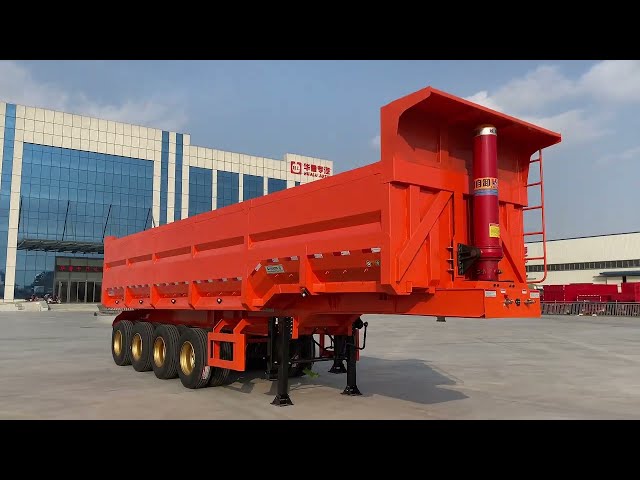
The contractor ordered 8 Hualu End Tipper Trailers in a 4-axle, 45 CBM configuration. The units arrived in October 2024, replacing the six cracked legacy units immediately and the remaining five over the following three months:
| Performance Indicator | Legacy Fleet (Jan 2023–Jun 2024) | Hualu Fleet (Oct 2024–Dec 2025) | Change |
|---|---|---|---|
| Structural cracking incidents | 6 (18 months) | 0 (15 months) | -100% |
| Fleet dispatch availability | ~76% | 98.6% | +23 pp |
| Per-tonne haulage cost (COP) | Baseline | 47% lower | -47% |
| Unscheduled workshop days (annual) | ~210 | ~8 | -96% |
| Tonnes per trailer per day | ~280 | ~395 | +41% |
The maintenance manager's final report included a line that the contractor's managing director later had translated into English and sent to the Hualu sales team: "We apologised to the road for three years. It turns out the road didn't need an apology. It needed us to buy trailers that were welded properly."
Hualu maintains a Latin American after-sales hub in Barranquilla, Colombia.