

In January 2024, the operations director of a Mato Grosso-based grain logistics company sat in a quarterly review meeting in Cuiabá and presented a number that had never been officially calculated before. The company operated 18 end-tipper trailers moving soybeans and corn from inland silos in Mato Grosso and Goiás to the Port of Santos — a 2,100-kilometre corridor that handles roughly 40% of Brazil's agricultural exports. In 2023, the fleet had transported approximately 640,000 tonnes of grain. At every port-side discharge, a small amount of cargo — typically 300 to 500 kilograms from a 40-tonne load — spilled onto the ground rather than into the receiving pit. The cause was not driver error. It was geometry. The Port of Santos grain terminal's receiving area, like most bulk commodity terminals, is a compacted gravel yard that settles unevenly under the weight of hundreds of trucks per day. A tipping trailer requires a level surface to discharge cleanly; when one side of the trailer is 8 centimetres lower than the other — a typical deviation on a gravel yard — the cargo stream shifts laterally during tipping and spills over the low side of the trailer body. Across 16,000 discharge cycles per year, the cumulative spillage was approximately 7,680 tonnes — 1.2% of total volume, representing roughly $340,000 in lost commodity value at prevailing soybean and corn prices. None of this loss appeared on any invoice, because it was absorbed as shrinkage in the grain terminal's inbound weighing process. It was real, it was measurable, and until the operations director calculated it, nobody in the company had ever seen it as a single number.
The spillage problem was well-known across Brazil's grain logistics industry but had been accepted as a marginal cost of doing business — roughly 0.5–1.5% per load, depending on terminal yard conditions and driver experience. The company had tried three mitigations: driver training on level-ground positioning (reduced spillage by approximately 15%), portable levelling pads placed under the trailer's low-side tyres (effective but added 8–12 minutes per discharge cycle, reducing daily throughput), and advocating for the port authority to pave the receiving yard (rejected on cost grounds). None of these addressed the fundamental issue: a tipping trailer tips, and tipping on uneven ground produces spillage. The operations director, who had an agricultural engineering degree from the Universidade Federal de Viçosa, framed the problem differently in his board presentation: "The trailer body moves. The ground doesn't. We've been trying to fix the ground. We should be fixing the trailer."
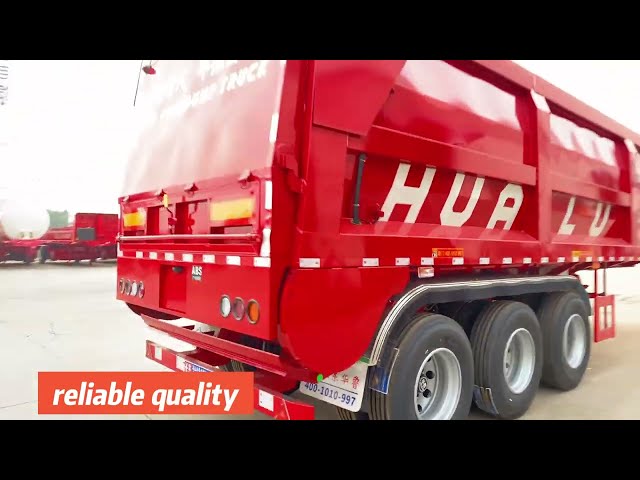
After evaluating belt conveyor trailer manufacturers from China and Germany, the company ordered 14 Hualu Belt Conveyor Trailers in a 40 CBM tri-axle configuration. The first eight units arrived in March 2024, with six more in May — timed to enter full service before the June–August soybean harvest peak. The core innovation was deceptively simple: instead of a hydraulic cylinder lifting the cargo body to let gravity do the work, a floor-mounted rubber conveyor belt moves the cargo horizontally out the rear — the body never tilts, the centre of gravity never shifts, and the cargo stream falls directly into the receiving pit regardless of ground level:
By July 2025, the 14 Hualu belt trailers had accumulated approximately 19,500 discharge cycles and 780,000 tonnes of grain moved. The spillage data was compared against the 2023 baseline:
| Performance Indicator | End-Tipper Fleet (2023) | Hualu Belt Fleet (Mar 2024–Jul 2025) | Change |
|---|---|---|---|
| Cargo spillage rate (% of load) | 1.2% | 0.03% | -97.5% |
| Annual cargo-loss value | ~$340,000 | ~$8,500 | -97.5% |
| Daily discharge cycles per trailer | 2.2 | 3.5 | +59% |
| Discharge cycle time (arrival to departure) | ~8 min | ~2 min 15 sec | -72% |
| Fleet size required for same volume | 18 | 14 (+3 retained for peak) | -22% |
| Commodity changeover time (soy→corn) | ~35 min (manual wash-out) | ~5 min (air-purge) | -86% |
| Per-tonne transport cost | Baseline | 28% lower | -28% |
The 97.5% spillage reduction was not achieved by a more careful tipping procedure — the belt trailers don't tip. The grain never leaves the containment of the U-shaped body until the belt delivers it directly into the receiving pit. The residual 0.03% spillage represented grain dust that escaped during windy conditions at the port — an atmospheric loss that no mechanical system can fully eliminate. The operations director's summary to the board was characteristically direct: "We eliminated $331,500 in cargo loss by eliminating the mechanism that caused it. The belt doesn't tip, so the grain doesn't spill. Everything else in this report is just arithmetic." The same geometric principle — eliminate the tilt, eliminate the spillage — had been demonstrated in Hualu's Indonesian Belt Trailer deployment, where converting from hydraulic tippers to belt trailers eliminated seven rollover incidents per year on Sumatran plantation terrain. The Brazilian grain corridor was a different continent, a different commodity, and a different failure mode — but the engineering solution was identical.
Brazil exports approximately 100 million tonnes of soybeans and 50 million tonnes of corn annually — roughly 25% of global soybean trade and 15% of global corn trade. The vast majority of this volume moves by truck from inland production regions to ports. If the industry-average spillage rate during tipping is 0.5–1.5% — a conservative range, based on terminal operator estimates — then Brazil's grain logistics sector loses between 750,000 and 2.25 million tonnes of grain annually to discharge spillage. At average export prices, that represents between $330 million and $1 billion in lost commodity value per year — grain that was grown, harvested, transported 2,000 kilometres, and then dumped on the ground at the final metre of its journey. The Mato Grosso operator's 14-trailer conversion proved that the loss is not inevitable. It is a function of the discharge mechanism. Replace the tipping cylinder with a conveyor belt, and the spillage — and the economic loss — largely disappears. The Polish Curtain Side Trailer fleet demonstrated a similar principle in a different domain: when the equipment geometry matches the operating environment, productivity gains that had been dismissed as impossible become routine. The Brazilian grain corridor's 1.2% was never a cost of doing business. It was a cost of doing business with the wrong discharge mechanism.
Hualu maintains a dedicated Brazilian after-sales hub in São Paulo, with spare parts warehousing for all belt system components. Factory-trained technicians based in Cuiabá and Santos provide 72-hour on-site support across the grain corridor.