

In early 2024, the operations manager of a Dubai-based third-party logistics company operating out of Jebel Ali Port — the busiest container port in the Middle East, handling over 14 million TEU annually — tracked a metric that wasn't on any of the company's official dashboards. Every morning, between 07:00 and 11:00, an average of seven of the company's 15 box trailers sat stationary in the loading queue at the company's Jebel Ali Free Zone warehouse. They were not broken. They were not waiting for cargo. They were waiting for a loading dock. The warehouse had four dock doors. Each trailer took approximately 42 minutes to load — 22 minutes of actual forklift operation, plus 20 minutes of repositioning, re-stacking, and waiting while a single forklift navigated the 13.6-metre tunnel of a rear-door-only box trailer. With four docks and 15 trailers each requiring 2–3 loading cycles per day, the queue was mathematically inevitable. The operations manager calculated that the company was losing approximately 90 minutes of productive time per trailer per day — not to traffic, not to customs, but to the geometry of loading through a single rear door.
The financial consequence was well-understood but had been accepted as a fixed cost of Jebel Ali operations: at the port's prevailing drayage rates and the company's average revenue of approximately AED 1,850 (~$500) per port run, each lost trailer cycle represented roughly 0.4 runs per day. Across 15 trailers operating 300 days per year, the queue was costing approximately AED 3.3 million (~$900,000) in unrealised annual revenue — not counting the overtime paid to drivers who started their shifts at 06:00 but couldn't complete their third run until after 19:00 because the morning queue pushed their entire schedule forward. The company had tried staggering shifts, adding a fifth dock door (rejected by the free zone authority due to space constraints), and pre-loading trailers overnight (rejected by clients whose cargo wasn't ready until morning). Every solution hit the same wall: a box trailer has one door, one door means one forklift, and one forklift means a queue.
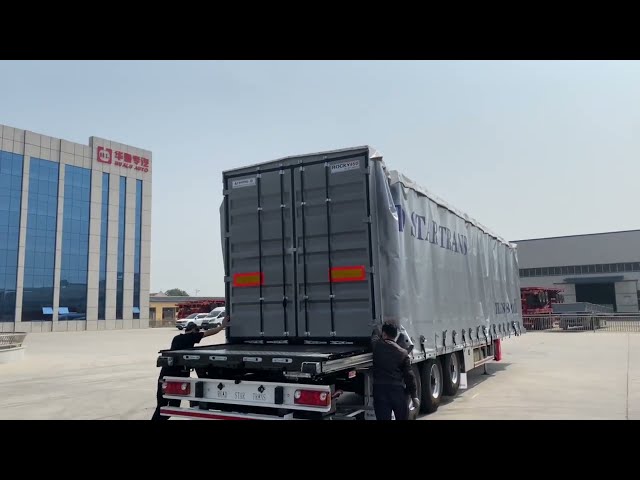
The operations manager first saw a curtain-side trailer at a logistics expo in Dubai World Trade Centre. The demonstrator had both side curtains rolled up, revealing the full 13.6-metre cargo bed accessible from either side, with a forklift loading from the left while another unloaded from the right — two machines working simultaneously on the same trailer. A sliding roof panel was retracted, and an overhead gantry crane was lowering a 4-tonne machinery crate directly onto the deck. The entire loading demonstration took 11 minutes. The operations manager returned to Jebel Ali with a single photograph on his phone and a question for his procurement team: "Who builds these for the throughput we need?"
After evaluating manufacturers from China, Turkey, and Europe, the company ordered 11 Hualu Curtain Roll Trailers — a configuration with full-length roll-up PVC curtains on both sides, a sliding roof for overhead access, and the same 13.6-metre deck length as the box trailers they replaced. The first six units entered service in April 2024, with five more following in June:
By January 2025, the 11 Hualu Curtain Roll Trailers had accumulated approximately 8,400 port runs between Jebel Ali and destinations across the UAE. The fleet data was compared against the January–March 2024 baseline — the last quarter of box-trailer-only operation:
| Performance Indicator | Box Trailers (Q1 2024) | Curtain Roll Fleet (Apr–Dec 2024) | Change |
|---|---|---|---|
| Avg dock-to-departure time | 42 min | 19 min | -55% |
| Daily port runs per trailer | 2.4 | 3.8 | +58% |
| Cargo damage during loading | 2.1% of shipments | 0.04% | -98% |
| Trailers queued at 09:00 (daily avg) | 7 | 1.2 | -83% |
| Annual revenue per trailer (AED) | Baseline | +49% | +49% |
| Driver overtime (monthly hours, fleet) | ~280 | ~85 | -70% |
| Curtain maintenance events (annual) | N/A (box trailers) | 2 (tension adjustment only) | Negligible |
The 55% dock-time reduction was the structural driver of every subsequent improvement. The company's warehouse had not changed — four dock doors, same free zone building, same number of forklifts. What changed was that the curtain roll trailers could be loaded from both sides simultaneously by two forklifts, halving the effective loading time even before accounting for the eliminated repositioning delays. The sliding roof added a third loading vector: cargo that previously required a separate flatbed trailer and crane bay could now be loaded directly into a curtain roll trailer at the same dock position. The 49% per-trailer revenue increase — achieved without adding a single tractor unit, driver, or dock door — was, as the operations manager described it in the quarterly review, "the cheapest capacity we've ever created." A similar transformation was documented at the Polish cross-border fleet where Curtain Side Trailers cut warehouse dwell time by 45% — the same geometric principle, applied to European palletised logistics rather than Middle Eastern port drayage.
Jebel Ali Port operates under a throughput pressure that few logistics environments can match. With over 14 million TEU moved annually, the port's free zone warehouses and distribution centres process approximately 38,000 container movements per day. A trailer that occupies a dock door for 42 minutes instead of 19 minutes is not just slower — it consumes a scarce resource (dock time) that is shared across thousands of daily transactions. At the scale of Jebel Ali's logistics ecosystem, a 23-minute-per-trailer loading-time saving, multiplied across the hundreds of trailers that serve the free zone daily, represents tens of thousands of hours of recovered dock capacity per year — capacity that requires no new construction, no regulatory approval, and no capital expenditure beyond the trailer specification decision. The Dubai company's 11-trailer conversion demonstrated that the bottleneck was never the warehouse. It was the trailer door count. The Indonesian Belt Trailer fleet that eliminated hydraulic tipping rollovers demonstrated the same principle in a completely different operating context: when the equipment geometry matches the operating environment, bottlenecks that had been accepted as structural constraints simply disappear.
Hualu maintains a dedicated GCC after-sales hub in Dubai, UAE, with spare parts warehousing for all curtain roll system components, running gear, and load-securing hardware. Factory-trained technicians based in Jebel Ali and Abu Dhabi provide 24-hour on-site support across the UAE. All common wear items are stocked for same-day dispatch.