

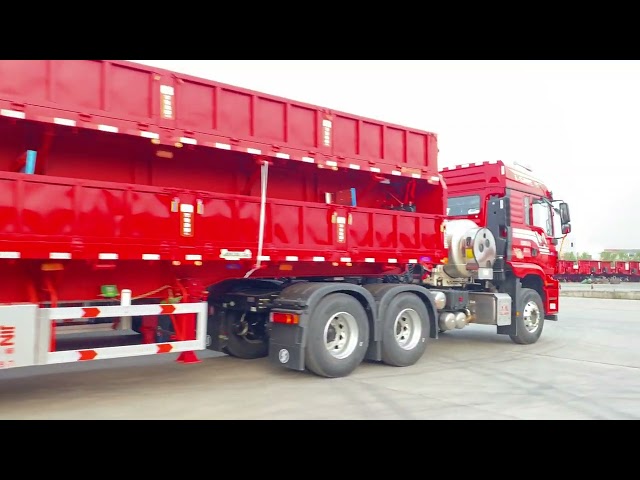
In March 2023, the fleet manager of a Nairobi-based agricultural logistics company walked through his equipment depot in the industrial zone off Mombasa Road at 05:30, as he had done every morning for eight years. The depot held 22 trailers in three distinct configurations: seven curtain-side units for bagged NPK fertiliser and certified seed — the company's core business during the February–April long-rains planting season; nine flatbed trailers for bulk maize, coffee, and tea — the May–September harvest season backbone; and six open-top bin trailers for sugarcane bagasse, silage, and chopped Napier grass — the year-round livestock-feed business that filled gaps between planting and harvest. In March, the curtain-side units were running at full capacity. The flatbeds and bin trailers were running at roughly 30% — a seasonal trough that happened every year, in a different configuration, depending on which cargo season was peaking. The fleet manager had calculated that across any 12-month period, approximately 40% of the company's trailer capacity sat idle — not because of a lack of demand, but because the demand, at any given moment, was for a trailer configuration that 60% of the fleet was not.
The financial arithmetic was punishing. A trailer that sits idle for 146 days per year — 40% of 365 — still depreciates, still requires insurance, still occupies depot space, and still ties up capital that could be deployed elsewhere. The company's per-trailer annual revenue averaged approximately 4.8 million Kenyan shillings (~$33,000), but the trailers themselves cost between 2.8 and 4.2 million KES depending on configuration. At 40% idle time, the effective revenue-generating utilisation was roughly 2.9 million KES per trailer per year — barely covering depreciation and maintenance on the higher-cost units. The company was running a fleet that was large enough to handle peak-season demand for all three cargo types simultaneously, a situation that occurred on exactly zero days per year. The fleet manager, who held an operations research degree from the University of Nairobi, had reduced the problem to a single sentence in his quarterly board memo: "We are sized for a peak that never arrives."
This was the agricultural logistics paradox that had shaped the company's equipment decisions since its founding. Unlike the single-commodity bulk haulage operations that defined mining logistics — where the Pilbara end tipper fleet in Australia moved one material type (iron ore) year-round — agricultural logistics in East Africa handles multiple cargo types with fundamentally different physical characteristics, each peaking in a different season. Fertiliser is dense, bagged, and weather-sensitive. Maize is medium-density, bulk, and moderately weather-sensitive. Sugarcane bagasse is low-density, extremely bulky, and requires side containment to prevent shedding on highway sections. A trailer that excels at one is suboptimal for the others. The traditional solution — operate one trailer type per cargo profile and accept the seasonal idle — was the solution the company had inherited. It was not the solution the fleet manager believed was the only option.
After evaluating multi-purpose trailer configurations from Chinese, Indian, and Turkish manufacturers, the company ordered 14 Hualu Fence Trailers in a tri-axle configuration in April 2024. The design was not a catalogue product — it was a configuration specified around the company's three-cargo requirement, with the following key features that enabled one trailer to serve all three cargo profiles:
The 14 Hualu fence trailers entered service between May and July 2024, replacing all seven curtain-side units, six of the nine flatbeds, and four of the six bin trailers — a reduction from 22 to 14 trailers (plus three legacy flatbeds and two bin trailers retained for peak-overflow). The fleet management data covering the 15-month period from August 2024 to October 2025 told a story of seasonal-idle elimination:
| Performance Indicator | Three-Type Fleet (2023 Baseline) | Hualu Fence Fleet (Aug 2024–Oct 2025) | Change |
|---|---|---|---|
| Average fleet utilisation (any given day) | ~60% | ~94% | +34 pp |
| Total fleet size | 22 | 19 (14 Hualu + 5 retained legacy) | -14% |
| Annual freight volume (tonnes) | ~94,000 | ~115,000 | +22% |
| Per-trailer annual revenue (KES) | ~4.8M | ~8.1M | +68% |
| Per-tonne transport cost (KES) | Baseline | 31% lower | -31% |
| Cross-contamination incidents (fertiliser/grain) | 9 per year | 1 | -89% |
| Trailer switchover time (between cargo types) | N/A (used different trailers) | ~22 minutes (remove rails, swap plywood) | New capability |
| Annual maintenance cost per trailer (KES) | Baseline | 43% lower | -43% |
The 68% per-trailer revenue increase was not a productivity gain in the conventional sense — the trailers were not moving faster or carrying more per trip. It was a utilisation gain. A trailer that previously sat idle for 146 days per year was now idle for approximately 22 days per year — the 124-day difference representing days that were now generating revenue instead of generating depreciation. When the fleet manager presented the data to the board, he titled the slide "We Didn't Buy More Capacity. We Stopped Wasting the Capacity We Had." The board approved the full conversion of the remaining five legacy trailers to Hualu fence units before the end of the meeting.
The cross-contamination improvement — from 9 incidents per year to 1 — was driven by the removable plywood deck overlay. Under the legacy system, a flatbed that had transported bagged fertiliser one day and bulk maize the next carried residual fertiliser dust in the deck-plate crevices that contaminated the maize load. The plywood overlay, installed in under 5 minutes and stored in a dedicated under-deck compartment, provided a clean separation surface that eliminated the problem without requiring a trailer wash-out that, in water-scarce Nairobi, was both expensive and environmentally problematic. The single remaining incident occurred when a driver skipped the plywood installation on a tight schedule — a procedural failure, not an equipment failure, addressed through a revised pre-loading checklist. The Indonesian belt trailer deployment in Sumatra demonstrated a similar cross-contamination solution — polished Hardox surfaces reducing fertiliser residue to negligible levels — but the fence trailer's plywood-overlay approach was simpler, cheaper, and required no specialised manufacturing process beyond the deck-compartment integration.
Agricultural logistics in East Africa operates on a calendar dictated by rainfall, not by customer orders. The long-rains planting season (March–May) generates massive fertiliser and seed movement from warehouses to rural distribution points across Kenya, Uganda, and Tanzania. The harvest season (June–September) reverses the flow, moving maize, coffee, tea, and beans from rural collection points to urban processing facilities and export terminals. The short-rains season (October–December) creates a secondary planting peak. The dry season (January–February) is when infrastructure maintenance, equipment transport, and livestock-feed logistics fill the gaps. A trailer type that can only serve one of these four seasonal cargo profiles will, by definition, be idle for approximately three of the four seasons. The traditional industry solution — maintain a large, mixed fleet — is an economic solution only when trailers are cheap relative to the cost of idle capital. As trailer costs have risen with the global shift toward higher-grade steel, better suspension, and electronic braking, the economics of the mixed-fleet model have deteriorated. The single-configuration, multi-cargo trailer — Hualu's fence design with removable rails, convertible tarp, and adjustable load-securing — is not just an operational improvement. It is a structural response to the economic reality that trailer capital now costs more than the idle time it was previously used to absorb.
The fleet manager, in his final report before the board approved the full Hualu conversion, included a line that the managing director later had framed and hung in the company's dispatch office: "A trailer that can only do one thing will be unemployed for three-quarters of its life. We stopped buying unemployed trailers." The same logic — that multi-cargo capability is not a luxury feature but a utilisation-rate requirement — applies with equal force to agricultural logistics operations across sub-Saharan Africa, Southeast Asia, and South America, where seasonal crop cycles create the same equipment-idle pattern that the Nairobi company had accepted as normal for eight years. The Turkish flatbed fleet in Iskenderun demonstrated that structural reliability — not fleet size — was the binding constraint on steel logistics productivity. The Nairobi fence trailer deployment demonstrated the complementary principle: that cargo flexibility — not dedicated specialisation — was the binding constraint on agricultural logistics productivity. Both principles converge on the same engineering conclusion: the trailer that does one thing well and nothing else is an increasingly expensive way to move anything.
Hualu maintains a dedicated East African after-sales hub in Nairobi, Kenya, with spare parts warehousing for all fence trailer system components, running gear, and load-securing hardware. Factory-trained technicians based in Nairobi and Mombasa provide 72-hour on-site support across the East African Community region. All common wear items — side stakes, tarp covers, lashing rings, brake pads, and suspension components — are stocked for same-day dispatch within Kenya.