

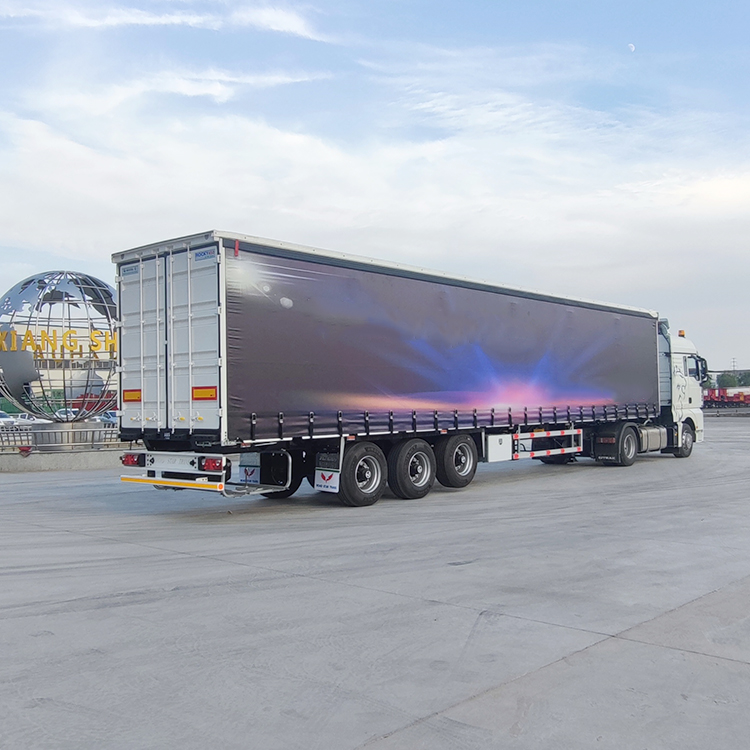
In Brazil's fiercely competitive freight market, one national logistics operator faced a chronic problem that many carriers know all too well: valuable cargo space going to waste. Standard curtain trailers, with their rigid dimensions and inefficient interior layouts, were forcing the company to run extra trips, burn excessive fuel, and watch profit margins erode with every underfilled load. The solution arrived in the form of 160 custom-built 3-axle curtain trailers from Hualu—a fleet-wide transformation that didn't just add space but fundamentally rewired the economics of their entire operation. What followed was a measurable leap in performance: a 20% utilization gain and a 16% surge in net profits, proving that in logistics, the cubic meter you save is the revenue you earn.
1. The Space Problem That Was Costing Millions
Before the Hualu trailers arrived, the operator's fleet of standard equipment was hemorrhaging potential revenue with every dispatch. Their existing trailers maxed out at around 90 m³, but the real inefficiency lay in how that space was used—awkward interior dimensions meant pallets didn't stack cleanly, irregular cargo left dead zones, and load distribution was a daily guessing game. The company was dispatching 10 to 12 trucks per route just to cover what should have been a 9-truck job, and fuel costs per ton of freight delivered were climbing steadily. For a fleet moving thousands of tons monthly across Brazil's vast highway network, that waste translated into seven-figure losses annually. The logistics director knew they couldn't grow their way out of the problem—they had to haul smarter.
2. 160 Trailers, One Bold Decision
Rather than incrementally upgrading a few units, the operator made a decisive bet on scale: a single order of 160 Hualu 3-axle curtain trailers, customized to their exact freight profiles. Hualu's engineering team worked closely with the carrier to map out their typical cargo mix—everything from automotive parts to consumer goods to bulk agricultural products—and tailored each trailer's interior configuration accordingly. The result was a fleet of trailers offering flexible cargo volumes ranging from 100 m³ to over 120 m³ per unit, with adjustable load-securing tracks, multi-position curtain openings, and reinforced flooring that could handle concentrated heavy loads without compromising structural integrity. Every trailer was built to the same exacting standard: durable European-spec axles, corrosion-resistant side rails for Brazil's humid coastal routes, and a curtain system that could be fully opened in under two minutes for rapid loading and unloading.
3. 20% Utilization Gain—From Better Design, Not Just Bigger Boxes
The utilization improvement didn't come from simply packing more volume into a larger box—it came from smarter design that eliminated the dead spaces standard trailers couldn't avoid. With Hualu's optimized interior dimensions, the operator's load planners could now fit two additional pallet rows per trailer without compromising weight distribution or safety. The adjustable load tracks allowed mixed-height cargo to be stacked securely, turning previously unusable overhead space into productive capacity. One route that previously required 11 trailers to move a specific monthly volume now moved the same freight with just 9 trailers—a 22% reduction in truck count for that lane. Across the entire 160-trailer fleet, the average utilization rate climbed from 78% to over 94%, meaning more tons of cargo were moving per kilometer traveled, per liter of diesel burned, and per hour of driver time logged.
4. 16% Profit Surge—The Math Behind the Margin
The financial impact was immediate and unmistakable. With fewer trips required to move the same volume of freight, the operator slashed fuel consumption by nearly 18% on key long-haul routes connecting São Paulo to the northeastern export hubs. Maintenance costs dropped as well—fewer total miles driven meant less wear on tires, brakes, and running gear across the fleet. Driver utilization improved too, with the same number of drivers covering more cargo volume per shift, effectively boosting labor productivity without adding headcount. When the operator's finance team ran the numbers after six months of full deployment, the bottom-line improvement was stark: net profit margins had expanded by 16% compared to the same period the previous year. That wasn't a one-time efficiency gain—it was a structural shift in the economics of every load they carried.
5. From Idle Volume to Competitive Firepower
Today, that 160-trailer fleet has become the operator's single greatest competitive advantage. Where competitors are still dispatching underfilled rigs and absorbing the cost of wasted space, this carrier is moving more freight with fewer assets, quoting faster delivery timelines, and winning contracts that demand both reliability and cost efficiency. The Hualu trailers have held up to Brazil's punishing road conditions—the 3-axle configuration provides exceptional stability on uneven terrain, and the corrosion-resistant build has shown zero structural issues after thousands of kilometers of coastal runs. More importantly, the operator has built a new operational playbook around the trailers' flexibility, dynamically reconfiguring loads to match last-minute customer orders without sacrificing utilization. What started as a fleet replacement has become a strategic weapon—proof that in freight transport, the space you stop wasting is the profit you start keeping.