

On a humid August night in 2024, the operations director of an Iskenderun-based steel logistics company — Turkey's largest private transporter of long steel products, moving rebar, structural beams, and pipe from the country's southern steel mills to construction sites across Anatolia and the Marmara region — received an email from the project manager of the Çanakkale 1915 Bridge approach road consortium. The subject line was two words: "Delivery Status." The body was shorter: the consortium had invoked the liquidated-damages clause of the supply contract after the company's third late delivery in five weeks. The penalty rate was 0.15% of the undelivered tonnage value per calendar day — approximately $4,100 per day at the current shortfall. The contract required 14,000 tonnes of reinforcing steel delivered over nine months, from July 2024 to March 2025. By 23:47 on August 14, only 1,840 tonnes had been delivered against a scheduled 2,800 tonnes. The shortfall was not a demand problem. It was an equipment problem.
The company operated 16 flatbed trailers acquired over a seven-year period from three Turkish and two European manufacturers. These were not old trailers by industry standards — the oldest was a 2016 model — but they were the wrong trailers for the duty cycle. Long steel products — 12-metre rebar bundles, 18-metre structural beams, and nested pipe sections — concentrate their weight on a narrow contact area. A 26-tonne rebar bundle resting on two dunnage timbers applies approximately 13 tonnes of load through each timber's contact patch of roughly 0.3 square metres, generating a ground pressure of 43 tonnes per square metre — roughly equivalent to the footprint pressure of a fully loaded 40-tonne excavator, concentrated on a deck plate designed for distributed cargo. Over hundreds of loading cycles, the concentrated loading deformed the deck plates of the legacy fleet between the cross-members — an 8 mm steel plate that should remain flat for its service life developed permanent depressions of 12–18 mm, creating stress concentrations at the deformation boundaries that initiated cracks in the underlying cross-member welds. In the eight months between January and August 2024, the fleet accumulated 19 deck-plate buckling incidents requiring workshop straightening or plate replacement, and 7 main-beam web cracks at cross-member attachment points — failures that had been rare in the company's first decade of operation but were now occurring at a rate of more than three per month.
This pattern — deck deformation driving structural cracking — was not unique to this fleet. Similar failure modes had been documented across heavy steel logistics operations globally, including the structural cracking that Hualu's QSTE700 chassis eliminated in the Pilbara iron ore haulage fleet in Australia, where 174 days of combined downtime were reduced to near-zero through the same steel-grade upgrade. The Iskenderun fleet director had read that case study. At 23:52 on August 14, he forwarded it to the managing director with a note: "This is what we need — but for flatbeds, not tippers."
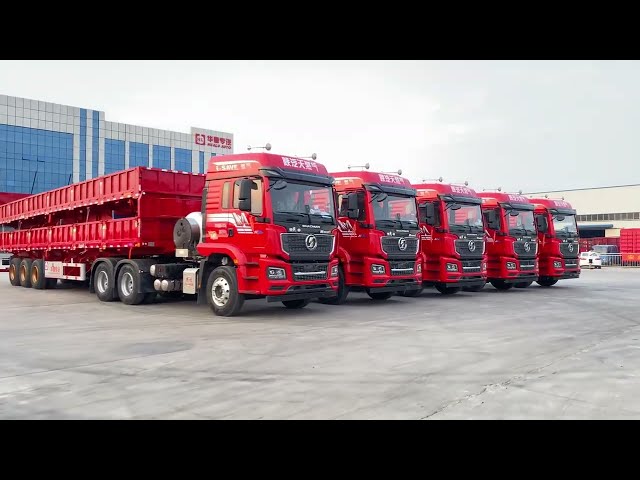
After an accelerated two-week evaluation — constrained by the daily accrual of contract penalties — the company ordered 12 Hualu Flatbed Trailers in a 13.6-metre tri-axle configuration. The first six units were air-freighted as knocked-down kits to Istanbul and assembled at Hualu's Turkish distributor facility in Gebze, entering service on September 22, 2024 — 38 days after the penalty-triggering email. The remaining six arrived by container vessel in October. The specification was not the standard Hualu flatbed catalogue — it was tailored for concentrated long-steel loading based on the failure analysis of the legacy fleet:
The 12 Hualu flatbeds entered service between September 22 and October 28, 2024. The project's final steel delivery was made on March 14, 2025 — two weeks ahead of the contractual deadline. The fleet management data, comparing the seven-month contract period against the eight-month pre-Hualu period, told a story of structural elimination rather than incremental improvement:
| Performance Indicator | Legacy Mixed Fleet (Jan–Aug 2024) | Hualu Flatbed Fleet (Sep 2024–Mar 2025) | Change |
|---|---|---|---|
| Deck-plate buckling incidents | 19 (8 months) | 0 (7 months) | -100% |
| Main-beam structural cracks | 7 | 0 | -100% |
| Tonnes delivered (total contract volume) | 1,840 (of 14,000) | 8,200 (of 14,000) | 59% of total, on 12 of 28 trailers |
| Missed delivery windows (contractual) | 3 (triggered penalty clause) | 0 | -100% |
| Subcontracted tonnage (% of total) | ~40% | ~12% | -28 pp |
| Average tonnes per trailer per week | ~68 | ~105 | +54% |
| Per-tonne delivery cost (TRY equivalent) | Baseline + 18% sub-contractor premium | Baseline — no subcontractor premium on Hualu loads | ~18% saving on Hualu-moved tonnes |
| Unscheduled workshop hours (fleet total) | ~640 | ~18 (all tyre or lighting) | -97% |
| Liquidated damages paid (TRY) | ~₺420,000 (~$13,000) | ₺0 | -100% |
The 59% figure — 8,200 tonnes out of 14,000 — requires context. The Hualu fleet represented 12 of the company's 28 trailers during the contract period (the original 16-legacy fleet plus the 12 Hualu units, with the three worst legacy units retired immediately upon Hualu delivery). On 43% of the fleet, the Hualu flatbeds moved 59% of the contract volume. The remaining 41% was split between the 13 retained legacy trailers (29%) and subcontracted trucks (12%). The Hualu fleet's per-trailer productivity — 105 tonnes per week versus 68 tonnes per week for the legacy units — was driven by availability, not speed. The legacy fleet lost approximately 80 working days to workshop repairs during the contract period; the Hualu fleet lost none. A trailer that is available every morning moves more tonnes than a trailer that spends every second week in a repair bay, regardless of how fast either one travels on the highway.
This dynamic — where structural reliability, not horsepower or driver skill, was the binding constraint on fleet productivity — mirrors findings from other Hualu deployments in heavy-haul applications. The lowboy comparison test in India's wind energy corridor demonstrated the same principle: Hualu trailers completed routes that competitors could not finish, not because they were faster but because they didn't break. The Iskenderun fleet director, in his contract close-out report, adopted the same analytical framework that had shaped the Kazakhstan fuel fleet's -35°C tank trailer deployment: identify the failure mechanism, specify the engineering that eliminates it, and let availability-driven productivity replace repair-driven downtime. "The number of trailers in your fleet doesn't matter," he wrote. "The number of trailers that start every morning does."
The operations director, a mechanical engineer who had previously managed maintenance for a Turkish steel mill's internal logistics fleet, prepared a technical brief for the company's procurement file. Its central argument was that flatbed trailer procurement in the long-steel logistics sector systematically undervalues cross-member spacing relative to deck-plate thickness. A thicker deck plate (10 mm or 12 mm) adds approximately 170–340 kg of dead weight per millimetre of additional thickness across a 13.6-metre deck — weight that reduces legal payload capacity and increases fuel consumption on every kilometre, loaded or empty. Reducing cross-member spacing from 600 mm to 400 mm achieves approximately the same improvement in deck deformation resistance as adding 2.5 mm of plate thickness — without adding a single kilogram of dead weight. The closer spacing reduces the bending moment on the deck plate between supports by a factor of (400/600)² ≈ 0.44, meaning the plate experiences less than half the bending stress under the same concentrated load. This is a structural efficiency gain that costs nothing in operational weight and everything in manufacturing precision — closer cross-member spacing requires more welding, tighter tolerances, and higher-quality jigging during chassis assembly. It is a manufacturing investment, not a material cost, and it is invisible on a specification sheet that lists only steel grade and plate thickness.
The operations director concluded the brief with an observation that the managing director later quoted in the company's procurement policy update: "We spent seven years buying flatbeds by comparing deck thickness. We should have been comparing cross-member spacing. The first number is on the spec sheet. The second number determines whether the deck is still flat after 10,000 tonnes."
Turkey is the world's fifth-largest construction market by output, with an annual construction sector value exceeding $180 billion. The country's steel production — approximately 34 million tonnes annually, making it the world's eighth-largest steel producer — feeds both domestic infrastructure and a net export market spanning the Middle East, North Africa, and Europe. The logistics of moving long steel products from the Iskenderun, Ereğli, and Izmir steel mill clusters to construction sites across Turkey's 783,000 square kilometres of mountainous terrain is, by volume and by road complexity, one of the most demanding flatbed trailer applications in the world. The Çanakkale 1915 Bridge approach road project was a single contract. Turkey's Ministry of Transport and Infrastructure has 14 major highway and bridge projects in its current five-year plan, and the country's reconstruction efforts following the February 2023 earthquakes in Kahramanmaraş have added an estimated 200 million tonnes of construction material demand over a decade. Every tonne moved on a flatbed trailer that suffers deck deformation is a tonne moved slower and more expensively than it should be. Multiplied across the national steel logistics fleet, the economic waste from under-engineered flatbed decks — measured in repair downtime, subcontracted overflow, and late-delivery penalties — runs into the tens of millions of dollars annually. The Iskenderun case demonstrates that the solution is not more trailers but better-engineered ones.
Hualu maintains a dedicated Turkish distributor facility in Gebze, Kocaeli, with spare parts warehousing for all flatbed system components, running gear, and load-securing hardware. Factory-trained technicians based in Gebze and Iskenderun provide 48-hour on-site support across Turkey's steel logistics corridors. All common wear items are stocked for same-day dispatch within Turkey, with major structural components available within 5 working days.