

In November 2023, the maintenance superintendent of a Port Hedland-based mining services contractor sat across from the managing director and placed a single-page spreadsheet on the desk. The document summarised the preceding 12 months of fleet performance across the company's 22 end tipper trailers — the backbone of its iron ore haulage operation, moving crushed ore from mine-site stockpiles to port storage facilities along the Pilbara's mine-to-port corridors. The numbers told a story that no amount of scheduled maintenance could fix: 31 hydraulic cylinder failures (seal blowouts, rod scoring, and two complete cylinder replacements), 8 structural cracking incidents (main beam webs, cross-member welds, and kingpin mounting plates), and 174 combined days of equipment unavailability across the fleet. The direct cost — parts, labour, mobile crane hire for cylinder replacements, and subcontractor trucks hired to cover unavailable units — totalled approximately AUD 1.47 million (~$960,000). The indirect cost — contract tonnage penalties for missed delivery windows, driver idle time, and the creeping reputational damage of unreliable equipment in a market where mine operators track contractor availability as a key performance indicator — was not on the spreadsheet but was the reason the meeting had been called.
The fleet's failure profile was not random. The maintenance superintendent had mapped every incident by trailer age, component, and operating route. Three patterns emerged. First, hydraulic failures concentrated on trailers older than five years and occurred disproportionately on routes with more than 15 kilometres of unsealed mine access road — the fine red Pilbara dust, famous for destroying seals and bearings, was entering the hydraulic systems through breather caps and wiper seals that had been specified for European operating conditions, not for a desert where airborne particulate concentration regularly exceeds 500 µg/m³. Second, structural cracking clustered at the main beam-to-kingpin transition and the rear hinge mounting points — both locations where the legacy trailers' ASTM A572 Grade 50 steel (yield strength 345 MPa) was being cycled beyond its fatigue limit by the combination of 70-tonne payloads and corrugated road surfaces. Third, the cracking incidents were accelerating: four in 2021, eight in 2022, and now eight in 2023 — the fleet was not just unreliable; it was deteriorating at an increasing rate.
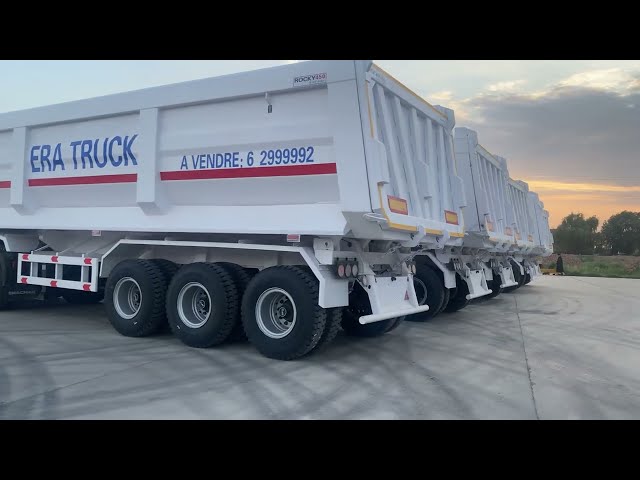
The contractor's procurement team evaluated end tipper manufacturers from Australia, China, and South Africa over a four-month period. They selected Hualu End Tipper Trailers based on three criteria that directly addressed the failure patterns identified in the fleet analysis: steel grade for fatigue resistance at high-stress transition zones, hydraulic cylinder sealing specification for high-dust environments, and the manufacturer's documented track record in iron ore haulage in Western Australia. Fourteen units — 10 standard 40 CBM and 4 extended 50 CBM — were ordered in December 2023, with delivery staggered between January and June 2024 to allow phased fleet conversion without disrupting ongoing contracts.
By February 2025, the 14 Hualu end tippers had accumulated approximately 2.3 million tonnes of iron ore moved across an estimated 32,000 individual haul cycles. The maintenance superintendent's monthly report — which, under the old fleet, had been a catalogue of failures, replacements, and subcontractor invoices — had become notable for its brevity:
| Performance Indicator | Legacy Mixed Fleet (2023) | Hualu Fleet (Jan 2024–Feb 2025) | Change |
|---|---|---|---|
| Hydraulic cylinder failures (annual) | 31 | 0 | -100% |
| Structural cracking incidents | 8 | 0 | -100% |
| Combined equipment downtime (days/year) | 174 | 11 (all tyre or minor electrical) | -94% |
| Average unloading cycle time (arrival to departure) | 3 min 10 sec | 1 min 16 sec | -60% |
| Fleet availability at 05:00 dispatch | 74% | 99.2% | +25 pp |
| Annual maintenance cost per trailer (AUD) | Baseline (~$67,000) | ~$18,400 | -73% |
| Contract tonnage penalty incidents | 17 | 0 | -100% |
| Subcontractor truck hire (annual AUD) | ~$420,000 | $0 | -100% |
| Tonnes moved per trailer per operating day | ~340 | ~470 | +38% |
The 60% reduction in unloading cycle time — from 3 minutes 10 seconds to 1 minute 16 seconds — was the mechanism that drove the tonne-per-trailer-per-day improvement. The HYVA dual-cylinder system's 28-second full lift and 17-second lower, compared to the legacy fleet's 55-second lift and 40-second lower, recovered roughly 50 seconds per unloading cycle. Multiplied across the average 7 cycles per trailer per operating day and 14 trailers, that recovery represented approximately 8.2 hours of additional productive time per fleet per day — time that was converted directly into additional tonnes moved without adding a single trailer, driver, or litre of overhead fuel to the cost base.
But the metric that the managing director highlighted in the board presentation was not the efficiency gain. It was the line showing zero contract tonnage penalty incidents — down from 17 in 2023. Each penalty incident under the company's mine-site agreements carried a financial penalty of AUD 3,200–8,500 depending on the shortfall magnitude, plus a non-monetary consequence that was arguably more damaging: penalty incidents were reported quarterly to the mine operator's procurement department and factored into the annual contractor performance review that determined contract renewal. A penalty-free year was not just a cost saving — it was a contract-renewal asset. Two weeks after the 14-month review, the company was awarded a three-year extension on its largest iron ore haulage contract. The mine operator's procurement manager cited "sustained fleet availability above 99%" as a material factor in the decision.
The maintenance superintendent, a mechanical engineer who had spent 15 years maintaining heavy haulage equipment in the Pilbara before joining the contractor, prepared a technical summary for the company's procurement file. Its core argument was that the legacy fleet's failures were not random events but predictable consequences of a material specification mismatch between the equipment and the operating environment. The Pilbara's iron ore haulage cycle imposes three simultaneous stresses on an end tipper trailer that are individually manageable but cumulatively destructive to conventional steel: 70-tonne concentrated payloads that cycle the chassis through its full stress range on every load, corrugated unsealed road surfaces that superimpose high-frequency vibration on the payload-induced stress, and ambient temperatures that cycle from 5°C at pre-dawn dispatch to 45°C at midday, creating thermal expansion stresses at every welded joint. ASTM A572 Grade 50 steel (345 MPa yield) was adequate for any one of these stresses. It was not adequate for all three simultaneously, applied 2,500 times per year, year after year.
QSTE700 (700 MPa yield) changes the fatigue equation not by being "stronger" in a simple tensile sense, but by raising the fatigue endurance limit — the stress amplitude below which the material can be cycled indefinitely without crack initiation — to a level that exceeds the combined stress amplitude of the Pilbara duty cycle. The post-weld stress-relief heat treatment at the transition zones addresses the residual stress concentration that welding introduces into even high-strength steel. Together, these two engineering decisions — higher-grade steel and post-weld heat treatment — eliminated the crack-initiation mechanism that had destroyed eight legacy trailers in three years. The maintenance superintendent's closing line in the procurement memo: "We didn't buy stronger trailers. We bought trailers whose fatigue limit exceeds our operating stress. The fact that our operating stress hadn't changed in 15 years, and nobody had specified steel that could handle it, tells you everything you need to know about how this industry buys equipment."
The dust-protection specification on the hydraulic system addressed the second failure mechanism with equal precision. The legacy fleet's hydraulic breathers used a 40-micron sintered-bronze filter element — adequate for European quarries where airborne dust concentration rarely exceeds 100 µg/m³, but effectively transparent to the Pilbara's sub-10-micron iron oxide particles that pass through 40-micron pores and accumulate in hydraulic oil as abrasive slurry. The Hualu specification's 3-micron absolute-rated desiccant breathers, combined with the five-stage wiper seal assembly on each cylinder rod, reduced the rate of hydraulic oil contamination to a level that the maintenance superintendent described as "laboratory-grade compared to the soup we were running in the old fleet." At the 14-month mark, hydraulic oil analysis from all 14 trailers showed particulate counts below ISO 4406 17/15/12 — a cleanliness level that hydraulic component manufacturers associate with effectively indefinite seal and bearing life.
Hualu maintains a dedicated Australian after-sales hub in Perth, Western Australia, with spare parts warehousing for all end tipper system components — HYVA cylinder assemblies, Hardox 450 body panels, BPW suspension components, WABCO braking parts, and JOST kingpin assemblies. Factory-trained technicians are based in Port Hedland and Karratha, providing 24-hour on-site support across the Pilbara region. All common wear items are stocked for same-day dispatch within Western Australia, with major structural components available within 5 working days.