

In January 2023, the managing director of a Johannesburg-based vehicle logistics company sat in a quarterly review meeting and stared at a number that made the entire room go quiet. Over the preceding 12 months, his company had transported 6,240 vehicles from South African dealership hubs and auction yards to customers in Zambia, Zimbabwe, Botswana, and Namibia. Of those, 519 vehicles — 8.3%, or roughly one in every twelve cars — had been delivered with some form of transit damage: scratches from inadequate upper-deck clearance, dents from tie-down straps that had loosened on rough roads, undercarriage scrapes from low-clearance loading angles on uneven ground, and paint damage from road debris striking vehicles on the lower deck. The direct cost — repair bills, insurance deductibles, and customer compensation — totalled approximately 3.7 million South African rand (~$198,000). The indirect cost — dealer relationships deteriorating, repeat business declining, and the company's reputation in a market where vehicle logistics contracts are won and lost on delivery condition — was not on the spreadsheet but was on everyone's mind.
The company operated 14 car carrier trailers acquired over an eight-year period from four different manufacturers. The fleet was a maintenance patchwork: different deck heights, different tie-down systems, different ramp angles, and — critically — no two trailers loaded the same way. Drivers developed individual methods for each unit, memorising which trailer needed extra clearance for SUVs on the upper deck and which one required wooden blocks under the ramp to prevent undercarriage scraping. The loading process for an 8-car trailer, which should have taken 35 minutes from first car to last strap, routinely exceeded an hour. The consequence was not just slow turnaround — though that mattered — but inconsistency. An inconsistent loading process produces an inconsistent damage profile, and an inconsistent damage profile is not a problem that fleet maintenance can solve. It is a problem that only standardised equipment can solve.
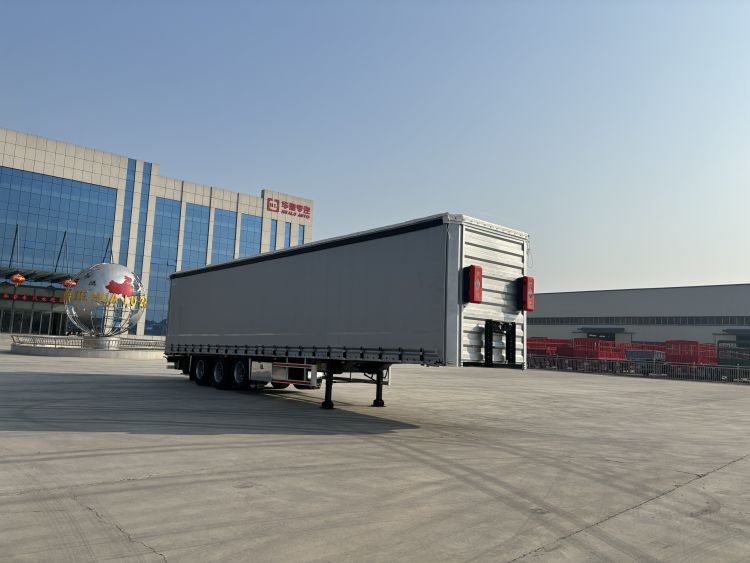
After evaluating car carrier manufacturers from China, Europe, and India, the company ordered 10 Hualu Car Carrier Trailers in April 2023, replacing 12 of the 14 legacy units. Two newer European-built units were retained for short-haul Johannesburg–Gaborone routes while the Hualu fleet focused on the long-haul corridors: Johannesburg–Lusaka (1,600 km), Johannesburg–Harare (1,100 km), and Johannesburg–Windhoek (1,400 km) — routes that combined South African highways with sections of patched tarmac, gravel detours around roadworks, and border-post queuing that could add hours of idling, vibration, and exposure to dust and heat. The specification delivered in two batches (July and September 2023):
The 10 Hualu car carriers accumulated approximately 580,000 combined kilometres between September 2023 and August 2025, delivering vehicles across all four international corridors. The fleet management data told a story of elimination rather than improvement:
| Performance Indicator | Legacy Mixed Fleet (2022) | Hualu Fleet (Sep 2023–Aug 2025) | Change |
|---|---|---|---|
| Transit damage rate (% of vehicles delivered) | 8.3% (1 in 12) | 0.29% (1 in 340) | -96.5% |
| Annual damage-related costs (ZAR) | ~R3.7 million | ~R112,000 | -97% |
| Vehicles per trailer per month | 52 | 78 | +50% |
| Average loading time (8-car configuration) | 68 minutes | 32 minutes | -53% |
| Annual insurance premium | Baseline | 41% lower | -41% |
| Fleet size required for annual volume | 14 | 12 (10 Hualu + 2 retained) | -14% |
| Border-post reloading incidents (vehicles shifted in transit) | 14 per year | 0 | -100% |
| Driver loading-related complaints (monthly) | ~19 | ~2 | -89% |
The damage-rate collapse from 8.3% to 0.29% was not achieved by driving more carefully or training drivers better — though both improved as secondary effects. The primary mechanism was geometric: the Hualu upper deck's infinite-position hydraulic locking eliminated the fixed-clearance compromise that had caused the majority of roof-scrape damage on the legacy fleet. On the old trailers, upper-deck height was adjustable in three preset positions — low (for vans and sedans), medium (for compact SUVs), and high (for full-size SUVs and pickups). Loading a mixed consignment of, say, three Toyota Corollas and two Toyota Fortuners required setting the deck to the high position to accommodate the Fortuners, which left 120 mm of wasted clearance above the Corollas. That 120 mm represented wasted fuel consumption from increased aerodynamic drag and — critically — a margin of error that could have been used to prevent roof contact on bumpy road sections. The Hualu system allowed the loading supervisor to set the height precisely for the tallest vehicle on the upper deck, maximising clearance below the deck structure for the lower-deck vehicles while minimising aerodynamic dead space above the upper deck. The loading geometry was now a variable to be optimised per consignment, not a compromise to be accepted.
The border-post reloading stat deserves particular attention. Cross-border vehicle logistics in Southern Africa involves mandatory stops at border posts where vehicles are sometimes partially unloaded for customs inspection. On the legacy fleet, reloading after inspection was the highest-risk moment in the entire delivery cycle — fatigued drivers, time pressure from queued traffic behind them, and inconsistent deck geometry made it the moment when most damage occurred. The Hualu trailers' wireless remote-controlled deck adjustment meant the loading supervisor could stand at the optimal vantage point — outside the trailer, watching the vehicle's roofline relative to the upper deck — while adjusting the height in real time. Fourteen border-post damage incidents per year dropped to zero. For a logistics director managing four international corridors, eliminating a category of failure that occurred at the furthest point from headquarters, in a location with no repair facilities and limited communication, was worth as much as the damage-cost saving alone.
The 8.3% damage rate that sparked this procurement decision was not an outlier in the Southern African auto logistics market — it was typical. Informal discussions at the South African Vehicle Logistics Forum in 2023 revealed that cross-border damage rates of 6–10% were common among operators using mixed fleets of ageing equipment. The entire sector had normalised transit damage as a cost of doing business, budgeting for repair and insurance deductibles rather than investing in the equipment that would eliminate the damage at its source. The Johannesburg company's 96.5% damage reduction — and the 41% insurance-premium reduction that followed — demonstrated that the cost of not upgrading the fleet was significantly higher than the cost of the fleet itself.
The managing director's closing observation at the 2025 annual general meeting, later quoted in the company's procurement manual, crystallised the lesson: "For eight years, we budgeted for damaged cars as if it were a line item we couldn't remove — like diesel or tyre wear. It turns out damaged cars were never a cost of doing business. They were a cost of doing business with the wrong trailers."
Hualu maintains a dedicated Southern Africa after-sales hub in Johannesburg, with spare parts warehousing for all car carrier system components — hydraulic deck cylinders, strap assemblies, ramp hydraulics, and running gear. Factory-trained technicians based in Johannesburg and Lusaka provide 72-hour on-site support across the Southern African Development Community (SADC) region. All common wear items are stocked for same-day dispatch within South Africa.
Related Hualu deployments: Indian Lowboy comparison test — zero structural cracks after 603km loaded route; Turkish Flatbed fleet overhaul — deck engineering eliminated plate buckling across 14,000 tonnes.