

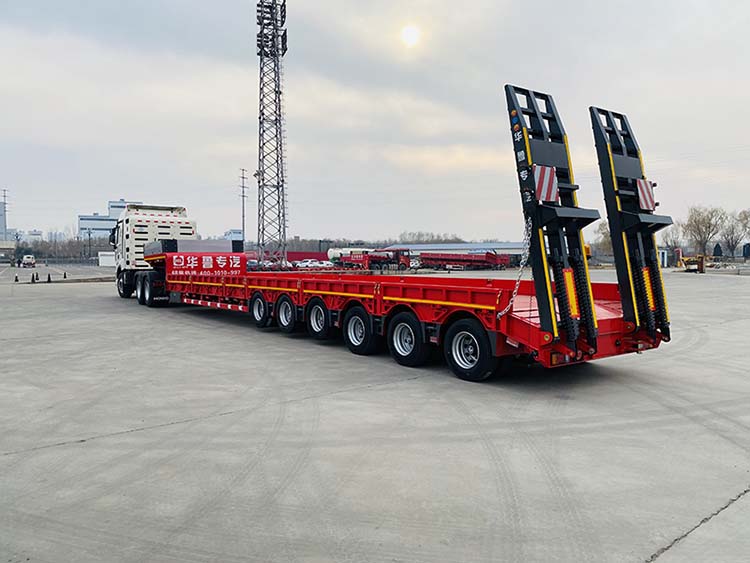
On the scorching highways of São Paulo state, a Brazilian logistics firm specializing in heavy excavators and steel coils was watching its profit margins evaporate. Their fixed‑axle low‑bed trailers were brutal on fuel—empty return legs burned just as much diesel as loaded runs, because every axle ground against the asphalt whether needed or not. Tyre replacement came far too often, and the constant drag made each kilometre unnecessarily expensive. Desperate for a solution, they turned to Hualu, a manufacturer known for tailor‑made heavy haulage equipment. What arrived was a 6‑axle drop‑deck trailer with air suspension on the front three axles—liftable on command. That single innovation turned their fleet economics upside down, delivering a verified 17% fuel saving and cutting overall operating costs by more than 15% over six months.
1. The Problem – Fixed Axles Bleed Money
Every working day, these trailers hauled 50‑ton loads of mining gear and coiled steel from the industrial hub of Campinas to construction sites across the interior. With six axles always on the ground, weight distribution was safe but inefficient. The real killer was the return trip: empty trailers still rolled with all six axles down, creating massive rolling resistance and scrubbing tyres sideways on every corner. Fuel consumption hovered around 5.2 km per litre on loaded runs and barely improved when empty. Tyre sets lasted barely 40,000 km, and suspension components wore prematurely from constant vibration. The fleet manager calculated that nearly 30% of their fuel bill was wasted on empty or light‑load journeys—a cost they could no longer absorb in Brazil’s volatile fuel market.
2. Hualu Custom Solution – Smart Liftable Axles
Hualu’s engineers designed a bespoke 6‑axle low‑bed trailer with the first three axles mounted on a programmable air‑suspension system. At the push of a button inside the cab, the driver can raise those front axles completely off the road—tyres clear of the pavement, suspension locked upward, and drag instantly reduced. When carrying full loads, all six axles lower to maintain legal axle‑weight limits and ensure stable, safe transport. The remaining three axles are fixed but also feature Hualu’s heavy‑duty air bags for improved ride quality. Moreover, the entire trailer’s axle count, track width, and deck length were customised to match the company’s typical cargo dimensions and route regulations. This flexibility means the trailer adapts to the load, not the other way around—a game‑changer for a fleet that handles mixed freight.
3. The Fuel‑Saving Reality – 17% Less Diesel
Over a six‑month trial covering 120,000 km across two identical routes, the data was unequivocal. With the lift axles raised on empty or light runs—about 60% of total mileage—the trailer’s rolling resistance dropped sharply. Fuel economy improved from 5.2 km/l to 6.1 km/l on average, a straight **17% reduction** in diesel consumption. For a fleet burning 800 litres per truck per week, that translated into weekly savings of 136 litres per trailer, or over 3,500 litres annually per vehicle. Tyre wear also slowed dramatically: front‑axle tyres, now lifted when not needed, showed 40% less tread loss, and rear tyres lasted 25% longer due to lower overall stress. Brake pad replacement intervals stretched by 20%, and chassis fatigue eased because the air suspension absorbed road shocks more effectively. Total operating costs—fuel, tyres, maintenance, and downtime—fell by an estimated 15.2%, giving the company a clear competitive edge in bidding for long‑haul contracts.
4. Fleet‑Wide Adoption – A Proven Workhorse
Impressed by the numbers, the logistics firm ordered ten more identical Hualu customs within a year. Drivers praise the cab‑controlled lift system for its simplicity and instant feedback; they no longer dread empty return legs, knowing they can save fuel with a single touch. The maintenance team reports fewer unscheduled repairs, and the reduced tyre debris has even lowered roadside cleanup costs. More importantly, the ability to customise axle spacing and suspension tuning allowed Hualu to tailor each trailer to specific regional weight regulations, avoiding fines and streamlining inspections. The Brazilian operator now markets itself as a “green haulier” with demonstrably lower carbon footprint per tonne‑kilometre. For Hualu, this case has become a flagship reference in Latin America, proving that smart lift‑axle air suspension isn’t just a luxury—it’s a money‑saving necessity that turns a heavy‑haul monster into a lean, fuel‑sipping workhorse, kilometre after kilometre.