

On 12 February 2025, at 04:30 IST, the fleet director of a Chennai-based heavy-lift transport company was woken by his lead driver calling from the shoulder of National Highway 544, approximately 90 kilometres from Coimbatore. A 62-tonne wind turbine nacelle — a precision-engineered assembly worth approximately $380,000 — was sitting on a cracked lowboy trailer. The crack, visible in the driver's flashlight photograph, ran diagonally through the web plate of the left main beam, approximately 60 centimetres forward of the rear suspension mounting bracket. The nacelle was intact. The trailer was not roadworthy. The delivery deadline — commissioning of a 120 MW wind farm expansion in Tamil Nadu's Tirunelveli district — was 72 hours away. The fleet director dispatched a recovery crew, called the wind farm project manager to explain a delay that would cost roughly $14,000 in liquidated damages, and opened the file on his desk labelled "Lowboy Procurement — 2025."
This was not the first structural failure the company had experienced. In the preceding 12 months, its mixed fleet of seven lowboy trailers — sourced from two Indian and one Turkish manufacturer over a six-year period — had recorded 11 structural cracking incidents requiring workshop repair. Each incident followed a pattern: heavy concentrated loads (nacelles, turbine hubs, generator stators), extended highway runs at 60–70 km/h on Indian road surfaces that mix smooth tarmac with abrupt expansion joints and pothole patches, and failure initiation at the same stress-concentration points — gooseneck transition welds, suspension bracket attachments, and cross-member-to-main-beam joints. The company's maintenance log showed that its lowboy fleet spent an average of 37 days per year per trailer off the road for structural repairs — a figure that, across seven trailers, represented approximately $215,000 in annual lost revenue from missed delivery slots.
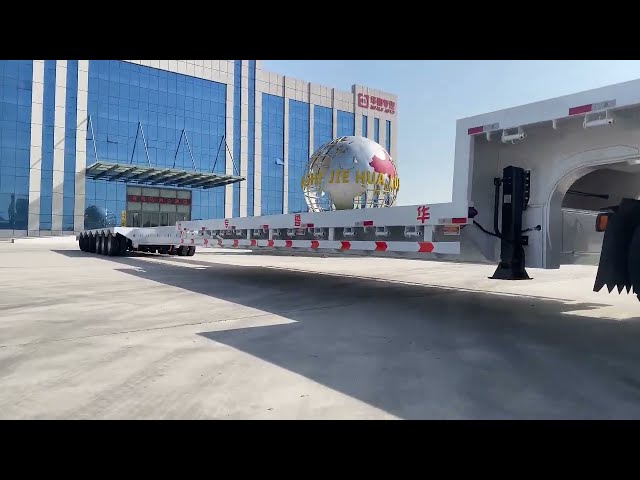
Rather than base the next procurement decision on manufacturer specifications alone, the fleet director designed a comparative field test. He secured three demonstration units from three manufacturers — identified in the test report as Manufacturer A (Indian, welded-chassis construction, price-conscious segment), Manufacturer B (Turkish, bolted modular design, mid-market), and Hualu (Chinese, QSTE700 steel, hydraulic gooseneck). All three were 4-axle lowboy configurations rated for 60–80 tonnes. All three were equipped with BPW axles and WABCO braking. The differences were in the chassis engineering: steel grade, weld protocol, cross-member spacing, and gooseneck design.
The test route was chosen for its relevance to the company's actual operating environment. It began at a wind turbine assembly yard in Sriperumbudur, on the western outskirts of Chennai, and ran 603 kilometres to a wind farm construction site near Udumalaipettai in the foothills of the Western Ghats. The route comprised three distinct segments: 380 kilometres of National Highway (NH 544 and NH 81 — smooth tarmac with expansion joints every 30 metres), 155 kilometres of Tamil Nadu State Highway (narrower, variable surface quality, sharp curves on the Pollachi–Udumalaipettai section), and 68 kilometres of unpaved site-access road (compacted laterite, 8–12% gradient in sections, monsoon-damaged surface with 15–25 cm ruts). Each trailer would carry an identical 62-tonne wind turbine nacelle — a concentrated load distributed over approximately 8 metres of deck length, creating a point-load stress regime that the fleet director's engineering team had identified as the primary driver of their existing fleet's cracking problem.
A three-person engineering team from the company accompanied each trailer in a separate vehicle, stopping at five pre-designated inspection points along the route to photograph and measure any visible structural deformation. Weld inspection was performed visually at each stop, with dye-penetrant testing at the final inspection point before the site-access segment. The pass criterion was simple: complete the full 603-kilometre route with no structural crack exceeding 2 mm in length detectable by dye-penetrant testing at any weld joint on the main beams, cross-members, or gooseneck assembly.
| Test Metric | Manufacturer A (Welded, Indian) | Manufacturer B (Bolted, Turkish) | Hualu (QSTE700, Hydraulic Gooseneck) |
|---|---|---|---|
| Completed full 603 km route? | No — halted at 478 km (crack in cross-member weld) | No — halted at 551 km (crack at gooseneck transition) | Yes — completed with zero detectable cracks |
| Weld cracks detected at final inspection | 3 (main beam web × 1, cross-member × 2) | 1 (gooseneck transition, 14 mm length) | 0 |
| Measurable deck deflection under load | 8.2 mm | 5.6 mm | 3.1 mm |
| Gooseneck attach/detach cycle time | 4 min 20 sec (mechanical) | 2 min 50 sec (hydraulic) | 1 min 35 sec (hydraulic, wireless remote) |
| Unpaved segment avg speed (loaded) | 12 km/h (driver caution) | 18 km/h | 26 km/h |
| Post-test dye-penetrant result | Fail — 3 cracks, largest 18 mm | Fail — 1 crack, 14 mm | Pass — zero indications |
| Post-test trailer condition | Requires workshop repair before redeployment | Requires workshop repair before redeployment | Ready for immediate next dispatch |
The fleet director's report, circulated to the company's board and later shared — with manufacturer names anonymised — with two other Indian heavy-lift operators, contained an observation that would shape the company's procurement policy going forward: "The welding, not the steel thickness, was the decisive variable. Manufacturers A and B both used adequate plate thicknesses on paper. Both failed at the welds — the heat-affected zones where the base metal's fatigue resistance had been degraded by the welding process itself. Hualu's post-weld stress-relief heat treatment at the main beam-to-gooseneck transition — a process step that adds approximately 4 hours to the manufacturing cycle and is invisible in a specification sheet — was, in our engineering team's assessment, the single factor that prevented crack initiation on the Hualu unit."
Based on the test results, the company ordered 14 Hualu Lowboy Trailers in April 2025 — six 3-axle 60-ton units for turbine hub and blade-root transport, and eight 4-axle 80-ton hydraulic-gooseneck units for nacelle and generator stator transport. The specification, refined from the test unit's performance data, included:
By December 2025, the 14 Hualu lowboys had accumulated approximately 84,000 combined loaded kilometres across 230 nacelle, hub, and blade-root deliveries to seven wind farm sites in Tamil Nadu, Karnataka, and Andhra Pradesh. The fleet recorded zero structural cracking incidents — a result that the fleet director described in a quarterly review as "not an improvement over the old fleet but an elimination of a category of failure that we had accepted as normal." The old fleet's 37 days per trailer per year of structural-repair downtime dropped to effectively zero for the Hualu units; the only unscheduled maintenance events recorded were two tyre replacements (from road debris on unpaved segments) and one hydraulic-hose replacement (from abrasion against a misaligned hose clamp, corrected under warranty within 48 hours).
The fleet director, who held a master's degree in mechanical engineering from IIT Madras, turned the test data into an internal technical note that the company now uses as part of its procurement evaluation process for any structural trailer. The core argument: a welded joint is not simply two pieces of steel joined together — it is a localised metallurgical transformation in which the base metal adjacent to the weld (the heat-affected zone, or HAZ) experiences grain coarsening, residual stress accumulation, and, in some cases, microstructural changes that reduce its fatigue strength by 20–40% compared to the unaffected parent material. The wider the HAZ and the higher the residual stress, the lower the fatigue life of the joint. Manufacturers who invest in post-weld heat treatment, controlled cooling rates, and full-penetration weld geometries reduce the HAZ impact and extend fatigue life. Manufacturers who treat welding as a joining process rather than a metallurgical process produce trailers that look identical on delivery and diverge dramatically after 50,000 kilometres.
This insight — invisible on a specification sheet, measurable only through comparative testing — is why Hualu's stress-relief heat treatment at critical transition zones became the deciding factor in the procurement decision. The Turkish-manufactured trailer (Manufacturer B in the test) had marginally thicker main beam web plates than the Hualu unit — 16 mm versus 14 mm — and still failed at the gooseneck transition weld. Thicker steel cannot compensate for a compromised heat-affected zone. The fleet director's recommendation to the board was characteristically direct: "Spec sheets tell you what steel was used. Only a loaded test tells you whether the welding was done right."
India is installing wind energy capacity at approximately 3.5 GW per year, with government targets set at 140 GW by 2030. Each GW of installed capacity requires roughly 450 turbine units — each of which requires 4 to 7 specialised heavy-lift trailer movements (nacelle, hub, blades, tower sections, transformer). India's wind energy supply chain alone will generate approximately 1.5 million heavy-lift trailer movements between now and 2030. The cost of a structural failure on any one of those movements — measured in crane demobilisation and remobilisation, missed grid-connection deadlines, and liquidated damages under power purchase agreements — can exceed $25,000 per incident. Multiplying that risk across a six-figure annual delivery schedule makes the procurement decision about trailer engineering quality not a purchasing question but a business-continuity question.
The Tamil Nadu test protocol — three trailers, identical loads, same route, dye-penetrant pass/fail criterion — has since been adopted informally by two other Indian heavy-lift operators who received copies of the fleet director's report. It represents a shift in procurement practice from specification-based evaluation to performance-based evaluation, and it has made the 603-kilometre Chennai–Coimbatore corridor an unofficial certification route for lowboy trailers seeking to enter the Indian wind energy logistics market. Hualu passed it. Two established competitors did not. For any heavy-lift operator evaluating lowboy procurement in a market where structural failure carries six-figure consequences, those results are worth reading in full.
Hualu maintains a dedicated South Asia after-sales hub in Chennai, Tamil Nadu, with spare parts warehousing for all lowboy system components — gooseneck hydraulics, suspension parts, braking components, and structural repair sections. Factory-trained technicians based in Chennai and Coimbatore provide 48-hour on-site support across the Tamil Nadu–Karnataka–Andhra Pradesh wind energy corridor. All common wear items are stocked for same-day dispatch within India, with major structural components available within 5 working days from Hualu's regional supply chain.