

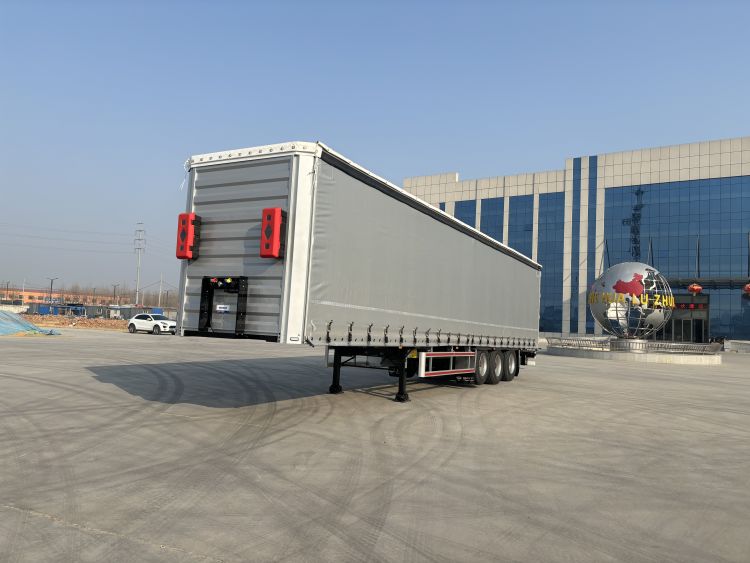
For six years, the logistics manager of Bình Dương Agricultural Logistics — a Đắk Lắk-based company that supplies fertiliser and crop protection products to 2,400 coffee farming households across Vietnam's Central Highlands and exports their harvested beans to European and Japanese roasters — described his operation with a phrase that became a running joke in the company's weekly operations meeting: "We are the most efficient transporter of empty trailers in Southeast Asia."
The numbers were not funny. The company operated 18 tractor-trailer combinations split into two distinct fleets: nine Curtain Side Trailers dedicated to hauling bagged NPK fertiliser, herbicides, and soil conditioners from the company's central warehouse in Đắk Lắk province to 64 distribution points scattered across the Central Highlands; and nine Flatbed Trailers that collected harvested Robusta and Arabica coffee beans — dried, bagged, or in bulk — from those same distribution points and transported them to the company's export processing facility near Buôn Ma Thuột. The geography was circular: the fertiliser went outbound from the warehouse, the coffee came inbound to the processing plant. The destinations overlapped by approximately 80%. Yet the trailers could not: fertiliser required an enclosed, weather-protected cargo space, while bulk coffee needed an open-top container suitable for gravity loading from drying-platform hoppers. A curtain-side trailer returning empty from the highlands and a flatbed trailer heading out empty to collect coffee were the same problem viewed from two different directions.
In 2023, the company's fleet covered approximately 940,000 kilometres. Of those, 461,000 — 49% — were deadhead kilometres: trailers moving without cargo, burning diesel, paying road tolls, and occupying drivers without generating a single đồng of revenue. At Vietnamese bulk transport rates and an average diesel consumption of 31 litres per 100 kilometres, the deadhead portion alone consumed roughly 143,000 litres of fuel — fuel that contributed to nothing but exhaust. The logistics manager calculated that deadhead kilometres represented approximately $187,000 in annual wasted operating expenditure, not including the opportunity cost of trailers and drivers unavailable for revenue-generating work.
On 14 March 2024, at 08:15 local time, the logistics manager stood at the loading bay of the company's Buôn Ma Thuột processing plant and watched two events unfold simultaneously. On one side of the yard, a curtain-side trailer was being washed out after delivering 26 tonnes of NPK compound — the standard cleaning protocol to prevent fertiliser residue from contaminating the trailer before its next load. On the other side, a flatbed trailer was being loaded with 24 tonnes of bulk Robusta coffee beans, poured from an overhead hopper at a rate that sent a cloud of coffee dust billowing across the yard. The curtain-side trailer, once cleaned, would drive 180 kilometres back to the warehouse empty. The flatbed trailer, once loaded, had arrived at the plant empty that same morning. The logistics manager took a photograph of the two trailers — one being cleaned of the cargo the other could have carried, both having travelled empty in opposite directions — and sent it to the company's managing director with a three-word caption: "This must stop."
The managing director authorised a search for a single-trailer solution within 48 hours. The requirement was explicit: one trailer that could legally and safely carry bagged agricultural inputs in one direction and bulk coffee beans in the other, without reconfiguration between trips, without cross-contamination risk, and without compromising payload capacity in either mode. The search led to the Hualu Double Box Trailer — a twin-compartment design with a fixed central partition that divides the cargo bed into two independently accessible bays: a fully enclosed, weather-sealed forward compartment for bagged fertiliser and chemicals, and an open-top rear bin for bulk agricultural commodities.
The company ordered 11 Hualu Double Box Trailers in April 2024, replacing all nine curtain-side units and three of the oldest flatbeds. The six remaining flatbeds were retained for peak-season overflow. The first six Hualu units arrived in June 2024, with the remaining five delivered in August — timed to enter service before the October–December coffee harvest season, when the fleet would face its maximum operational stress. The delivered specification:
By September 2025, the fleet had completed a full coffee harvest season and two fertiliser distribution cycles. The data was compared against the 2023 baseline:
| Performance Indicator | Dual-Fleet Model (2023) | Hualu Double Box Fleet (Sep 2024–Aug 2025) | Change |
|---|---|---|---|
| Deadhead kilometres (% of total) | 49% | 5% | -44 pp |
| Total fleet size | 18 trailers | 11 trailers (+6 flatbeds peak only) | -39% baseline |
| Tonnes moved per trailer per month | 142 | 243 | +71% |
| Per-tonne transport cost (VND equivalent) | Baseline | 34% lower | -34% |
| Annual diesel consumption (fleet) | ~291,000 L | ~167,000 L | -43% |
| Fertiliser-to-coffee changeover time | N/A (separate trailers) | 18 minutes | New capability |
| Cross-contamination incidents | 4 per year (from improper flatbed cleaning) | 0 | -100% |
| Annual maintenance (per trailer) | Baseline | 38% lower | -38% |
| Driver overtime (monthly hours, fleet) | ~310 | ~95 | -69% |
The deadhead collapse — from 49% to 5% — was the structural win that changed the company's economics at a fundamental level. The remaining 5% represented unavoidable empty movements: repositioning trailers for maintenance, one-off specialised deliveries, and the occasional mismatch between fertiliser demand and coffee harvest volumes during the shoulder season. But the 44-percentage-point gap between 49% and 5% represented approximately 414,000 deadhead kilometres eliminated — kilometres that were now carrying paying cargo in both directions. At the company's average revenue of approximately 8,200 VND per tonne-kilometre, the captured deadhead kilometres alone generated roughly $135,000 in additional annual revenue — money that, under the dual-fleet model, had been literally burning in the form of diesel moving empty trailers across the Central Highlands.
But the logistics manager, when presenting the results to the board, spent the least time on the financials. The slide he dwelled on was titled "Driver Overtime" — and it showed a 69% reduction in monthly overtime hours across the fleet. Under the old model, drivers on fertiliser-outbound routes typically finished their delivery by early afternoon but could not return to base because there was no coffee to backhaul until the following morning. They waited — on the clock, in accommodation paid by the company, burning hours that counted against legal driving limits without moving a single kilometre closer to home. The double-box trailers eliminated the wait: a driver delivered fertiliser to a distribution point in the morning, loaded coffee at the same location or one within 30 kilometres, and was back at the processing plant by evening — one trip, two cargoes, no dead time. "The drivers stopped complaining about waiting," the logistics manager told the board. "They started complaining about normal things — like traffic."
The structural problem that Bình Dương Agricultural Logistics solved — dedicated fleets running empty in alternating directions because cargo types demand different trailer configurations — is not unique to Vietnamese coffee logistics. It replicates wherever agricultural supply chains involve bagged inputs going out and bulk harvests coming back: cocoa in Côte d'Ivoire, palm oil in Indonesia, soybeans in Brazil, maize in Kenya, wheat in Pakistan, rice in Thailand. In every one of these corridors, the same diesel is being burned to move the same empty trailers in the same alternating directions. The double-box concept — one trailer, two cargo environments, zero deadhead compromise — is a general solution to a structural problem, not a niche adaptation for a single commodity or geography.
At the final review meeting, the managing director asked the logistics manager what he would tell another agricultural logistics operator considering the same investment. The answer — later printed in the company's internal procurement guidelines — was characteristically direct: "Count your deadhead kilometres. Multiply by your diesel price. Then ask yourself why you're paying to transport nothing."
Hualu maintains a dedicated ASEAN after-sales centre in Ho Chi Minh City, Vietnam, with spare parts warehousing for all Double Box system components, running gear, and load-securing hardware. Factory-trained technicians based in Buôn Ma Thuột provide 48-hour on-site support across the Central Highlands region. All common wear items — door seals, tarpaulin covers, lashing rings, brake pads, and suspension components — are stocked for same-day dispatch within Vietnam.
Related Hualu deployments: Indonesian Belt Trailer fleet — 7 rollovers reduced to zero; Indian Lowboy comparison test — zero weld cracks on 603km route.