
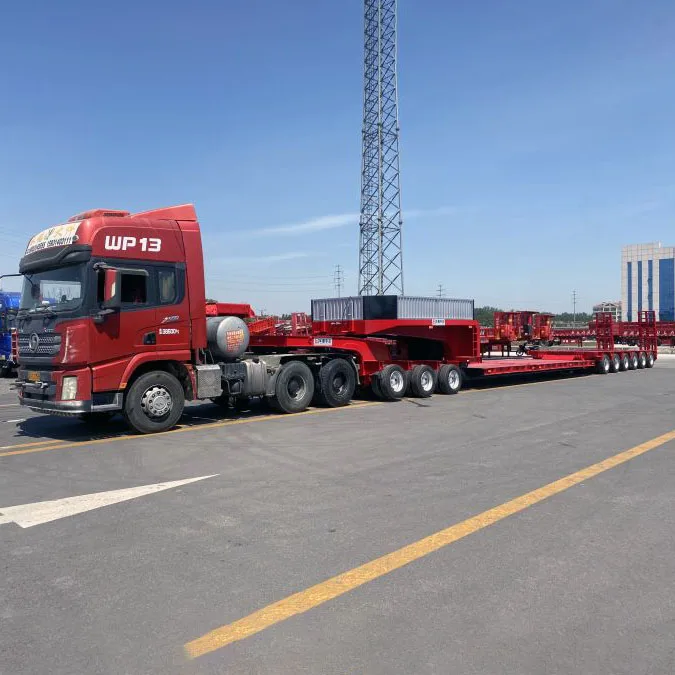
Axle Configurations: Choosing the Right Setup for Your Payload
The number of axles on a low-bed trailer is the primary factor determining its load capacity, weight distribution, and maneuverability. Here is how our configurations differ:
3-Axle Low-Bed: The versatile workhorse of heavy transport. Ideal for payloads up to 50 tons. It offers an excellent balance of maneuverability, fuel efficiency, and cost-effectiveness for standard heavy machinery.
4-Axle Low-Bed:Designed for enhanced weight distribution. Perfect for dense cargo in the 50-60 ton range, reducing stress on individual axles and ensuring compliance with stricter regional weight limits.
5-Axle Low-Bed:Built for specialized heavy transport (50-65 tons). The additional axle significantly lowers ground pressure. **Crucially, it features advanced steering axles that reduce the turning radius by up to 10%. This allows the trailer to follow the tractor's path smoothly, eliminating tire scrubbing and extending tire life by over 30%, making it highly suitable for navigating tight construction sites or urban areas.**
6 & 7-Axle Low-Bed: The ultimate heavy-haulers for extreme loads up to 80 tons. These configurations maximize weight distribution across a larger footprint. **Equipped with multi-axle steering systems, they guarantee exceptional stability and safety even at high speeds or during lane changes. The steering mechanism transforms sliding friction into rolling motion during turns, drastically reducing tire wear and minimizing the risk of rollovers, ensuring unmatched performance for indivisible, ultra-heavy cargo.
Core Product Advantages
Optimal Load Distribution:Multi-axle low-bed designs ensure that 40-80 ton payloads are evenly spread, protecting both the cargo and road infrastructure from excessive point loads.
Robust Structural Integrity: Constructed with high-strength steel and advanced automatic submerged arc welding, our frames resist twisting and deformation under extreme stress.
Enhanced Stability & Safety: The low-deck design lowers the center of gravity, significantly reducing rollover risks. Combined with premium braking systems, they offer reliable stopping power under massive loads.
Fully Customizable:Whether you require a standard low-bed, a concave-deck (drop-deck) design for taller machinery, or extendable options, Hualu tailors axle spacing, suspension types, and deck heights to your exact cargo specifications.
Best Practices for Safe Operation
Precision Loading:Always center the cargo on the deck. For 60-80 ton loads, ensure the weight is evenly distributed across all axles to prevent overloading the kingpin or rear axle groups.
Secure Immobilization: Utilize heavy-duty chains, binders, and designated tie-down points. When loading machinery via rear ramps, ensure the equipment is fully blocked and immobilized before transit.
Adapt Driving Dynamics:Heavy-haul low-beds require longer braking distances and wider turning radii. Avoid sudden acceleration, hard braking, or sharp turns to prevent cargo shift or trailer jackknifing.
Rigorous Pre-Trip Inspection:Before every haul, check tire pressure, suspension components, and braking connections to ensure the multi-axle system is functioning flawlessly.
Essential Maintenance Guide
Tire Management:Multi-axle trailers put immense stress on tires. Check tire pressure weekly and inspect tread depth regularly. Rotate tires as recommended to prevent uneven wear caused by high payloads.
Suspension & Axle Care: Inspect leaf springs, air suspension bags, and axle alignments every 30,000 km. Keep suspension components clean and properly lubricated to maintain accurate weight distribution and ride stability.
Steering System Upkeep (For 5-7 Axle Models): Regularly inspect steering linkage joints, hydraulic cylinders, and hoses for leaks or looseness. Keep all pivot points and lubrication fittings well-greased to ensure smooth tracking. Periodically check the steering angle consistency to maintain optimal turning performance and prevent premature tire wear.
Braking System Upkeep: Heavy loads accelerate brake wear. Inspect brake linings every 20,000 km and replace them immediately if worn. Check air lines and valves for leaks to guarantee consistent braking power.
Structural Maintenance:Wash the trailer regularly, especially the undercarriage, to remove mud and corrosive materials. Inspect the frame, welds, and tie-down points for any signs of fatigue or cracks after transporting maximum payloads.