

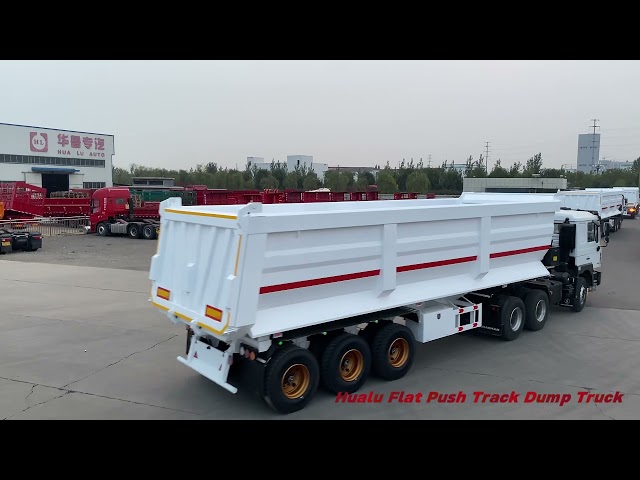
In February 2022, a hydraulic end-tipper loaded with 38 tonnes of NPK fertilizer compound was reversing into position at a Sumatran palm oil plantation. The designated unloading area was a graded earth pad at the edge of a mature palm grove — flat enough on paper, but softened by three days of monsoon rain. As the hydraulic cylinder extended and the trailer bed began its ascent, the right-side rear tyres sank four centimetres into the saturated soil. The angle of tilt, combined with the uneven ground, shifted the centre of gravity outside the vehicle's stability envelope. Within two seconds, the trailer and its cargo were on their side. Nobody was injured. But the cleanup — recovering 38 tonnes of mixed NPK from a drainage ditch, repairing a twisted chassis, and explaining to the plantation manager why fertiliser delivery would be delayed by nine days — cost the company approximately $27,000 in direct losses and an incalculable amount of operational trust.
It was the seventh tipping-related incident that year across the company's 60-trailer fleet. The logistics director, a third-generation plantation engineer who had spent 18 years moving everything from raw palm fruit bunches to bagged urea across Sumatra's 85 plantations, called a meeting with the board. His opening slide contained exactly four words: "We cannot level Sumatra." The point was not rhetorical. Sumatra's plantation topography — undulating laterite slopes, river-valley floodplains, and deeply rutted estate roads carved through tropical clay — meant that perfectly flat unloading positions existed on fewer than 30% of the company's delivery sites. Hydraulic tipping, with its inherent requirement for stable, level ground, was a technology designed for a geography the company did not inhabit.
The logistics director had first encountered belt conveyor trailers at an agricultural machinery expo in Bangkok, where a European manufacturer was demonstrating a grain-belt unit on a deliberately uneven surface. The principle was elegantly simple: instead of raising the entire cargo body to let gravity do the work, a heavy-duty rubber conveyor belt embedded in the trailer floor moves the cargo horizontally out the rear — the trailer body never moves, the centre of gravity never shifts, and the ground can be as uneven as Sumatran reality requires. The director returned from Bangkok with a single question for his procurement team: "Who builds these at industrial scale?"
After evaluating manufacturers from Germany, Turkey, and China, the company ordered 28 Hualu Belt Conveyor Trailers in a phased deployment beginning Q4 2023. The selection criteria were, in order of priority: belt durability under abrasive tropical laterite conditions, corrosion resistance in 85% average humidity, parts availability within ASEAN, and total cost of ownership versus the existing hydraulic fleet. The configuration delivered to Sumatra was as follows:
The 28 Hualu Belt Trailers entered service between October 2023 and February 2024. The company's fleet management system tracked every trip, every unloading event, every maintenance intervention, and every weather condition across the 12-month period ending February 2025. The data was compared against the 2022 baseline — the last full year of hydraulic-only operation:
| Performance Indicator | Hydraulic Fleet (2022 Baseline) | Hualu Belt Fleet (Mar 2024–Feb 2025) | Change |
|---|---|---|---|
| Unloading-related rollover incidents (annual) | 7 | 0 | -100% |
| Daily delivery cycles per trailer | 2.1 | 3.6 | +71% |
| Average unloading time (40-tonne load) | 6 min 30 sec | 2 min 15 sec | -65% |
| Fertiliser cross-contamination incidents | 11 per year | 0 | -100% |
| Usable unloading sites (% of plantation locations) | ~30% | ~95% | +65 pp |
| Trailer-related downtime (days/year/unit) | 18.3 | 4.7 | -74% |
| Annual maintenance cost per trailer | Baseline | 52% lower | -52% |
| Fleet size required for same throughput | 60 trailers | 42 trailers (28 new + 14 retained tippers for specific routes) | -30% |
| Insurance premium (annual fleet policy) | Baseline | 22% lower | -22% |
The elimination of rollover incidents — from 7 per year to zero — was the headline number, but the 65-percentage-point expansion in usable unloading sites was the operational insight that made the logistics director's career. Under the hydraulic regime, delivery planners maintained a database of "green sites" (confirmed level, safe for tipping), "amber sites" (borderline, driver discretion required), and "red sites" (tipping prohibited — product had to be transferred to smaller vehicles or unloaded by hand). Roughly 30% of plantation delivery locations were green, 45% were amber, and 25% were red. The belt trailers converted virtually all amber and red sites to usable — the only remaining restrictions were overhead clearance for the tractor unit and basic road access. In practical terms, this meant fertiliser could now be delivered directly to the field edge rather than to a central depot requiring secondary transport, eliminating an estimated 14,000 internal transfer movements per year across the 85-plantation network.
The hydraulic tipper's fatal flaw is not engineering quality — it is geometry. A tipping trailer, regardless of how well it is built, must lift its entire payload to an angle where gravity overcomes the material's internal friction and the cargo begins to slide. At a 45-degree tilt, the combined centre of gravity of the trailer and its load shifts upwards and — critically — laterally. If the ground beneath the trailer's tyres is not perfectly level, that elevated, offset centre of gravity can move outside the vehicle's stability triangle. When it does, the trailer tips. This is not a product defect. It is a physical constraint that no amount of chassis reinforcement, wider axles, or operator training can eliminate — only mitigate.
The belt conveyor trailer eliminates the geometry problem by eliminating the tilt. The cargo body remains horizontal throughout the entire unloading cycle. The belt moves horizontally, carrying material out the rear in a controlled stream. The centre of gravity does not rise. It does not shift laterally. It stays exactly where it was when the trailer was parked. This means the trailer can unload on a 12-degree lateral slope — common on Sumatran plantation terraces — with exactly the same stability it had when it arrived. The wireless remote control adds a further safety layer: the operator stands 15 metres away, at a vantage point where they can see both the discharge stream and the surrounding area, instead of sitting in the cab monitoring hydraulic gauges.
The cross-contamination elimination — which saved the company an estimated $180,000 annually in rejected fertiliser loads and customer compensation — was an unexpected bonus. The polished internal surfaces of the Hardox 450 body, combined with the belt's self-cleaning action as it runs over the return rollers, meant that switching from urea to NPK compound to dolomite between deliveries required nothing more than a five-minute water rinse. Under the old hydraulic tipper system, residual material trapped in corners and weld seams meant that fertiliser changeover required a 45-minute manual clean-out — which, when skipped under time pressure, resulted in cross-contaminated loads rejected by plantation quality control.
Sumatra's operating conditions — monsoon rainfall exceeding 2,500 mm annually, laterite soils that turn from iron-hard to porridge within an hour of heavy rain, and plantation roads that are maintained to agricultural rather than highway standards — are not unique. They are replicated across the palm oil, rubber, sugarcane, and tropical fruit industries of Indonesia, Malaysia, Thailand, the Philippines, Colombia, Ecuador, Brazil, Nigeria, and Côte d'Ivoire. In every one of these markets, hydraulic tipping trailers are operating at a fundamental mismatch with their environment. The Sumatran deployment demonstrates that the belt conveyor alternative is not a niche European innovation — it is a production-proven solution that has operated through two full monsoon seasons without a single weather-related unloading failure.
The fleet manager's closing observation during the 12-month review meeting has since been quoted in the company's procurement manual: "We spent 20 years trying to train drivers to find level ground. Then we bought trailers that don't need it." For any agricultural logistics operator managing bulk material delivery across challenging tropical terrain, that sentence encapsulates the entire business case.
Every Hualu Belt Conveyor Trailer is manufactured under ISO 9001:2015 quality management and is available with the following certifications:
Hualu maintains a dedicated ASEAN after-sales centre in Jakarta, Indonesia, with spare parts warehousing for all belt system components, hydraulic drive parts, and running gear. Factory-trained technicians based in Medan (North Sumatra) and Pekanbaru (Riau) provide 48-hour on-site support across Sumatra's plantation belt. All common wear items — belt sections, tension rollers, drum bearings, and hydraulic seals — are stocked for same-day dispatch within Indonesia.