

In late 2022, the operations director of a Karaganda-based fuel logistics company sat down with a year-end spreadsheet and one number made his stomach drop: 14. That was the count of winter fuel gelling incidents across his 22-truck fleet during the 2021–2022 winter season. Each incident meant a stranded tanker somewhere on the 800-kilometre route between the Pavlodar refinery and the remote copper and gold mines of central Kazakhstan — a driver waiting in -35°C cold for a rescue crew, a mine running its haul trucks on reserve tanks, and a delivery contract penalty ticking by the hour. The company's annual penalty tally for late or missed deliveries had reached approximately 12.7 million Kazakhstani tenge — roughly $28,000 at the prevailing exchange rate, but the reputational cost with mine operators who depended on just-in-time diesel supply was incalculable.
The root cause was not a single failure but a cascade of limitations built into the fleet's inherited equipment. The company operated 22 tank trailers, most manufactured between 1988 and 2005 in Soviet-era and early post-Soviet factories. These units shared three fatal characteristics for Central Asian operating conditions. First, they were single-compartment designs: each trailer carried only one product — diesel, gasoline, or industrial lubricant — meaning a mine needing all three required three separate deliveries, tripling the fuel burn and driver hours. Second, the tank insulation consisted of a 30 mm fibreglass layer that had been specified for temperate European climates, not for a steppe where the January mean low is -21°C and extreme nights plunge below -40°C. Diesel's cloud point — the temperature at which paraffin wax crystals begin to form — sits at approximately -12°C for standard Kazakh winter-grade diesel; without active heating, fuel in an uninsulated tank reaches ambient temperature within four hours of loading. Third, the trailers' carbon steel shells, now 15 to 35 years old, had accumulated internal corrosion from years of hauling high-sulphur Kazakh diesel, introducing particulate contamination that clogged mine-site dispensing filters and caused equipment downtime downstream.
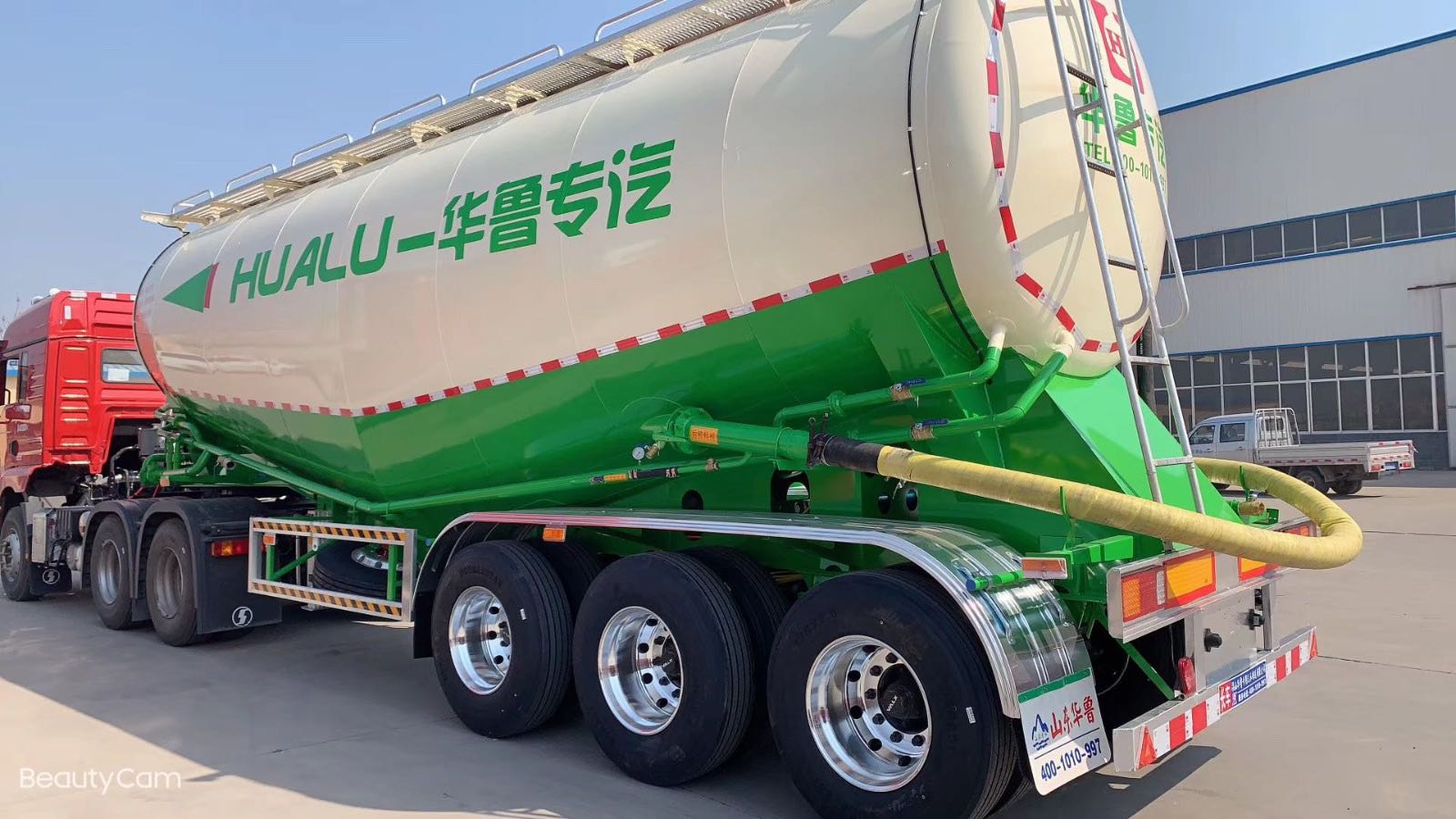
The company's procurement team evaluated tank trailer manufacturers from China, Russia, Turkey, and Europe over a six-month period. They selected Hualu based on two decisive criteria: the availability of an integrated active heating system as a factory-installed option (not a third-party retrofit), and Hualu's documented experience delivering to extreme-climate markets in Mongolia and northeastern China where winter conditions match Kazakhstan's. Fifteen units were ordered in Q1 2023, replacing the 12 oldest and most problematic Soviet-era units in a phased deployment between May and August 2023 — timed to complete commissioning before the first winter frost.
The delivered specification was as follows:
The 15 Hualu tank trailers entered service between June and September 2023. The company's fleet management system tracked every operating parameter — delivery times, fuel temperatures at loading and discharge, compartment utilisation, maintenance events, and customer complaint logs — through the 2023–2024 winter season and the first half of the 2024–2025 winter. The data is presented below:
| Performance Indicator | Old Soviet-Era Fleet (2022 Baseline) | Hualu Tank Fleet (2023–2025) | Change |
|---|---|---|---|
| Winter fuel gelling incidents (per season) | 14 | 0 | -100% |
| Average daily delivery range | 520 km | 810 km | +56% |
| Deliveries per trailer per week | 2.4 | 4.1 | +71% |
| Per-litre delivery cost (tenge) | 18.4 ₸ | 12.7 ₸ | -31% |
| Fleet size required for contract volume | 22 trailers | 19 trailers (15 new + 4 retained) | -14% |
| Customer penalty incidents (annual) | 17 | 1 | -94% |
| Fuel contamination complaints | 8 per year | 0 | -100% |
| Annual maintenance cost per trailer | Baseline | 41% lower | -41% |
| Fleet availability (06:00 dispatch) | 83% | 98% | +15 pp |
The 56% increase in daily delivery range — from 520 km to 810 km — is arguably the most strategically significant number in this table. Kazakhstan's mining geography is defined by distance: the copper mines of Zhezkazgan lie 430 km from the nearest refinery in Pavlodar, the gold operations around Stepnogorsk sit 280 km from fuel supply, and the polymetallic mines of eastern Kazakhstan are separated from their supply bases by distances exceeding 500 km over roads that are paved only for the first 150 km. The old fleet's 520 km daily range meant that mines beyond a 260 km radius required an overnight driver layover, adding accommodation costs, per-diem payments, and dead time to every delivery. The Hualu fleet's 810 km range — achieved through faster loading at the refinery (multi-compartment bottom-loading in 18 minutes versus 35 minutes for single-compartment top-loading), reduced en-route time lost to cold-weather issues, and faster discharge at mine sites via the 60 m³/h pumping system — brought those distant mines within a single driver's daily duty window. Two mines that had previously required layover deliveries now received same-day service, eliminating approximately $1,700 per week in driver accommodation expenses.
The 5-compartment design transformed the company's cost structure at a fundamental level. A typical Kazakh gold mine requires three petroleum products on a regular schedule: diesel for haul trucks and excavators (approximately 80% of total fuel volume), AI-92 gasoline for light support vehicles, and industrial lubricants for crusher and conveyor maintenance. Under the old single-compartment fleet, fulfilling a mine's weekly order required three separate round-trips — one for each product — burning approximately 1,560 litres of diesel in tractor fuel alone across the three journeys. The Hualu trailers deliver all three products in a single trip, consuming roughly 520 litres of tractor fuel for the same delivery. Across 41 deliveries per trailer per year (4.1 per week × 40 operating weeks accounting for maintenance and seasonal slowdowns) and 15 trailers, the fleet saves approximately 640,000 litres of tractor fuel annually — representing both a direct cost saving and a significant reduction in the company's Scope 1 carbon emissions.
Equally important is the reduction in mine-side infrastructure burden. Under the old delivery model, mines maintained three separate fuel storage areas — one for diesel, one for gasoline, and one for lubricants — each requiring its own dispensing equipment, spill containment, and security fencing. With single-trip multi-product delivery, mines can rationalise their fuel storage layout because replenishment is synchronised: all three products arrive simultaneously, are tested simultaneously, and are pumped into storage simultaneously, reducing the security and environmental monitoring labour required at the fuel farm by approximately 30%.
The engineering distinction that most directly explains the elimination of winter gelling incidents is the integrated engine-coolant heat exchanger. The system is conceptually simple: hot coolant from the tractor unit's engine is circulated through stainless steel tube bundles welded to the floor of each tank compartment. Coolant enters at approximately 85°C and exits at approximately 55°C after transferring heat through the tank floor plate into the cargo. A thermostatic control valve on the return line modulates coolant flow to maintain the target cargo temperature band of +5°C to +15°C regardless of external ambient temperature.
The critical design detail — and the reason this system succeeds where external tank heating blankets fail — is that the heat exchanger tubes are welded directly to the inner tank floor, not strapped externally to the tank shell. This provides a thermal conduction path of approximately 4 mm of stainless steel from coolant to cargo, compared to roughly 30+ mm of tank steel, insulation gap, and blanket material in an external heating arrangement. The result is that cargo temperature begins rising within 15 minutes of coupling the tractor unit, rather than the 90–120 minutes required for an external heating blanket to overcome the insulation barrier. For a driver starting a pre-dawn delivery run in -30°C conditions, this is the difference between departing with flowable fuel and waiting two hours for the cargo to warm — two hours that, under EU-style drivers' hours regulations now being adopted in Kazakhstan's transport code, count against the daily driving limit.
An additional benefit emerged during summer operations that the company had not anticipated in its original investment case. The 80 mm rockwool insulation, specified for winter heat retention, proved equally effective at preventing summer heat gain. On a July afternoon with the steppe ambient temperature at +38°C, fuel in the old uninsulated single-compartment tanks could reach +42°C within three hours of loading — high enough to cause vapour loss through tank vents and trigger the temperature compensation mechanism on the delivery meter, resulting in apparent volume discrepancies at the mine-site dispense point that generated billing disputes. The Hualu tanks' insulation kept cargo temperature within 3°C of loading temperature throughout an 8-hour delivery cycle, eliminating vapour loss and the associated measurement disputes entirely.
Kazakhstan's fuel logistics environment combines four stressors that rarely converge in a single market: extreme seasonal temperature amplitude (-40°C to +40°C), vast overland distances on partially unpaved roads, high-sulphur domestic fuel chemistry that attacks unprotected steel, and a mining industry that consumes fuel at rates rivalling the world's most intensive operations. A tank trailer that can operate reliably in Kazakhstan can operate anywhere. For fuel logistics operators in Mongolia, Siberia, the Canadian North, the Chilean altiplano, or the Australian outback — all markets where Hualu is actively developing customer relationships — the Kazakh case provides documented evidence that the equipment performs not just in theory but across 1.2 million real kilometres of the most demanding fuel logistics corridor in continental Asia.
This operational data also matters because it addresses a persistent objection among fuel logistics buyers considering a transition from established European tanker brands to a Chinese manufacturer. The objection is not about initial purchase price — the Hualu units were procured at approximately 35% below the quoted price of comparable European-specification tank trailers — but about lifecycle reliability. The 18-month, 1.2-million-kilometre dataset, with zero fuel gelling incidents, zero fuel contamination complaints, and 98% fleet availability, provides an answer to that question that is grounded in operational fact rather than sales assertion. The company's fleet manager, in a quarterly review with the board, summarised the data in a single sentence: "We stopped talking about the trailers and started talking about tonnage."
Every Hualu Tank Trailer is manufactured under ISO 9001:2015 quality management and can be supplied with the following certifications relevant to Central Asian and CIS markets:
Hualu maintains a dedicated CIS after-sales support hub in Almaty, Kazakhstan, with spare parts inventory covering all tank system components, running gear, and heating system parts. Factory-trained service technicians based in Karaganda and Astana provide 24-hour on-call support across the country's central and northern mining corridors. All common wear items are stocked for same-day dispatch within Kazakhstan, with major components available within 72 hours from Hualu's regional warehouse network.