

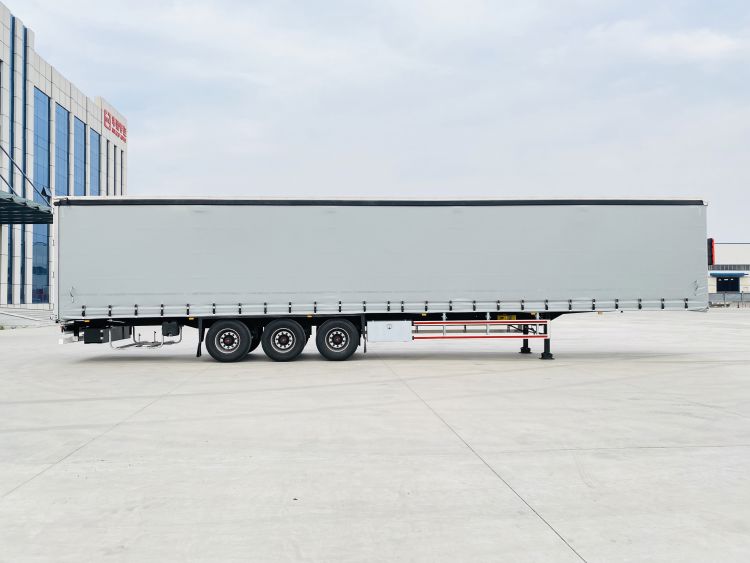
In early 2024, a Wrocław-based third-party logistics provider operating 45 tractor-trailer units across the Germany–Poland–Czech Republic triangle was confronting a paradox: its trucks were spending more time stationary than moving. The company's core business — just-in-time delivery of palletised consumer goods, automotive components, and retail merchandise for pan-European clients — demanded rapid turnaround at warehouses in all three countries. Yet the fleet's conventional Curtain Side Trailers were ageing European-built units with worn sliding curtain systems, corroded roof mechanisms, and a combined average age of 8.3 years. Forklift operators at client warehouses complained that jammed curtain rails and stiff tension straps turned a 20-minute side-load operation into a 50-minute ordeal. The fleet manager tracked a painful metric: average dock-to-departure time across all 45 trailers was 38 minutes — nearly double the 20-minute target specified in the company's key client contracts.
The financial consequences were compounding. At 1.8 daily trips per trailer versus a 2.5-trip benchmark, the fleet was losing approximately 31 revenue-generating trips every day. Multiply that by an average revenue of €340 per trip across 260 operating days, and the annual opportunity cost approached €2.7 million. Worse, 4.2% of shipments in 2023 resulted in cargo damage claims — torn packaging from weather exposure through ageing curtain gaps, crushed corner boxes from inadequate internal load securing, and water ingress during the frequent rainstorms that sweep across the Central European Plain. The company's insurance premium had risen 18% year-on-year, and two major retail clients had issued formal performance warnings.
After benchmarking six manufacturers at the 2023 IAA Transportation show in Hanover, the fleet director selected Hualu Curtain Side Trailers — not primarily on price (though the factory-direct model was 22% below comparable European OEM quotes), but on three features that directly addressed the operation's specific pain points. Hualu's sliding curtain system uses a double-row sealed ball bearing track with aluminium carriers — a design that eliminates the rail-jamming problem that plagued the old fleet. The curtains retract from either end to expose the full 13.6-metre cargo bed, allowing two forklifts to load simultaneously from opposite sides. And the roof is a sliding design that opens in tandem with the curtains, enabling overhead crane loading for heavy or awkward items without removing the trailer from the dock.
The 22 units were delivered to Wrocław in two batches — 12 in March 2024 and 10 in May 2024 — in the following configuration:
After nine months of full-fleet operation (June 2024–February 2025), the fleet director presented the data to the company's board. The numbers exceeded every projection in the original investment case:
| Performance Indicator | Old Mixed Fleet (2023 Avg) | Hualu Curtain Side Fleet (Jun 2024–Feb 2025) | Change |
|---|---|---|---|
| Average dock-to-departure time | 38 minutes | 21 minutes | -45% |
| Daily trips per trailer | 1.8 | 2.7 | +50% |
| Annual revenue-generating trips (fleet) | ~21,060 | ~31,590 | +50% |
| Cargo damage claims (% of shipments) | 4.2% | 0.09% | -98% |
| Annual insurance premium | Baseline +18% YoY increase | Baseline -12% (first reduction in 4 years) | 30 pp swing |
| Fleet fuel consumption (L/100 km) | 33.8 | 30.1 | -11% |
| Unscheduled curtain/roof repairs (monthly) | 7.4 | 0.3 | -96% |
| Trailer downtime (days/year/unit) | 14.2 | 3.1 | -78% |
The 520 kg weight saving per trailer — achieved through QSTE700 steel main beams, aluminium rims, and finite element analysis-optimised cross-member spacing — drove the 11% fuel consumption reduction. At the fleet's annual mileage of approximately 2.1 million kilometres and Polish diesel prices averaging €1.48 per litre during the measurement period, the fuel saving alone recovered approximately €128,000 per year — equivalent to the delivered cost of roughly two additional trailers.
The cargo damage reduction from 4.2% to below 0.1% deserves particular attention. The previous fleet's combination of ageing curtain fabric (with pinhole tears that admitted rain) and limited internal lashing points meant that even properly palletised loads could shift during emergency braking or crosswind conditions on the autobahn. Hualu's integrated logistic track system with 48 variable-position anchor points — versus 16 fixed rings in the old design — enabled load planners to customise restraint geometry for every shipment configuration. The 1,200 g/m² curtain fabric, certified to EN 12641, provided both weather sealing and structural load containment. For a logistics provider handling €60 million in cargo value annually, eliminating 4.1 percentage points of damage claims represented approximately €2.46 million in avoided cargo losses, deductible payments, and client goodwill erosion.
The 17-minute dock-time saving per load cycle is not simply a convenience — it is the mechanism that generated the 50% increase in daily trips. A typical Wrocław–Dresden–Prague triangular route covers approximately 480 kilometres with 7.5 hours of driving time under EU drivers' hours regulations. At 38 minutes per loading event and 2.5 loading events per day (one at origin, one at the mid-route cross-dock, and a partial at destination), the old fleet spent 95 minutes per day stationary at docks. The Hualu fleet's 21-minute average reduced that to 52.5 minutes — recovering 42.5 minutes of productive time per trailer per day.
Those 42.5 recovered minutes are the difference between fitting a third trip into the driver's allowable duty window or leaving the trailer idle. At an average trip revenue of €340, one additional daily trip across 22 trailers for 260 operating days generates approximately €1.94 million in incremental annual revenue — revenue captured without adding a single tractor unit, driver, or litre of overhead fuel to the cost base. This is capacity creation through equipment design, not fleet expansion.
Furthermore, the sliding roof capability — specified on 14 of the 22 units — opened a new revenue stream. The company could now bid on contracts requiring overhead crane loading: prefabricated concrete elements, steel structural sections, and oversized machinery components that previously required subcontracting to specialised open-top hauliers. In the first six months of operation, crane-loaded cargo represented 8% of total trip volume and 14% of gross revenue, at margins 4.7 percentage points above the fleet average due to limited competition for side-accessible, crane-compatible trailers in the corridor.
Europe's logistics infrastructure is built around the pallet — specifically the EUR/EPAL 800 × 1,200 mm wooden pallet that forms the standardised unit load for consumer goods, industrial components, and food products across the continent. Loading and unloading palletised freight through rear doors alone — the method required by conventional Box Trailers — forces forklift operators to navigate a 2.48-metre-wide, 13.6-metre-deep tunnel in a single-file sequence: enter, place load, reverse out, repeat. A full 33-pallet load takes approximately 22 individual forklift movements, each one constrained by the trailer width. Loading from both sides simultaneously with fully open curtains halves the forklift travel distance per pallet and decouples the two operators — they work in parallel rather than taking turns.
This is not marginal optimisation. For a distribution centre handling 200 trailer loads per day, reducing per-trailer dock occupancy from 38 to 21 minutes frees up approximately 56.7 dock-hours per day — the equivalent capacity of three additional loading bays without building a single square metre of warehouse space. For logistics clients whose warehouse leases in Central European logistics parks run €5–8 per square metre per month, that avoided capital expenditure is a tangible, quantifiable benefit of specifying curtain side trailers over rear-door-only alternatives.
Every Hualu Curtain Side Trailer is manufactured under ISO 9001:2015 quality management and is available with the following certifications relevant to EU and Central European operations:
Hualu maintains a dedicated European after-sales hub in Hamburg, Germany, with spare parts warehousing for all curtain system components, running gear, and electrical parts. Standard wear items — curtain rollers, tension straps, roof bows, and brake pads — are stocked for 48-hour delivery to any address within the European Union. Factory-trained technicians are available for on-site commissioning and fleet integration support at customer locations across the EU, United Kingdom, and EFTA states.