

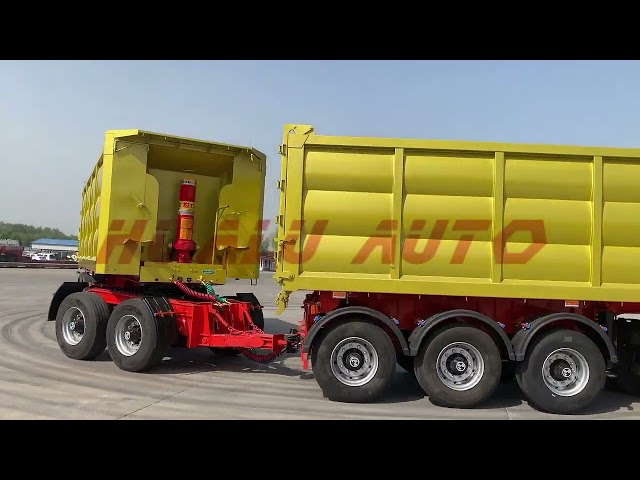
For a decade, the logistics director of a Kano-based agricultural supply company described his operation with a single phrase: "half our kilometres are dead." The company distributes bagged fertiliser, herbicides, and seeds to 200+ rural retailers across northern Nigeria, then backhauls harvested maize, sorghum, and soybeans from those same communities to central silos near Kano. The problem was structural: fertiliser moves in clean, weather-protected loads. Grain moves in bulk, often tarp-covered. The two cargo types demanded different trailer configurations — Curtain Side Trailers for bagged inputs heading out, and open-top trucks or Flatbed Trailers for grain coming back. One direction was always empty.
The numbers told a brutal story. The fleet of 14 trucks ran approximately 680,000 kilometres annually. Of those, roughly 320,000 kilometres — 47% — were deadhead return trips. At Nigerian diesel prices and an average fleet consumption of 34 litres per 100 kilometres, the company was burning approximately 109,000 litres of fuel per year moving empty trailers. That is fuel that transported nothing, earned nothing, and generated nothing but exhaust.
The logistics director evaluated three options. Option one was to continue running two separate fleets and accept the deadhead cost as a fact of life. Option two was to invest in swap-body systems — trailers that exchange cargo bodies at depots — but Nigeria's road network north of Kaduna made the precision docking required for body swaps impractical. Option three was a trailer that could legally and safely carry bagged agricultural inputs in one direction and bulk grain in the other, without reconfiguration between trips.
Option three led the company to Hualu Double Box Trailers — a twin-compartment design with a fixed central partition dividing the cargo bed into two independently accessible bays. The forward compartment is fully enclosed with lockable aluminium side doors, weather-sealed roof, and internal tie-down rails — purpose-built for bagged fertiliser, chemicals, and seed. The rear compartment is an open-top bin with 25 CBM capacity, tarpaulin cover with rope hooks, and a rear tailgate that opens for gravity-assisted grain discharge at silo receiving pits.
The company ordered five units in a tri-axle configuration:
The five Hualu double box trailers entered service between January and March 2024, replacing seven single-purpose trucks — four curtain-side units for outbound fertiliser and three flatbeds for inbound grain. The logistics director tracked three metrics monthly: deadhead percentage, per-tonne transport cost, and vehicle utilisation rate.
| Metric | Before (2023 Average) | After (2024 Q2–Q4 Average) | Change |
|---|---|---|---|
| Deadhead kilometres (% of total) | 47% | 8% | -83% |
| Fleet size required | 14 trucks | 12 trucks | -14% |
| Tonnes moved per truck per month | 187 | 294 | +57% |
| Per-tonne transport cost (NGN equivalent) | Baseline | 28% lower | -28% |
| Annual diesel consumption (fleet) | ~420,000 L | ~355,000 L | -15% |
| Trailer maintenance cost (monthly per unit) | Baseline | 34% lower | -34% |
The deadhead reduction from 47% to 8% was the structural win that made every other number possible. The remaining 8% represented trips where the return cargo was not available — a seasonal reality of agricultural logistics that no trailer design can eliminate. But the 39 percentage-point gap between 47% and 8% represented approximately 265,000 fewer deadhead kilometres per year. At the fleet's fuel consumption rate, that translated to roughly 90,000 litres of diesel saved annually — fuel that was now moving paying cargo instead of moving air.
The logistics director's summary to the company board was blunt: the capital outlay for five double box trailers was approximately the same as replacing the seven ageing single-use trailers they displaced. But the operating economics were fundamentally different. A single-purpose trailer on the Kano-to-Maiduguri fertiliser route generated revenue on roughly 53% of its kilometres. A double box trailer on the same route, backhauling grain to Kano, generated revenue on 92% of its kilometres. The trailer itself cost the same to purchase, finance, insure, and maintain. The difference was that one trailer earned money on 53% of its movements and the other earned money on 92%.
"We did not buy trailers," he told the board. "We bought utilisation. We bought the 39 percentage points between what our old fleet could do and what a properly designed trailer makes possible."
The board approved an additional order for four more double box trailers in the 2025 budget before the meeting adjourned.
The fixed central partition is not merely a divider. It is a structural element that enables simultaneous compliance with two different cargo security regimes. Bagged fertiliser requires enclosed, lockable, weatherproof storage to prevent moisture absorption — urea fertiliser exposed to humidity hardens into unusable blocks within 72 hours. Bulk grain, conversely, requires ventilation to prevent mould, and the ability to discharge by gravity at silo receiving pits. A single-compartment trailer forces the operator to choose one regime or the other. The double box design accommodates both simultaneously.
An additional operational detail emerged during the rainy season of 2024. The forward compartment's weatherproof seals — tested at the factory to IP54 standard — prevented water ingress during two recorded instances where trailers were caught in 90-minute rainfall events on unpaved roads south of Katsina. No bagged fertiliser was lost to water damage across the five trailers during the entire 2024 rainy season, compared to an average of 2.3 tonnes of spoilage per season on the previous curtain-side fleet.
The deadhead problem solved by the double box configuration is not unique to northern Nigeria. Any agricultural supply chain where inputs and outputs flow in opposite directions along the same corridor faces the same structural inefficiency. Fertiliser-to-grain in East Africa. Seed-to-harvest in Southeast Asia. Feed-to-livestock in Latin America. The Hualu Double Box Trailer is not a Nigerian trailer. It is an answer to a universal logistics question: how do you make the return trip pay?
Every Hualu trailer is manufactured by Liangshan Hualu Special Automobile Manufacturing Co., Ltd. — established in 2001, 150,000 m² facility in Shandong, China, 360+ employees. The company holds CCC, ISO 9001:2015, ISO/TS 16949, CE, DOT, and MIIT certifications, with over 50 patented technologies. Hualu exports to 30+ countries worldwide. For double box trailer specifications, compartment configurations, and agricultural logistics planning support, contact the Hualu sales team.