

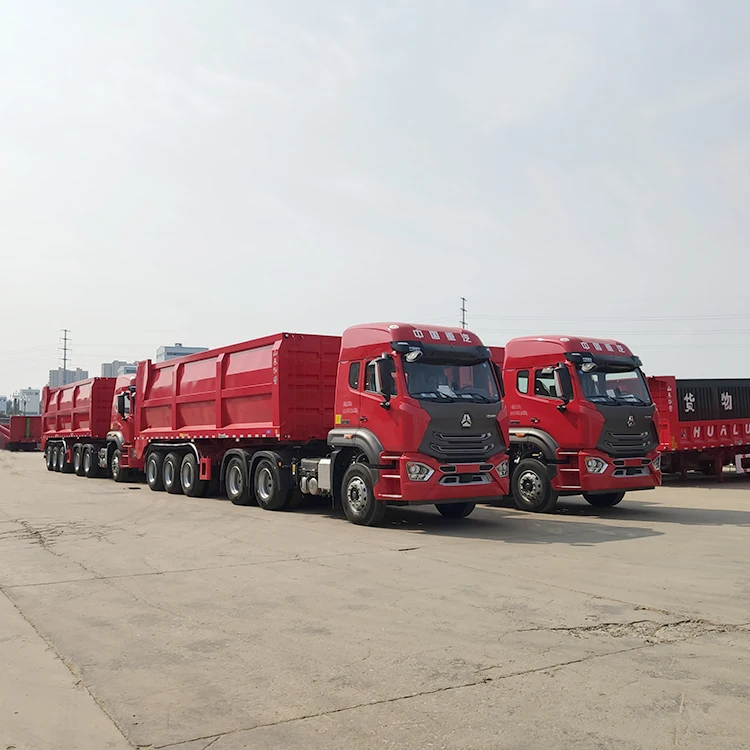
In February 2025, the head of a major Brazilian logistics firm made a pivotal visit to the Hualu manufacturing plant in China. His mission was driven by urgency and painful history—his previous fleet had just suffered a catastrophic loss of $39.6 million when twelve of his trailers overturned in a single convoy on a rain-soaked route. He arrived with a clear, non-negotiable brief: he needed a single trailer model robust enough to transport heavy construction gravel one day and delicate soybeans or silage the next, specifically engineered to conquer Brazil's notoriously muddy, pothole-scarred rural highways. His sole demand was the complete eradication of rollovers.
1. The Impossible Dual-Cargo Requirement
Brazilian logistics is unforgiving, especially during the rainy season when dirt feeder roads turn into treacherous swamps. This client's operation demanded extreme versatility. Carrying dense, shifting gravel requires a low, firm center of gravity, while transporting voluminous, lightweight soybeans demands spacious, flexible loading. Standard trailers invariably compromise one for the other. The client's recurring nightmare was that this cargo disparity, combined with brutal road undulations, made his trailers constant rollover liabilities, threatening both his drivers and his bottom line with every departure.
2. The $39.6 Million Catastrophe
The breaking point occurred during a routine transit across a notoriously uneven stretch. Without warning, a chain reaction of instability caused twelve out of twenty-four units to topple sideways into the thick mud. The direct economic devastation hit $39.6 million in destroyed equipment and spilled cargo, but the reputational damage and operational halt were even more crippling. This disaster was the catalyst that brought the client directly to Hualu's doorstep in February 2025, demanding a scientific, unbreakable solution to Brazil's harsh geographical reality—no more excuses, no more fatalities.
3. Engineered from the Ground Up for Brazil
Hualu's senior engineers didn't simply retrofit an existing model; they initiated a comprehensive redesign tailored specifically to Brazil's unique climate, humidity, and terrain. They drastically lowered the chassis center of gravity and widened the axle track to maximize lateral stability against deep mud ruts. The new frame utilizes high-strength torsion-resistant steel, capable of absorbing the relentless pounding from cratered roads without flexing dangerously. By meticulously analyzing local soil composition and thermal variations, they tuned the suspension to remain ultra-responsive yet firm, ensuring the trailer stays planted flat regardless of surface irregularities.
4. The Remote-Controlled Unloading Revolution
The crown jewel of this new Belt Semi Trailer is its wireless remote-controlled discharge system. Traditional hydraulic tipping beds are notoriously dangerous on uneven ground—lifting a loaded bed on a slope is practically a suicide mission for stability. Hualu eliminated this risk entirely by integrating a powerful floor-mounted conveyor belt system. With a simple, safe press of a button from a distance, the cargo flows smoothly and horizontally out of the rear. This innovation ensures that unloading occurs without elevating the trailer body even a millimeter, guaranteeing absolute steadiness even on a 15-degree lateral incline, keeping the center of mass permanently grounded.
5. Flawless Results: Zero Accidents, Zero Rollovers
The client was so convinced by the live demonstration that he finalized a purchase agreement for 260 units on the spot. Since deploying these specially designed Belt Semi Trailers across Brazil's most demanding agricultural and mining routes, the statistical data speaks volumes. The fleet has maintained an immaculate safety record: zero rollover incidents, zero unloading accidents, and zero weather-related downtime. What was once a $39.6 million nightmare has transformed into the industry benchmark for safe, efficient, and undeniably eye-catching logistics in the Brazilian hinterlands, proving that intelligent engineering conquers even the roughest roads.