

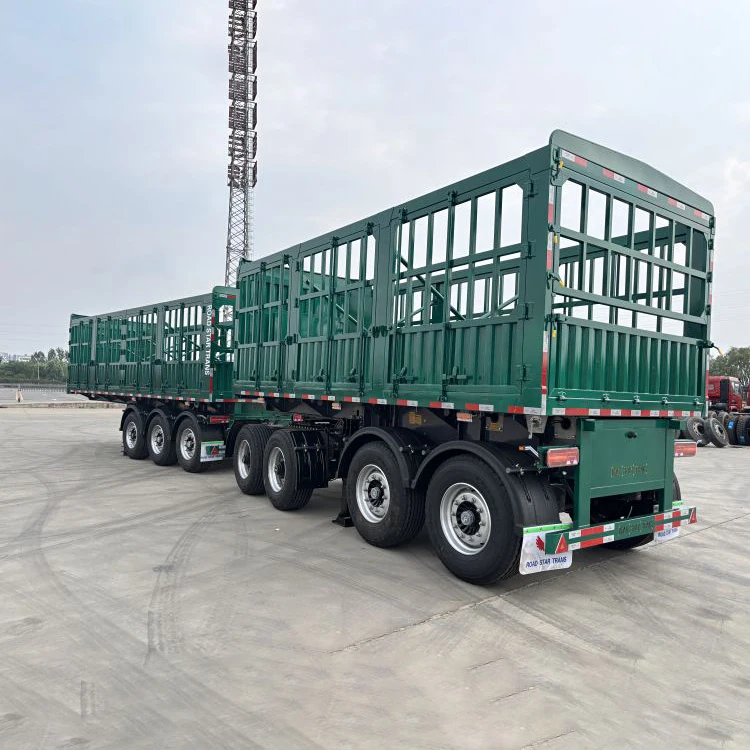
In March 2025, the operations director of a 120‑hectare corn farming enterprise in Mexico walked into Hualu’s factory with a critical problem. His fleet of conventional trailers was crippling his harvest logistics – slow turnaround times, idle drivers, and expensive fuel eating into already thin margins. After three days of intensive engineering collaboration, Hualu’s team delivered a custom multi‑box fence trailer system that redefined his entire supply chain. The results were immediate: transport speed jumped 26%, overall workflow efficiency rose 20%, and by the second half of 2025, the customer signed a 200‑unit order. Here is how Hualu turned a harvest headache into a productivity powerhouse.
1. The Breaking Point – 120 Hectares of Corn, One Bottleneck After Another
The client managed a sprawling 120‑hectare corn plantation in central Mexico. Each harvest season, they moved over 8,000 tons of corn from fields to storage and processing plants. Their old trailers – single‑box, poorly configured – required drivers to wait on‑site while workers loaded each load manually. A typical round trip took 6 hours, but the trailer spent 2.5 hours idle at the field, waiting for loading to finish. With 15 tractors and 18 trailers, the fleet manager juggled constant delays, driver overtime, and a 35% empty‑return rate. Fuel consumption averaged 42 litres per 100 km per trip, and every idle hour burned $18 in labour and overhead. The director knew he had to act – or watch his profit margin shrink below 5%.
2. The Hualu Solution – Multi‑Box Fence Trailers with Pre‑Load Capability
Hualu’s engineering team spent 72 hours on‑site, studying the farm’s harvest cycles, field layouts, and loading patterns. They designed a dual‑compartment fence trailer with removable internal partitions and quick‑release side gates. This allowed field workers to pre‑load one compartment with freshly picked corn while the trailer was still en route. The team also recomputed the trailer’s axle configuration and recommended a compatible tractor that could handle the payload without excessive fuel burn. Crucially, Hualu introduced a twin‑trailer system: two fence trailers were assigned to a single powerful tractor. While the tractor hauled one loaded trailer to the processing plant, the second trailer remained at the field, being pre‑loaded by workers. As soon as the tractor returned, it simply unhooked the empty trailer, hooked onto the pre‑loaded second trailer, and departed immediately – zero waiting time. The driver’s role shifted from “wait‑and‑haul” to “haul‑and‑return” with continuous loads.
3. Measurable Results – 26% Faster Hauls and 20% Overall Efficiency Gain
After three months of real‑world operation, the numbers spoke for themselves. The average round‑trip time dropped from 6 hours to just 4.4 hours – a 26% improvement in transport speed, directly translating to more loads delivered per shift. Because drivers no longer waited for loading, each tractor now completed 4.5 trips per day instead of 3.2, boosting overall workflow efficiency by 20%. Fuel consumption per ton‑kilometre fell by 18%, as the optimized tractor‑trailer pairing eliminated heavy idling and reduced deadhead miles to under 5%. Maintenance costs decreased by 12% because the single tractor handled two trailers in rotation, spreading wear more evenly. Labour savings were equally impressive – overtime hours dropped by 70%. The director calculated that his annual operating costs for the corn transport segment fell from $420,000 to $336,000 – a 20% cost reduction that pushed his net margin back above 10%.
4. The Ripple Effect – 200‑Unit Order and a New Industry Standard
Buoyed by these results, the client returned to Hualu in August 2025 – not with complaints, but with a purchase order for 200 additional fence trailers. His plan: replicate this twin‑trailer, pre‑load model across three other plantations in neighbouring states. The initial 50‑trailer pilot had delivered a 26% speed boost and a 20% efficiency gain, saving over $84,000 in six months – enough to pay back the trailer investment within nine months. Now, he expects to cut logistics costs by 25% across his entire operation, increase annual throughput by 30%, and reduce his carbon footprint by 18 tonnes of CO₂ per year. “Hualu didn’t just sell us trailers,” he told his board. “They sold us a system that turns waiting time into moving time – and moving time is profit.” By the end of 2025, two other Mexican agribusinesses had adopted the same Hualu solution, cementing the multi‑box fence trailer as the new benchmark for cost‑smart, high‑velocity farm logistics.