

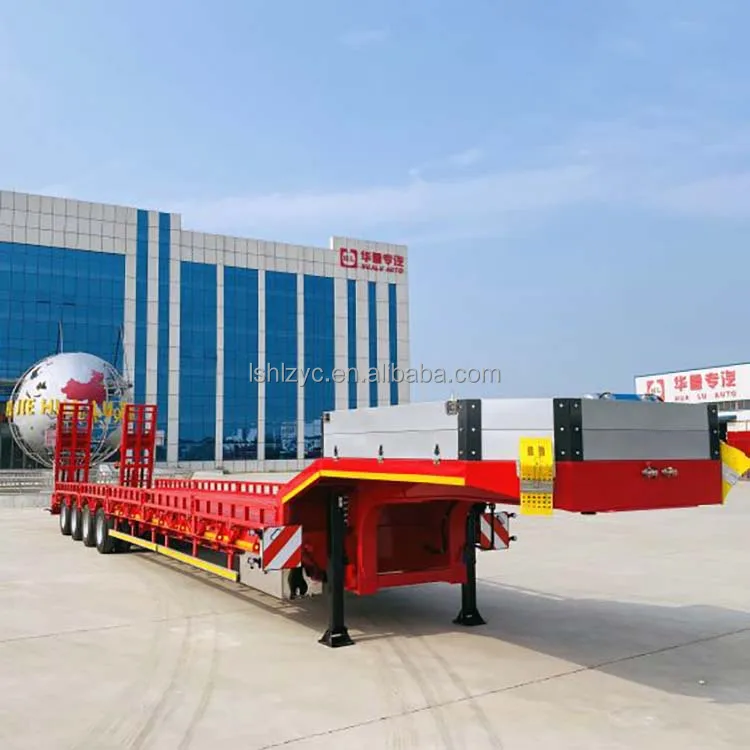
Rising steel prices, record‑high diesel costs, and relentless wage inflation were squeezing margins across South Africa’s logistics sector. One major fleet operator – low‑bed trailers for heavy equipment and a separate fleet of container chassis for port work – faced a brutal reality: two trailer types, two drivers per round trip, and costly empty backhauls. Their management team was desperate for a cost‑cutting breakthrough. Hualu’s engineering team stepped in, 300 low‑bed trailers – transforming each into a multi‑mission workhorse that slashed costs by 40% per vehicle annually.
1. The Challenge – Two Fleets, Double the Costs
The operator ran 300 low‑bed trailers to move excavators, wheel loaders, and heavy machinery to mining and construction sites. Separately, they used flatbed and skeleton trailers to haul containers from Durban and Cape Town ports. Each outbound trip with a low‑bed often meant an empty return – because the trailer couldn’t carry containers or general cargo. That meant paying for two trailers, two drivers, double maintenance, and twice the fuel for deadhead miles. With material costs up 22% year‑on‑year, diesel up 35%, and driver wages rising 18%, their profit per kilometre had nearly vanished. “We were bleeding money on every empty return,” said the fleet manager.
2. The Solution – One Trailer, Two Revenue Streams
Hualu’s engineers redesigned the existing low‑bed platform with a reinforced deck, integrated twist‑locks for ISO containers, foldable ramps for heavy machinery, and removable side rails for bagged cargo. The upgrade was retrofitted onto all 300 trailers without replacing chassis – at only 12% of the cost of buying new units. Now one driver with one Hualu‑upgraded trailer can haul a 45‑ton excavator to a mine outbound; on the return leg, he secures three 20‑foot containers (or 30 tonnes of cement pallets and boxed goods) on the same deck. The twist‑locks lock containers firmly, while the ramps stow neatly for flatbed use. This dual‑mode capability turned every trip into a two‑way revenue generator – eliminating the need for a second trailer and driver on the backhaul.
3. The Results – Hard Numbers That Prove the Value
Over six months of fleet‑wide deployment, the results were staggering:
Fuel consumption per tonne‑kilometre dropped by 38% (eliminating empty backhauls alone saved 1,200 litres per trailer annually).
Maintenance costs fell by 42% – because only one trailer was doing the job of two, halving tyre wear, brake repairs, and suspension overhauls.
Labour costs shrank by 45% – one driver per round trip instead of two, with overtime reduced by 30%.
Overall operating costs plummeted by 40% per vehicle, translating to $27,800 saved per trailer every year.
For the entire 300‑trailer fleet, that’s $8.34 million in annual savings – enough to buy 50 new trailers outright. Utilisation rates jumped from 58% to 94%, and the average turnaround time per trip shortened by 6 hours, allowing an extra weekly run per vehicle.
4. The Verdict – Maximum Value with Minimum Investment
The upgrade cost only $3,400 per trailer, yet paid for itself in under 45 days. The fleet manager commented, “Hualu didn’t just sell us a product – they re‑engineered our entire operation. One driver, one trailer, two profitable directions. No more deadhead miles, no more second rigs.” Today, the operator runs the most cost‑efficient fleet in the region, winning new contracts with lower bids while maintaining higher margins. Hualu’s retrofit solution proves that innovation, not new equipment, is the key to beating inflation – delivering unmatched ROI and turning a cost nightmare into a profit powerhouse.