

The Road From Karaganda to the Mine Wasn't Built for Trailers
Let's set the scene. You're hauling a 55-ton excavator from Almaty to a copper mine outside Karaganda. The highway is fine for the first 200 kilometers. Then it isn't. Gravel. Ruts. Checkpoints where the weight limit changes without warning. And somewhere in the middle, a pothole deep enough to swallow a gooseneck.
This is daily reality for operators across Kazakhstan, Uzbekistan, Kyrgyzstan, and Turkmenistan. And most of them are doing it with 3-axle flatbeds that were never designed for this kind of work.
A mining company we worked with recently was no different. Three old trailers. Constant breakdowns. Fuel costs eating into every shipment. Permits getting rejected at weigh stations because the weight distribution was always off.
They reached out to us with a simple question: "Do you actually have something that works out here, or is everyone just selling the same thing?"
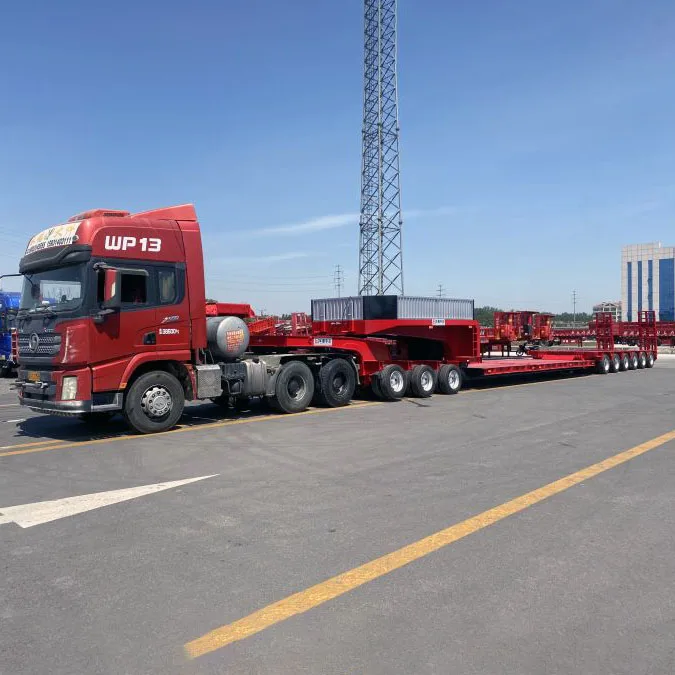
We shipped them one 6-axle lowbed semi-trailer with steerable lift axles and a hydraulic front lift system. Let them test it for 60 days.
They never sent it back.
What This Trailer Actually Does (Without the Buzzwords)
Six axles. That sounds like overkill until you're trying to spread 60 tons of equipment across a road that wasn't meant to carry it. More axles mean more contact points. More contact points mean the road doesn't destroy your tires — and you don't get flagged at every checkpoint.
But here's where it gets smart. Not all six axles are always on the ground. The steerable lift axles raise up when the trailer is empty or carrying a light load. So on the return trip — no cargo, just an empty frame rolling back to base — you're running on fewer axles. Less friction. Less fuel burn. Less tire wear. The moment you load up again, those axles drop back down and you're back to full capacity.
And the hydraulic lift at the front? Think of it as a built-in ramp that doesn't need a crane. Mine entrances with sharp drops. Construction sites with uneven ground. You raise the front, roll over the obstacle, lower it back down, and keep driving. Your cargo never touches the ground. Your driver never has to stop and wait for equipment.
The gooseneck lowbed design keeps everything low and stable. On the mountain routes between Bishkek and Osh, or the wind-swept steppes of western Kazakhstan, that low center of gravity is the difference between a smooth run and a rollover.
Length is customizable from 13 meters to 17.5 meters, so you're not paying for deck space you'll never use.
The Money Part (And Why It Matters More Than You Think)
We're not going to throw a number at you and hope it impresses. Instead, let's talk about what actually happened with the Karaganda client.
Before our trailer, he was running three separate units to move the same volume of equipment. Fuel costs were enormous. Tire replacements every six weeks. Downtime at weigh stations because his weight distribution never matched the permit.
After switching to our 6-axle lowbed, he retired two of the old trailers. Fuel consumption dropped noticeably — mostly because the lift axles aren't dragging on empty runs. Tire life nearly doubled. And every single permit cleared on the first try, because seven axles spread the load the way the regulations actually want it spread.
When he asked us for a quote on five more units, the per-unit cost came in significantly lower than what he'd been quoted by European manufacturers for a comparable spec. Not a little lower. Substantially lower. The kind of difference that lets you buy five trailers for what you'd pay for three from the other guys.
That's not a discount. That's what happens when you buy direct from the factory — no distributors, no middlemen, no markup for a logo you don't need.
Who This Is Really For
If you're hauling mining equipment, construction machinery, generators, or any oversized load across Central Asia — and you're tired of trailers that break down, get rejected, or cost you more in fuel than they earn you — this is the conversation you should be having.
We've shipped these to clients in Almaty, Tashkent, Bishkek, and Ashgabat. They don't write us because something went wrong. They write us when they need more.
Ready to Stop Replacing Trailers and Start Hauling?
Tell us what you're carrying, where you're hauling it, and how heavy it is. We'll put together a configuration and a price that'll make you wonder why you waited this long.
Get your custom quote within 24 hours. No obligation. No hassle.
Hualu Special Automobile — building heavy-haul trailers that actually survive the roads they're supposed to work on.